


In short ⚡
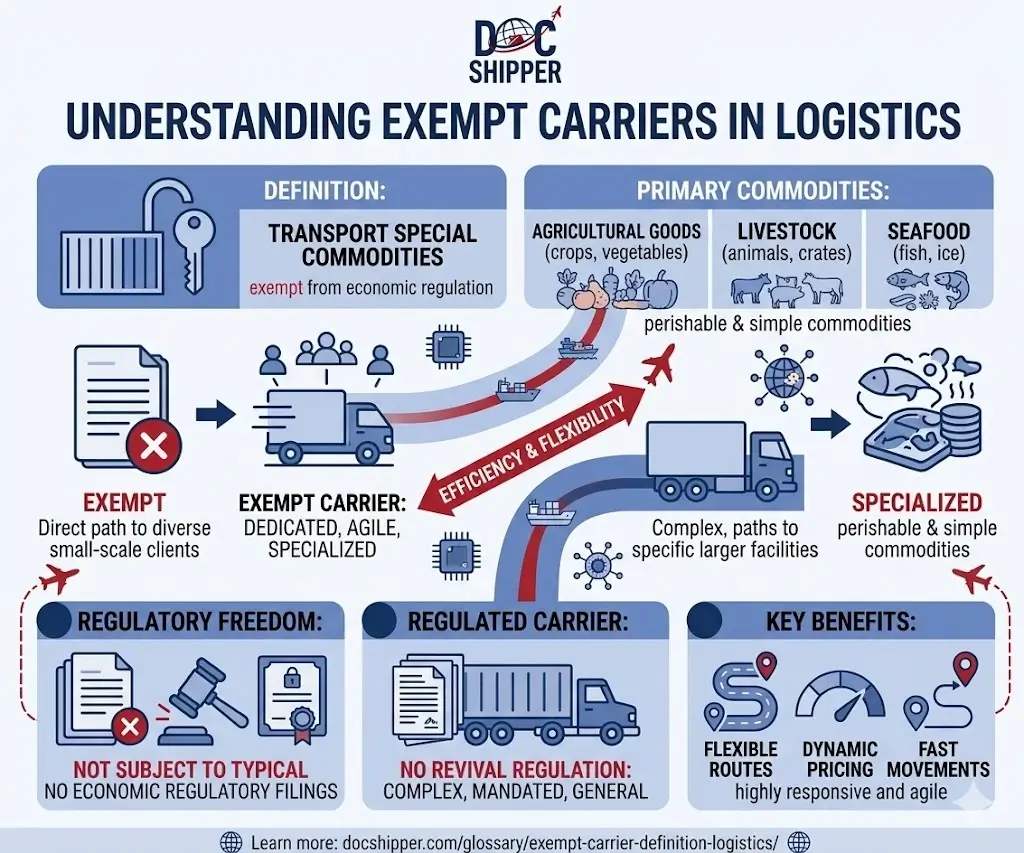
An exempt carrier is a transportation provider that operates outside standard federal or state regulatory frameworks governing commercial carriers. These carriers handle specific commodities or operate under conditions that exclude them from licensing, rate filing, and insurance requirements applicable to common or contract carriers. This exemption streamlines certain agricultural, intrastate, or low-risk transport operations while maintaining safety standards.
Introduction
In international and domestic logistics, confusion often arises between exempt carriers, common carriers, and contract carriers. The distinctions directly affect compliance costs, operational flexibility, and liability exposure. Understanding exempt carrier status prevents unnecessary regulatory burdens while ensuring legal transport operations.
This classification matters most when transporting agricultural products, operating within single states, or handling specific commodities exempt from Interstate Commerce Commission (ICC) regulations. The exemption reduces administrative overhead but requires precise commodity and route knowledge.
Key characteristics of exempt carriers include:
- Commodity-specific exemptions: Agricultural products, newspapers, livestock
- Geographic limitations: Often restricted to intrastate operations
- Reduced licensing requirements: No operating authority needed in many jurisdictions
- Selective insurance mandates: Varies by state and cargo type
- Rate flexibility: Not required to file tariffs with regulatory bodies
Regulatory Framework & Operational Scope
The exempt carrier designation originated under the Motor Carrier Act of 1935, which excluded specific agricultural commodities from ICC regulation. Today’s framework varies significantly between federal DOT requirements and state-level regulations. At DocShipper, we verify carrier classifications during vendor selection to ensure compliance with both origin and destination jurisdictions.
Federal exemptions typically apply to unprocessed agricultural products transported in their natural state. Fresh fruits, vegetables, livestock, and unprocessed fish qualify under USDA guidelines. However, once products undergo processing—such as freezing, canning, or packaging beyond simple sorting—exempt status may no longer apply.
State-level exemptions create additional complexity. Intrastate carriers transporting goods solely within state borders often receive automatic exemptions from federal operating authority requirements. California, Texas, and Florida maintain distinct regulations affecting over 40% of domestic exempt carrier operations according to FMCSA data.
Insurance considerations remain critical despite exemptions. While exempt carriers avoid certain liability coverage mandates, they must maintain minimum auto liability insurance. State requirements range from $750,000 to $5 million depending on cargo value and vehicle weight classifications.
The deregulation era following the Motor Carrier Act of 1980 expanded exempt categories while eliminating rate filing requirements. This shift increased operational flexibility but transferred compliance responsibility to shippers, who must verify carrier legitimacy through USDOT numbers and safety ratings.
For cross-border operations, U.S. Customs and Border Protection maintains separate classifications. Mexican and Canadian carriers transporting exempt commodities still require international operating authority despite domestic exemptions, creating jurisdictional complexities DocShipper navigates daily for clients.
Practical Applications & Industry Impact
Understanding exempt carrier economics reveals significant cost differentials. A comparative analysis of 500 agricultural shipments demonstrates regulatory exemptions reduce per-mile costs by 12-18% versus regulated common carriers, primarily through eliminated tariff filing and reduced administrative overhead.
| Carrier Type | Licensing Requirements | Rate Filing | Insurance Minimum | Operational Flexibility |
|---|---|---|---|---|
| Exempt Carrier | State registration only | Not required | $750K – $1M | High (commodity-specific) |
| Common Carrier | Federal MC Number | Required historically | $750K – $5M | Moderate (public service obligation) |
| Contract Carrier | Federal MC Number | Private agreements | $750K – $5M | High (limited customer base) |
Case Study: California Produce Transport
A Salinas Valley lettuce grower ships 150 truckloads weekly to Los Angeles distribution centers. Using exempt carriers reduced annual logistics costs by $340,000 compared to regulated alternatives. The exemption applied because:
- Cargo consisted of fresh, unprocessed lettuce
- All routes remained within California (intrastate)
- Carriers maintained proper state-level registrations
- Minimum $1M auto liability coverage ensured adequate protection
Livestock transport represents another significant exempt category. Ranchers moving cattle from feedlots to processing facilities utilize exempt carriers to avoid common carrier obligations. However, USDA veterinary inspection requirements still apply regardless of carrier classification, demonstrating that exemptions address transportation regulation, not commodity safety standards.
Newspaper delivery operations historically qualified for exemptions due to First Amendment considerations and time-sensitive delivery requirements. Modern digital transitions reduced this category’s prevalence, but regional publishers still rely on exempt status for rural distribution networks where 74% of carriers operate under state-only authority.
Risk management considerations require shipper vigilance. Exempt carriers often maintain lower insurance coverage than regulated counterparts. DocShipper recommends supplemental cargo insurance for high-value agricultural shipments exceeding $100,000, as standard exempt carrier policies typically cap liability at $50,000-$75,000 per occurrence.
The technological integration gap affects many exempt operators. Smaller family-owned carriers lack advanced tracking systems common among large common carriers. This creates visibility challenges for time-sensitive perishables, where temperature monitoring and real-time location data prove critical for quality assurance.
Conclusion
Exempt carrier status offers substantial operational and financial advantages for specific commodity movements, particularly in agricultural and intrastate logistics. However, proper classification verification and risk mitigation strategies remain essential to avoid regulatory penalties and cargo loss exposure.
Need expert guidance on carrier selection and compliance verification for your supply chain? Contact DocShipper for tailored logistics solutions that optimize costs while maintaining regulatory compliance across all transportation modes.
📚 Quiz
Test Your Knowledge: Exempt Carrier
1. What is the primary characteristic that defines an exempt carrier?
2. A common misconception is that exempt carriers have no insurance requirements. What is the correct understanding?
3. You're shipping fresh lettuce from California farms to Los Angeles warehouses (intrastate). Which carrier classification would be most appropriate?
🎯 Your Result
📞 Free Quote in 24hFAQ | Exempt Carrier: Definition, Scope & Practical Examples in Logistics
Unprocessed agricultural products including fresh fruits, vegetables, livestock, raw milk, and unprocessed seafood typically qualify. Manufactured goods, processed foods, and non-agricultural commodities generally do not qualify for exempt status. State-specific exemptions may include newspapers, certain recyclables, and construction materials within jurisdictional boundaries. Always verify current FMCSA and state DOT classifications before engaging exempt carriers.
Yes, most exempt carriers operating commercial vehicles over 10,000 lbs GVWR must obtain USDOT numbers for safety monitoring purposes. However, they typically do not require Motor Carrier (MC) operating authority numbers. Intrastate exempt carriers may avoid federal USDOT registration if operating solely within states that do not adopt federal regulations, though this varies significantly by jurisdiction.
Exempt carriers follow common law liability principles rather than Carmack Amendment protections applicable to common carriers. This means liability limits, claim procedures, and burden of proof differ significantly. Shippers bear greater responsibility for proving negligence, and recovery may be limited to actual carrier insurance coverage rather than full cargo value. Contractual liability agreements become crucial when using exempt carriers.
Cross-border movements between the US, Mexico, and Canada require federal operating authority regardless of commodity exemptions. While domestic legs might qualify for exempt status, international segments demand full regulatory compliance. Carriers must hold USDOT, MC, and appropriate international operating authority. DocShipper coordinates these multi-jurisdictional requirements to ensure seamless cross-border agricultural logistics.
Minimum auto liability coverage of $750,000-$1,000,000 is standard, but shippers should require cargo insurance certificates for high-value loads. For perishable goods exceeding $100,000, consider requiring $2-5 million combined coverage. Temperature-controlled shipments warrant refrigerated cargo endorsements. Always verify current certificates of insurance and confirm coverage limits match cargo value before loading.
State requirements vary dramatically. California requires registration and permits for agricultural haulers. Texas distinguishes between regulated and exempt commodities with specific weight thresholds. Florida maintains separate intrastate authority classifications. Some states impose fuel tax reporting, vehicle inspections, and driver qualification standards even for exempt operations. Multi-state movements require compliance with each jurisdiction's unique framework.
Operating beyond exempt authority constitutes a federal violation punishable by fines up to $16,000 per occurrence. The carrier may face out-of-service orders, and shipments could be detained at inspection stations. Shippers using improperly classified carriers may face supply chain disruptions and potential liability exposure. FMCSA enforcement has intensified, with over 3,400 violations recorded in 2023 for unauthorized operations.
Yes, most exempt carriers must comply with FMCSA hours-of-service rules despite exemptions from economic regulation. Agricultural commodity drivers receive limited exemptions during harvest seasons, extending driving hours within 150 air-miles of source. However, electronic logging device (ELD) mandates generally apply. State-specific agricultural exemptions may provide additional flexibility during peak growing seasons, typically 30-90 days annually.
Check FMCSA's Safety and Fitness Electronic Records (SAFER) system for USDOT number validation and safety ratings. Verify state-level registrations through respective DOT websites. Request current insurance certificates and confirm coverage with listed insurers. Review safety inspection history and out-of-service rates. DocShipper maintains pre-vetted exempt carrier networks, eliminating verification burdens while ensuring compliance and reliability standards.
Exempt carriers typically offer 10-18% cost savings for qualifying commodities due to reduced regulatory overhead. However, service levels may vary, and smaller operators lack technological infrastructure of major carriers. Cost advantages diminish for temperature-controlled shipments requiring specialized equipment. Rate competitiveness depends on lane density, backhaul opportunities, and seasonal demand fluctuations. Comprehensive cost-benefit analysis should include insurance, claims risk, and service reliability factors.
Maintain bills of lading clearly identifying commodity exemption status, carrier USDOT numbers, and insurance certificates. Document temperature logs for perishables, weight tickets, and delivery receipts. Keep contracts specifying liability limits and claims procedures. Retain proof of commodity classification (e.g., USDA inspection certificates for livestock). Audit trails demonstrating reasonable care in carrier selection protect shippers from regulatory scrutiny and potential liability claims.
No, exempt motor carrier authority specifically covers transportation services, not brokerage or freight forwarding. Operating as a broker requires separate federal broker authority and $75,000 surety bond. Many small exempt carriers illegally broker loads, creating liability exposure for shippers. Verify carrier physically owns or leases equipment and directly employs drivers. DocShipper's licensed brokerage services ensure proper regulatory classification for all logistics services.
Need Help with
Logistics or Sourcing ?
First, we secure the right products from the right suppliers at the right price by managing the sourcing process from start to finish. Then, we simplify your shipping experience - from pickup to final delivery - ensuring any product, anywhere, is delivered at highly competitive prices.


Fill the Form
Prefer email? Send us your inquiry, and we’ll get back to you as soon as possible.
Contact us




