


In short ⚡
An Expert System is an artificial intelligence program that mimics human decision-making by using a knowledge base and inference rules to solve complex problems in specialized domains. It captures expertise from domain specialists and applies logical reasoning to provide recommendations, diagnoses, or solutions in fields like logistics, customs classification, and supply chain optimization.
Introduction
Why do freight forwarders struggle with HS code classification while customs experts resolve these issues instantly? The answer lies in specialized knowledge that expert systems now digitalize and democratize.
In international logistics, expert systems transform decision-making by automating complex processes that previously required years of domain expertise. These AI-driven tools analyze regulatory requirements, calculate duties, and flag compliance risks with precision that matches human specialists.
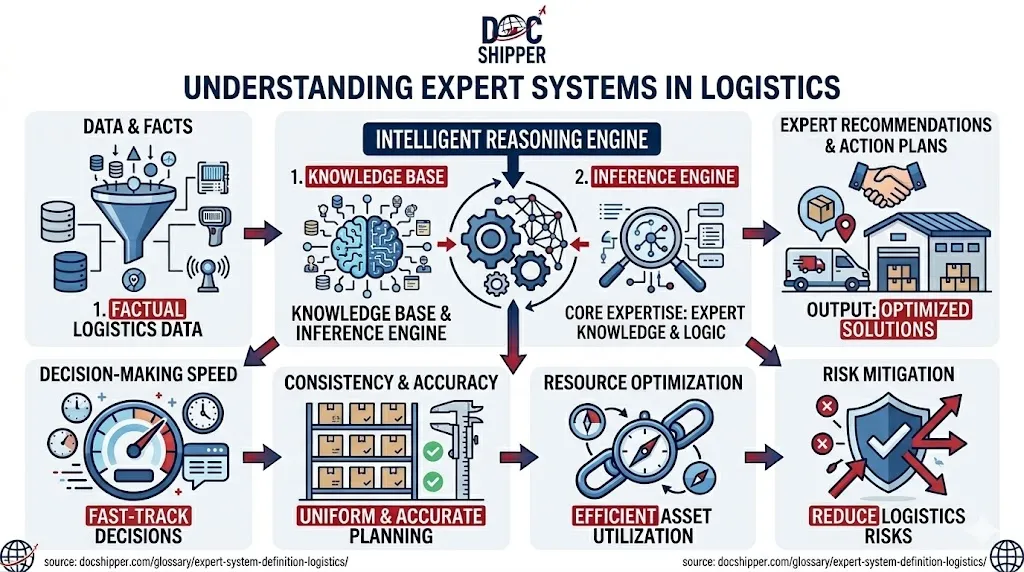
- Knowledge base: Contains facts, rules, and relationships specific to logistics domains
- Inference engine: Applies logical reasoning to derive conclusions from the knowledge base
- User interface: Enables non-experts to access specialized knowledge through simple queries
- Explanation facility: Justifies recommendations with transparent reasoning chains
- Knowledge acquisition module: Allows continuous updating as regulations and practices evolve
Deep Dive & Technical Architecture
Expert systems operate through three fundamental components working in concert. The knowledge base stores domain-specific information structured as production rules (IF-THEN statements), semantic networks, or frames. Unlike conventional databases, this knowledge represents relationships and heuristics that experts use intuitively.
The inference engine applies two primary reasoning strategies. Forward chaining starts with known facts and derives conclusions, ideal for classification tasks like determining product categories. Backward chaining begins with a hypothesis and searches for supporting evidence, perfect for diagnostic applications like identifying shipment delay causes.
In customs operations, expert systems interpret harmonized tariff schedules by encoding classification rules that consider material composition, product function, and regulatory definitions. The system queries users about product characteristics and navigates decision trees that mirror expert reasoning processes.
For trade compliance, systems integrate regulatory databases from sources like the World Trade Organization and national customs authorities. They monitor certificate requirements, license restrictions, and prohibited goods lists across 190+ countries, updating automatically when regulations change.
The explanation subsystem differentiates expert systems from black-box AI models. When recommending an HS code or flagging a compliance issue, the system displays its reasoning chain. This transparency builds user trust and facilitates knowledge transfer to human operators.
At DocShipper, we implement expert system logic in our customs clearance workflows, automatically validating documentation completeness and regulatory alignment before submissions. This preemptive verification reduces clearance delays by identifying issues that would otherwise cause rejections.
Concrete Examples & Implementation Data
Expert systems deliver measurable value across logistics operations. Consider HS code classification accuracy, where manual processes achieve 70-85% first-attempt accuracy according to customs broker benchmarks. Properly trained expert systems reach 92-97% accuracy with consistent application of classification rules.
| Application Area | Manual Process Time | Expert System Time | Accuracy Improvement |
|---|---|---|---|
| HS Code Classification | 15-45 minutes | 2-5 minutes | +12-22% |
| Import License Verification | 20-60 minutes | 1-3 minutes | +18-25% |
| Duty Calculation | 10-30 minutes | 30-90 seconds | +8-15% |
| Certificate of Origin Validation | 5-20 minutes | 1-2 minutes | +10-18% |
Use Case: A European electronics importer handles 500 SKUs monthly from Asian suppliers. Their manual classification process required 125 hours monthly and generated 15-20 classification disputes requiring expert review. After implementing an expert system trained on EU Combined Nomenclature rules, processing time dropped to 28 hours monthly, while disputes decreased to 3-5 cases requiring human intervention.
In trade agreement optimization, expert systems evaluate preferential tariff eligibility by analyzing product origin, value content, and processing criteria. A system can assess 200 shipments against 15 active trade agreements in under 10 minutes, identifying duty savings opportunities that manual review typically misses due to complexity.
For restricted party screening, expert systems cross-reference consignees, shippers, and manufacturers against sanctioned entity lists from OFAC, EU, UN, and national authorities. Real-time screening processes 1,000 names per second while applying fuzzy matching algorithms that catch name variations and transliteration differences.
Key implementation metrics show expert systems reduce compliance errors by 40-60%, accelerate document processing by 70-85%, and decrease customs query responses from days to hours. Organizations report ROI achievement within 6-14 months based on error reduction and labor redeployment.
The pharmaceutical sector demonstrates advanced applications where expert systems manage temperature-controlled logistics compliance. Systems monitor GDP requirements, validate carrier qualifications, and generate real-time alerts when shipment conditions deviate from specified parameters, preventing costly product losses.
Conclusion
Expert systems represent the bridge between human expertise and scalable automation in international logistics. They democratize specialized knowledge while maintaining the transparency and reliability that customs and compliance operations demand.
Need assistance implementing expert system logic in your customs or logistics workflows? Contact DocShipper for specialized guidance.
📚 Quiz
Test Your Knowledge: Expert Systems in Logistics
What is the primary distinguishing feature of an expert system compared to traditional AI models?
A logistics company claims their expert system achieves 99% accuracy on HS code classification across all product categories. What is the most likely reality?
Your company processes 500 international shipments monthly with 15% manual classification errors. What is the most appropriate expert system implementation strategy?
🎯 Your Result
📞 Free Customs Consultation in 24hFAQ | Expert System: Definition, Applications & Concrete Examples
Expert systems use explicit rules and structured knowledge bases that domain specialists encode, making their reasoning transparent and auditable. Machine learning algorithms discover patterns from data without explicit programming but often function as "black boxes." In customs compliance, expert systems excel because regulations require explainable decisions and reasoning trails for audit purposes. They guarantee consistent application of rules, while ML models may produce variable outputs based on training data.
Expert systems incorporate knowledge acquisition modules that allow administrators to update rules without reprogramming the entire system. When tariff schedules change or new trade agreements take effect, specialists modify the relevant knowledge base sections. Advanced systems connect to regulatory databases through APIs, automatically flagging when source regulations update. The modular architecture means updates affect only specific rule sets rather than requiring complete system retraining like statistical models.
Expert systems augment rather than replace human expertise. They handle routine classifications, standard compliance checks, and repetitive documentation tasks with high accuracy. However, complex cases involving novel products, ambiguous regulations, or strategic trade decisions still require human judgment. The optimal model uses expert systems for initial processing and exception flagging, escalating edge cases to specialists. This division allows professionals to focus on high-value advisory work while systems manage volume processing.
Building an effective system requires structured domain knowledge from experienced specialists, regulatory source documents, historical case decisions, and exception handling protocols. For customs classification, this includes complete tariff schedules, classification rulings, product specifications, and material composition databases. Implementation typically involves 200-500 hours of knowledge engineering to capture expert decision processes and encode them as production rules. Ongoing maintenance requires 10-20 hours monthly to incorporate regulatory updates and refine rule accuracy.
Accuracy varies by product complexity and knowledge base completeness. For commodity goods with clear regulatory definitions, systems achieve 95-98% accuracy. Complex products involving multiple materials or ambiguous functional classifications typically achieve 85-92% accuracy. Chemical and pharmaceutical products reach 92-96% accuracy when systems incorporate molecular structure databases and regulatory classifications. The key factor is knowledge base depth—systems trained on narrow product categories outperform generalized classifiers significantly.
Primary challenges include data format standardization, real-time processing requirements, and legacy system connectivity. Expert systems need structured product data (descriptions, materials, functions) that existing ERPs may store inconsistently. API development connects expert systems to customs platforms, TMS, and WMS for seamless workflow integration. Processing speed matters for high-volume operations—systems must classify 50-100 items per minute to avoid bottlenecks. Change management represents the human challenge as staff adapt to system recommendations and learn when to override automated decisions.
Advanced systems maintain separate knowledge bases for each jurisdiction's regulations while sharing common product and company data. When processing a multi-destination shipment, the inference engine evaluates each country's specific requirements in parallel—checking import licenses for Country A, verifying labeling compliance for Country B, and calculating duties under Country C's tariff schedule. The system flags conflicts where product specifications meet one country's standards but violate another's, enabling proactive resolution before shipment departure.
ROI depends on shipment volume and current error rates. Organizations processing 200+ monthly shipments typically achieve payback within 8-14 months through reduced customs delays, lower brokerage fees from decreased rework, and avoided penalties. A mid-sized importer processing 500 shipments monthly might save 100 hours of specialist time, reduce classification errors from 15% to 3%, and avoid 8-12 customs queries monthly. These improvements translate to $40,000-$75,000 annual savings against implementation costs of $25,000-$50,000 for commercial systems.
Yes, the explanation facility provides audit trails that satisfy regulatory documentation requirements. When an expert system classifies a product, it records the reasoning chain—which rules fired, what product characteristics matched classification criteria, and what alternatives were considered. This documentation exceeds what manual processes typically generate. Customs authorities increasingly accept expert system outputs when implementations follow recognized standards and maintain verification protocols. Some jurisdictions require human review certification, which the system facilitates by presenting all supporting evidence.
The inference engine applies General Interpretive Rules (GIRs) that govern classification hierarchy when multiple codes apply. Systems evaluate essential character, specificity principles, and "last in order" tie-breaking rules automatically. For genuinely ambiguous cases, systems present multiple viable classifications with confidence scores and supporting reasoning for each option. This allows human reviewers to make informed decisions based on factors the system cannot evaluate—like marketing strategy or customer expectations. The best practice involves flagging confidence scores below 85% for mandatory human review.
Modern expert systems incorporate customizable rule weighting and strategic parameter settings. Companies can adjust how aggressively systems pursue duty optimization versus classification certainty. Risk-averse organizations increase the threshold for automatic processing, routing more cases to human review. Growth-focused companies might prioritize speed over exhaustive verification for low-value shipments. These preferences integrate into the inference engine as meta-rules that influence how the system evaluates competing recommendations and escalation triggers.
Effective systems need quarterly regulatory reviews to incorporate tariff schedule changes, trade agreement updates, and new compliance requirements. Knowledge engineers monitor system accuracy metrics, investigating cases where recommendations were overridden to identify knowledge gaps. User feedback loops capture situations where the system lacked necessary rules or applied outdated information. Annual comprehensive reviews validate that the knowledge base reflects current best practices and regulatory interpretations. Organizations typically allocate 5-10% of initial development costs annually for maintenance and enhancement.
Need Help with
Logistics or Sourcing ?
First, we secure the right products from the right suppliers at the right price by managing the sourcing process from start to finish. Then, we simplify your shipping experience - from pickup to final delivery - ensuring any product, anywhere, is delivered at highly competitive prices.


Fill the Form
Prefer email? Send us your inquiry, and we’ll get back to you as soon as possible.
Contact us




