


In short ⚡
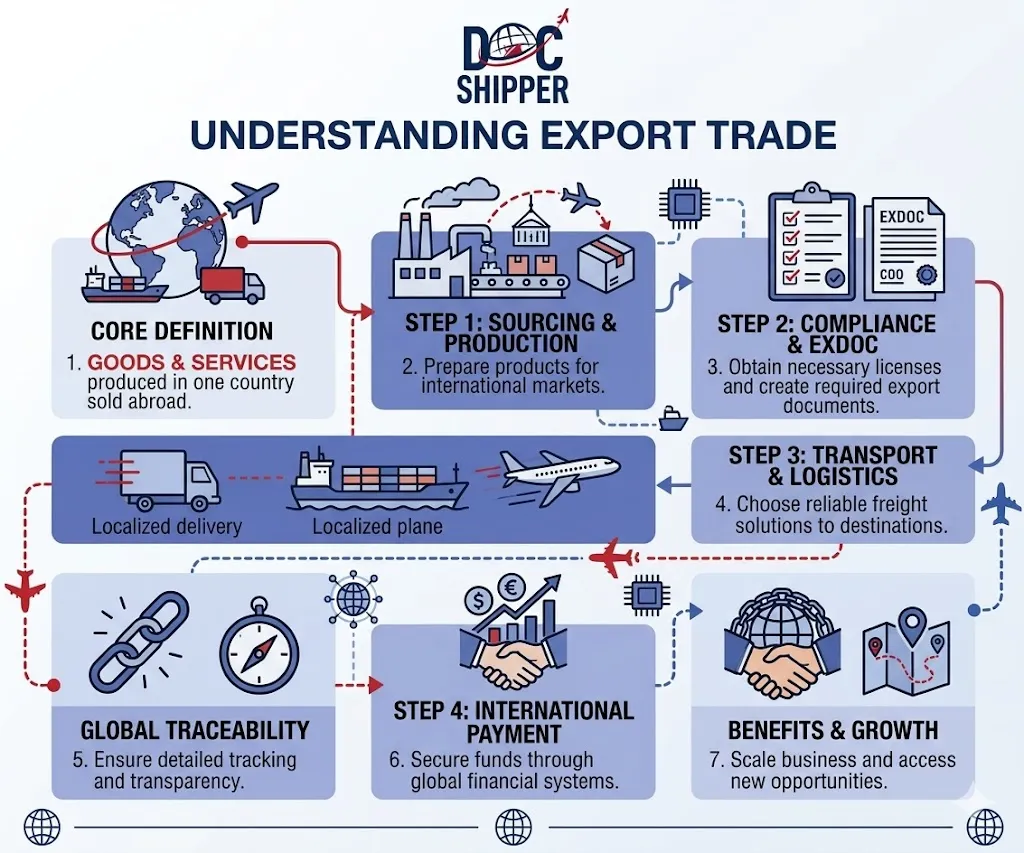
Export is the commercial process of sending goods or services from one country to another for sale or trade. This fundamental international trade activity involves customs formalities, documentation, and compliance with both domestic and foreign regulations to legally move products across borders.
Introduction
Many businesses struggle with the complexity of exporting their products internationally. Understanding customs regulations, documentation requirements, and logistics coordination can overwhelm even experienced companies. Yet export activities represent tremendous growth opportunities for businesses seeking to expand their market reach beyond domestic borders.
In today’s globalized economy, export competency has become essential for competitive advantage. From small manufacturers to multinational corporations, the ability to navigate international trade regulations determines market access and profitability.
Key characteristics of export operations include:
- Customs declarations validating the legal exit of goods from the origin country
- Export documentation such as commercial invoices, packing lists, and certificates of origin
- Regulatory compliance with export controls, trade sanctions, and product-specific restrictions
- Logistics coordination involving freight forwarders, carriers, and customs brokers
- Payment arrangements like letters of credit, wire transfers, or documentary collections
In-Depth Understanding & Expertise
Export operations require understanding multiple regulatory frameworks simultaneously. The export customs clearance process begins with proper classification of goods using the Harmonized System (HS) code, a standardized numerical method recognized internationally. This classification determines applicable duties, taxes, and whether specific licenses or permits are required.
Export licenses and controls vary significantly by product category and destination country. Dual-use goods, military equipment, certain technologies, and products subject to international agreements require special authorization. The U.S. Bureau of Industry and Security maintains comprehensive lists of controlled items and restricted destinations.
The Incoterms rules establish critical responsibilities between buyer and seller. Terms like FOB (Free On Board) or CIF (Cost, Insurance, and Freight) define who bears transportation costs, insurance obligations, and risk transfer points. Selecting the appropriate Incoterm impacts pricing strategy, liability exposure, and customer satisfaction.
Documentary requirements form the backbone of export compliance. The commercial invoice details transaction values and product descriptions. The packing list specifies shipment contents and packaging details. Certificates of origin verify manufacturing location, often required for preferential tariff treatment under free trade agreements.
Payment security mechanisms protect both exporters and importers in international transactions. Letters of credit provide payment guarantees through banking institutions. Documentary collections offer a middle ground between open account terms and full prepayment. At DocShipper, we guide clients through selecting appropriate payment terms that balance risk mitigation with competitive positioning.
Practical Examples & Data
Understanding export processes through concrete scenarios clarifies the operational realities businesses face. Consider these comparative examples across different industries and trade lanes:
| Product Category | Origin → Destination | Key Requirements | Average Timeline |
|---|---|---|---|
| Electronics | China → USA | FCC certification, commercial invoice, packing list | 25-35 days (ocean freight) |
| Pharmaceuticals | Germany → Brazil | Health certificate, temperature control, ANVISA registration | 3-5 days (air freight) |
| Machinery | USA → Vietnam | Certificate of origin, technical specifications, export license | 20-30 days (ocean freight) |
| Food Products | France → Japan | Phytosanitary certificate, halal/kosher certification if applicable | 15-25 days (ocean freight) |
| Textiles | India → EU | EUR.1 movement certificate, textile declaration | 22-32 days (ocean freight) |
Case Study: Electronics Manufacturer Expansion
A mid-sized electronics manufacturer in Shenzhen sought to export wireless headphones to the United States. The shipment value totaled $85,000 for 5,000 units. Required documentation included:
- Commercial invoice with detailed product descriptions and HS code 8518.30.20
- FCC Declaration of Conformity certifying electromagnetic compatibility standards
- Packing list specifying carton quantities, weights, and dimensions
- Bill of lading serving as the carrier’s receipt and title document
- Certificate of origin qualifying for standard tariff rates
The total export customs clearance process required 3 business days in China. Ocean freight from Shenzhen to Los Angeles took 18 days. Import duties at 2.5% and processing fees added $2,340 to the landed cost. At DocShipper, we coordinated the entire export process, ensuring documentation accuracy and avoiding costly delays.
Global Export Statistics:
- World merchandise exports reached $22.3 trillion in 2022
- Small and medium enterprises account for approximately 35% of global exports
- Digital documentation adoption has reduced export processing times by 40-60%
- Free trade agreements cover over 50% of international trade flows
- Documentation errors cause 70% of customs clearance delays
Conclusion
Export operations represent both significant opportunity and complexity for businesses engaging in international commerce. Mastering documentation requirements, regulatory compliance, and logistics coordination determines success in global markets. Professional guidance transforms export challenges into competitive advantages through systematic process management and expertise.
Need assistance with your export operations? Contact DocShipper for comprehensive support throughout your international shipping journey.
📚 Quiz
Test Your Knowledge: Export Operations
What is the primary definition of export?
Do all commercial goods require a specific export license to leave the country?
A textile manufacturer in India wants to export clothing to France. Which document proves manufacturing origin and may qualify for reduced tariffs under trade agreements?
🎯 Your Result
📞 Free Quote in 24hFAQ | Export: Definition, Process & Practical Examples
Standard export documentation includes a commercial invoice detailing transaction values, a packing list specifying shipment contents, a bill of lading or airway bill as the carrier receipt, and often a certificate of origin. Depending on product type and destination, additional documents like export licenses, phytosanitary certificates, or conformity declarations may be required. Each country maintains specific requirements accessible through customs authority websites.
The Harmonized System (HS) code is determined by examining your product's material composition, function, and intended use. National customs authorities provide searchable databases and classification tools. For complex products, consulting with a customs broker or trade compliance specialist ensures accuracy. Misclassification can result in incorrect duty assessments, shipment delays, or penalties. The World Customs Organization publishes the official HS nomenclature updated every five years.
Direct exporting involves selling directly to foreign customers, giving you complete control over the export process but requiring significant resources and expertise. Indirect exporting uses intermediaries like export trading companies or international distributors who handle foreign market complexities. Direct exporting offers higher profit margins and market knowledge but demands greater investment. Indirect exporting reduces risk and resource requirements while sacrificing some control and margin.
No, most commercial goods can be exported without specific licenses under general export authorizations. However, certain product categories require explicit licenses including military items, dual-use technologies, certain chemicals, and goods destined for embargoed countries. Export control regulations vary by country. In the United States, the Commerce Department and State Department maintain control lists. Always screen your products against relevant control lists before exporting.
Incoterms are internationally recognized trade terms defining responsibilities between buyers and sellers in international transactions. They specify who pays transportation costs, arranges insurance, handles customs clearance, and bears risk at each shipment stage. Common export terms include EXW (Ex Works), FOB (Free On Board), and CIF (Cost, Insurance, and Freight). Proper Incoterm selection affects pricing, liability, and customer satisfaction. The International Chamber of Commerce publishes official Incoterms rules.
Export customs clearance duration varies significantly by country, product type, and documentation completeness. In countries with advanced customs systems like the United States, United Kingdom, or Singapore, clearance often occurs within hours to one business day for compliant shipments. Developing nations may require several days. Shipments requiring physical inspection, additional permits, or correction of documentation errors experience longer delays. Electronic documentation and customs pre-clearance programs accelerate the process.
Letter of credit (LC) provides maximum security for exporters, guaranteeing payment if documentary requirements are met precisely. Documentary collections offer moderate security through banking channels without full payment guarantee. Wire transfer after shipment requires trust in the buyer but avoids LC fees. Cash in advance eliminates payment risk but disadvantages competitive positioning. Trade credit insurance protects against buyer default. The appropriate method balances transaction value, relationship trust, and market competition.
Yes, this practice called triangular trade or drop shipping is common in international commerce. The key requirement is accurate documentation reflecting the actual manufacturing origin for certificate of origin purposes and tariff determination. The exporting country processes export customs clearance based on where goods physically leave, while rules of origin determine preferential tariff eligibility based on manufacturing location. Proper declaration prevents customs complications and ensures compliance with trade agreement requirements.
Free trade agreements (FTAs) are treaties between countries reducing or eliminating tariffs and trade barriers on qualifying goods. Exporters benefit through preferential duty rates that lower costs for foreign buyers, making products more competitive. To qualify, goods must meet rules of origin requirements proving substantial manufacturing or processing occurred in FTA member countries. Certificate of origin documentation substantiates preferential treatment claims. Major agreements include USMCA, CPTPP, and EU trade agreements covering billions in annual commerce.
Export controls restrict what goods can be exported and to which destinations for national security, foreign policy, or nonproliferation reasons. They apply before goods leave the origin country and focus on product sensitivity and end-user concerns. Customs regulations govern the physical movement of goods across borders, focusing on valuation, classification, and duty collection. Export control violations carry severe penalties including criminal prosecution. Customs infractions typically result in financial penalties and shipment delays. Both systems require compliance for legal exporting.
Freight forwarders coordinate the physical movement of export shipments from origin to destination. They arrange carrier bookings, prepare shipping documentation, handle customs clearance procedures, manage cargo insurance, and provide tracking visibility. Acting as intermediaries between shippers and carriers, they leverage volume relationships for competitive rates. Freight forwarders also advise on optimal routing, packaging requirements, and regulatory compliance. Their expertise proves invaluable for companies without internal logistics departments or international shipping experience.
Small businesses should begin by researching target markets to understand demand, competition, and regulatory requirements. Develop relationships with freight forwarders and customs brokers who provide guidance through initial transactions. Start with countries having familiar business cultures or existing trade agreements with your home country. Participate in trade shows and utilize government export assistance programs offering counseling and financing support. Consider indirect exporting through established distributors initially. Document processes systematically and scale operations as experience and resources grow.
Need Help with
Logistics or Sourcing ?
First, we secure the right products from the right suppliers at the right price by managing the sourcing process from start to finish. Then, we simplify your shipping experience - from pickup to final delivery - ensuring any product, anywhere, is delivered at highly competitive prices.


Fill the Form
Prefer email? Send us your inquiry, and we’ll get back to you as soon as possible.
Contact us




