


In short ⚡
The 5S Program is a lean manufacturing methodology originating from Japan that optimizes workplace organization through five sequential steps: Sort, Set in Order, Shine, Standardize, and Sustain. This systematic approach eliminates waste, enhances safety, and boosts operational efficiency in warehouses, production facilities, and logistics centers worldwide.
Introduction
Many logistics facilities struggle with misplaced inventory, wasted time searching for tools, and safety hazards buried in cluttered workspaces. The 5S Program addresses these persistent challenges by creating a foundation for operational excellence.
In international trade and warehousing, where efficiency directly impacts profitability, this methodology has become essential. Companies implementing 5S typically report 15-30% productivity gains within the first year.
Key characteristics of the 5S Program include:
- Sequential implementation: Each step builds on the previous one
- Visual management: Color-coding, labels, and floor markings guide operations
- Employee engagement: Frontline workers drive continuous improvement
- Waste elimination: Focuses on the seven forms of waste (muda) in lean thinking
- Cultural transformation: Changes mindsets beyond physical organization
In-Depth Analysis & Expertise
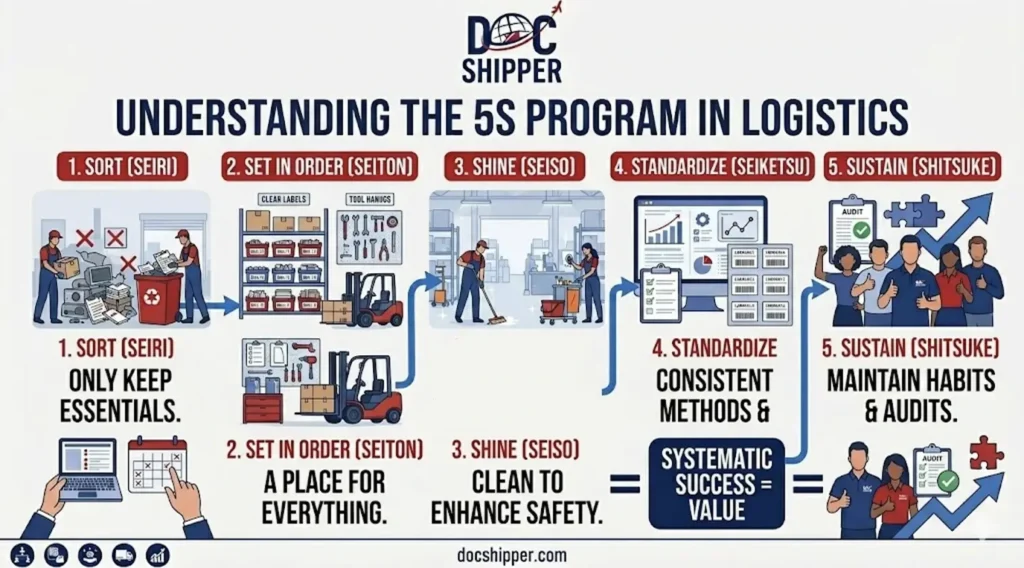
The 5S methodology derives its name from five Japanese terms: Seiri (Sort), Seiton (Set in Order), Seiso (Shine), Seiketsu (Standardize), and Shitsuke (Sustain). Each phase serves a specific purpose in transforming chaotic spaces into lean operations.
Seiri (Sort) involves distinguishing necessary items from unnecessary ones. Workers evaluate every tool, document, and material, removing what doesn’t add value. In warehousing, this might mean disposing of obsolete inventory or relocating slow-moving SKUs.
Seiton (Set in Order) creates designated locations for everything that remains. The principle “a place for everything, everything in its place” minimizes search time. Shadow boards for tools, labeled bin locations, and clearly marked aisles exemplify this step.
Seiso (Shine) emphasizes cleanliness as an inspection tool. Regular cleaning reveals equipment defects, leaks, and safety hazards before they escalate. Daily cleaning routines become preventive maintenance activities.
Seiketsu (Standardize) documents best practices through visual controls and standard operating procedures. Photographs of ideal workstations, checklists, and color-coded zones ensure consistency across shifts and facilities.
Shitsuke (Sustain) embeds these practices into organizational culture. Audits, training programs, and leadership commitment prevent backsliding. This final step transforms 5S from a project into a permanent operating system.
According to the Lean Enterprise Institute, organizations that successfully implement 5S create the foundation for advanced lean tools like kanban, just-in-time delivery, and total productive maintenance.
At DocShipper, we integrate 5S principles into our warehouse management services to ensure faster order processing and zero-defect shipments for our international clients.
Concrete Examples & Data
Real-world implementation demonstrates the measurable impact of the 5S Program across diverse logistics environments. The following data illustrates typical improvements:
| Metric | Before 5S | After 6 Months | Improvement |
|---|---|---|---|
| Time to Locate Items | 8.5 minutes | 2.1 minutes | 75% reduction |
| Workplace Accidents | 12 per year | 3 per year | 75% reduction |
| Order Processing Time | 45 minutes | 28 minutes | 38% faster |
| Floor Space Utilization | 68% | 89% | 31% increase |
| Equipment Downtime | 14 hours/month | 6 hours/month | 57% reduction |
Use Case: Electronics Distribution Center
A mid-sized electronics importer implemented 5S across their 50,000 sq ft warehouse. Initial challenges included mixed inventory locations, inadequate lighting in picking zones, and 23% of staff time spent searching for packing materials.
The Sort phase eliminated 4,200 obsolete components and consolidated 18 tool sets into 5 strategically located stations. Set in Order introduced color-coded floor tape (red for safety zones, yellow for traffic lanes, blue for staging areas) and vertical labeling visible from 20 feet.
After full implementation, the facility achieved 99.7% order accuracy, reduced picking errors by 82%, and freed up 8,000 square feet for expanded inventory. Most significantly, employee satisfaction scores increased 34% as frustration from disorganization disappeared.
Critical Success Factors:
- Leadership visibility: Senior management participated in weekly audits
- Customized training: Role-specific 5S modules for pickers, packers, and forklift operators
- Incremental rollout: Piloted in one zone before warehouse-wide expansion
- Celebration of wins: Monthly recognition for teams maintaining highest 5S scores
- Integration with technology: Linked 5S zones to warehouse management system (WMS) locations
Conclusion
The 5S Program represents more than workplace organization—it’s a strategic approach to operational excellence in logistics. Companies that commit to all five phases experience sustainable improvements in safety, quality, and throughput.
Need guidance implementing 5S in your warehousing or logistics operations? Contact DocShipper to optimize your supply chain infrastructure.
📚 Quiz
Test Your Knowledge: 5S Program
1. What is the primary purpose of the 5S Program in logistics operations?
2. Which statement correctly describes the "Sustain" (Shitsuke) phase of 5S?
3. A warehouse manager claims their facility doesn't need 5S because they already have a warehouse management system (WMS). What's the correct response?
🎯 Your Result
📞 Free Quote in 24hFAQ | 5S Program: Definition, Implementation & Concrete Examples
6S adds a sixth element—Safety (or Security)—to the traditional five steps. While safety is implicit throughout standard 5S implementation, some industries like chemical manufacturing or food processing explicitly designate it as a separate phase to emphasize hazard identification and risk mitigation protocols.
Initial implementation across a warehouse facility generally requires 3-6 months, with the Sort and Set in Order phases consuming 60% of that timeline. However, Sustain is ongoing—mature 5S programs require continuous auditing and reinforcement. Expect 12-18 months before the methodology becomes truly embedded in organizational culture.
Absolutely. The 5S methodology applies effectively to administrative spaces, freight forwarding offices, and customs brokerage departments. Digital 5S adaptations organize computer files, standardize email protocols, and streamline document workflows. The principles remain identical even when applied to information rather than physical inventory.
Failure typically stems from lack of leadership commitment, treating 5S as a one-time cleanup campaign rather than a continuous system, inadequate training, or absence of accountability mechanisms. Without regular audits and visible management participation, workplaces revert to previous disorganized states within 60-90 days.
Effective measurement combines quantitative metrics (search time, accident rates, space utilization, order accuracy) with qualitative assessments through standardized audit checklists. Most organizations use a scoring system (1-5 points per S category) conducted weekly or monthly, with results posted publicly to drive accountability and competition between teams.
Initial costs are modest—primarily labels, floor tape, shadow boards, and signage typically totaling $2,000-$8,000 for a mid-sized warehouse. The methodology emphasizes using existing resources more effectively rather than purchasing new equipment. Return on investment usually appears within 3-4 months through reduced waste and improved productivity.
Modern WMS platforms complement 5S by digitizing location assignments (Set in Order) and tracking inventory movements in real-time. Barcode scanning ensures items return to designated 5S zones, while system-generated reports identify areas falling below cleanliness or organization standards, triggering corrective action before physical audits.
Frontline workers are the backbone of successful 5S programs. They identify improvement opportunities during daily operations, participate in weekly mini-audits of their work zones, and contribute ideas to refine standards. Organizations that empower employees to stop processes when 5S standards slip maintain higher compliance rates than those relying solely on management enforcement.
5S actually facilitates ISO 9001 compliance by establishing the documented procedures, cleanliness standards, and visual controls that auditors seek. Many companies use 5S as the foundation for their quality management system, with Standardize and Sustain phases directly addressing ISO requirements for process documentation and continual improvement.
Address resistance through transparent communication about the "why" behind changes, involve skeptics in pilot programs where they can experience benefits firsthand, and celebrate early wins publicly. Demonstrating how 5S reduces frustration (not just increases discipline) converts critics into advocates. Allowing teams to customize standards within their zones also increases buy-in.
5S creates the operational discipline necessary for just-in-time (JIT) systems to function reliably. JIT depends on precise inventory locations, immediate visibility of stock levels, and zero defects—all outcomes of mature 5S implementation. Companies typically establish 5S before attempting JIT, as disorganized facilities cannot maintain the tight tolerances JIT demands.
Frequency depends on organizational maturity. During initial implementation, conduct audits weekly to reinforce habits. After 6-12 months, monthly audits suffice for most facilities, supplemented by daily informal checks by supervisors. High-risk areas like hazardous materials storage may warrant weekly audits indefinitely. The key is consistency—irregular audits signal that 5S isn't truly a priority.
Need Help with
Logistics or Sourcing ?
First, we secure the right products from the right suppliers at the right price by managing the sourcing process from start to finish. Then, we simplify your shipping experience - from pickup to final delivery - ensuring any product, anywhere, is delivered at highly competitive prices.


Fill the Form
Prefer email? Send us your inquiry, and we’ll get back to you as soon as possible.
Contact us




