


In short ⚡
The Elkins Act is a United States federal law enacted in 1903 that prohibits railroad companies from offering rebates or preferential rates to shippers, ensuring uniform pricing and fair competition in freight transportation. This legislation made both carriers and shippers liable for rate discrimination, fundamentally reshaping commercial shipping practices.
Introduction
In the early 20th century, freight transportation rates were chaotic and discriminatory. Large shippers received secret rebates while smaller businesses paid full published tariffs. This created an uneven playing field that threatened fair competition.
The Elkins Act emerged as a critical reform to stabilize the transportation industry. Named after Senator Stephen B. Elkins, this legislation revolutionized how carriers and shippers conduct business in international and domestic trade.
Understanding the Elkins Act remains essential for logistics professionals because:
- Rate transparency: Eliminates hidden pricing advantages that distort market competition
- Legal compliance: Both carriers and shippers face penalties for violations
- Contract integrity: Published tariffs become legally binding agreements
- Industry standardization: Creates predictable pricing frameworks for freight movement
- International implications: Influences global shipping regulations and trade practices
Historical Context & Legal Framework
The Elkins Act was passed on February 19, 1903, as an amendment to the Interstate Commerce Act of 1887. Prior legislation attempted to regulate railroad monopolies but lacked enforcement mechanisms against rebate practices.
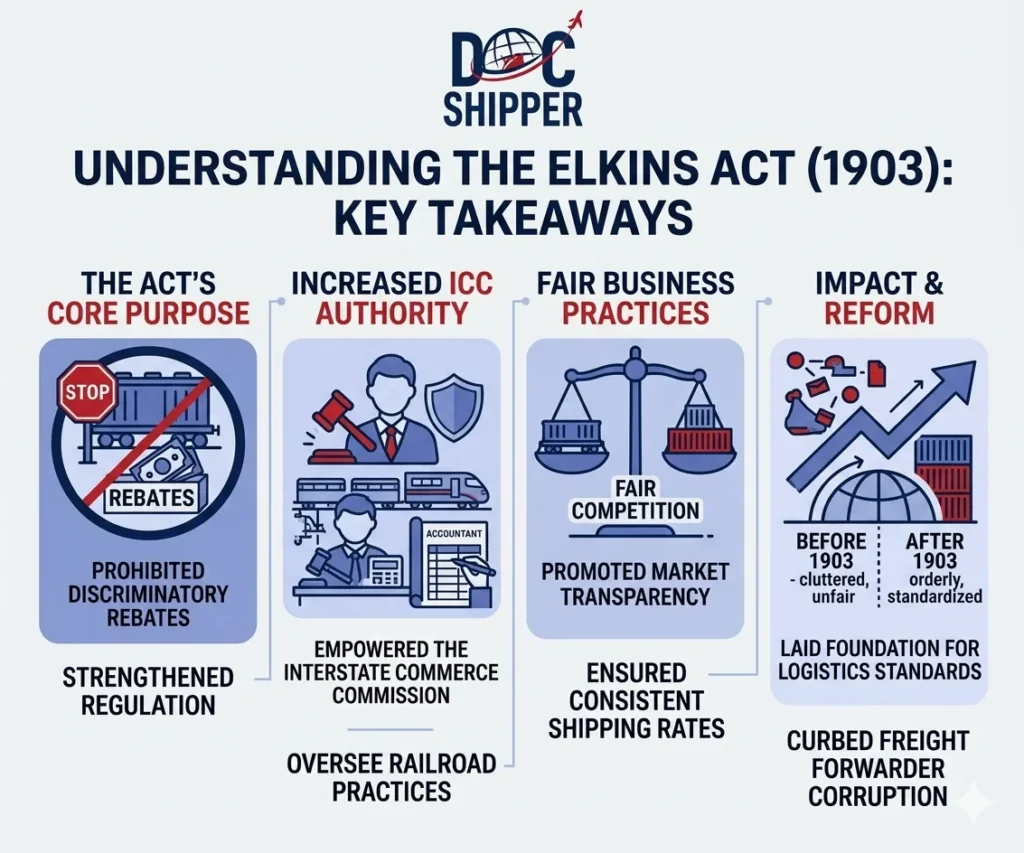
The law introduced five critical provisions that transformed transportation law:
Mutual liability represented the most revolutionary aspect. Unlike previous laws that only penalized carriers, the Elkins Act held shippers equally responsible for accepting preferential rates. This dual accountability eliminated the incentive structure that perpetuated discriminatory pricing.
Published tariff enforcement mandated that all rates must be filed with the Interstate Commerce Commission (ICC). Deviations from published rates became criminal offenses punishable by fines up to $20,000 per violation—a substantial sum in 1903 equivalent to approximately $600,000 today.
Elimination of rebates specifically prohibited carriers from offering refunds, concessions, or any form of rate reduction not available to all shippers. This provision closed loopholes that large corporations exploited through complex financial arrangements.
Corporate officer liability extended criminal penalties to executives who authorized illegal rebates. This personal accountability deterred corporate decision-makers from engaging in discriminatory practices, as noted in regulatory documents from the U.S. National Archives.
Injunctive relief empowered the ICC to seek court orders stopping violations immediately, rather than waiting for lengthy criminal proceedings. This mechanism provided rapid enforcement capability.
At DocShipper, we ensure all freight contracts comply with pricing transparency requirements derived from Elkins Act principles, protecting our clients from regulatory violations during international shipments.
Practical Impact on Modern Logistics
While railroad regulation has evolved substantially since 1903, the Elkins Act established precedents that continue shaping freight transportation today. Modern logistics operates under frameworks directly influenced by this legislation.
Modern regulatory equivalents: The Surface Transportation Board (successor to the ICC) maintains authority over freight rail rates, ensuring published tariffs remain binding. Ocean shipping follows similar principles under the Shipping Act of 1984, requiring carriers to file service contracts and maintain rate transparency.
| Transportation Mode | Regulatory Framework | Elkins Act Legacy |
|---|---|---|
| Rail Freight | Surface Transportation Board oversight | Direct application of published tariff requirements |
| Ocean Shipping | Federal Maritime Commission regulations | Service contract filing and rate transparency principles |
| Trucking | Largely deregulated since 1980 | Market-based pricing with contract law protections |
| Air Cargo | International Air Transport Association (IATA) guidelines | Voluntary rate filing systems based on transparency norms |
Use Case – International Container Shipping: A manufacturer in Ohio contracts with an ocean carrier for monthly container shipments to Hamburg. The carrier publishes a service contract rate of $2,850 per TEU. Under Elkins Act principles (now applied via maritime law), the carrier cannot offer the shipper a $2,400 rate while charging competitors the published $2,850. Both parties face penalties if discovered providing or accepting discriminatory rates.
Small business protection: The Act’s legacy particularly benefits small and medium enterprises in international trade. Published tariffs prevent carriers from reserving preferential rates exclusively for high-volume shippers, ensuring market access for businesses of all sizes.
Contract negotiation implications: Modern freight agreements must clearly specify rates, surcharges, and accessorial charges. Ambiguous pricing terms expose both parties to legal challenges. DocShipper structures all client agreements with explicit rate schedules that comply with transparency standards.
Digital transformation impact: Online freight marketplaces and digital booking platforms embody Elkins Act principles through algorithmic rate displays. When a platform shows identical rates to all users for the same service parameters, it operationalizes the century-old legal requirement of non-discriminatory pricing.
Conclusion
The Elkins Act established foundational principles of rate transparency and non-discrimination that continue protecting fair competition in freight transportation. Modern logistics professionals must understand these concepts to navigate regulatory compliance and contractual obligations effectively.
Need guidance on freight contract compliance or international shipping regulations? Contact DocShipper for expert logistics consultation.
📚 Quiz
Test Your Knowledge: Elkins Act
What was the fundamental legal innovation introduced by the Elkins Act of 1903?
A freight carrier offers Company X a rate of $2,400 per container while charging Company Y $2,850 for identical service on the same route. Both rates are for the same volume and service level. Is this permissible under Elkins Act principles?
Which modern transportation sector operates most directly under regulations derived from the original Elkins Act framework?
🎯 Your Result
📞 Free Quote in 24hFAQ | Elkins Act: Definition, Impact & Practical Applications in Freight Transportation
The Elkins Act aimed to eliminate discriminatory railroad rate practices by prohibiting rebates and preferential pricing. It made both carriers and shippers legally liable for deviations from published tariffs, ensuring all customers paid identical rates for comparable services. This protected small businesses from being priced out of freight transportation markets.
While the original Act specifically targeted railroads, its core principles remain embedded in contemporary transportation law. The Surface Transportation Board applies Elkins Act concepts to rail freight today. Ocean shipping, trucking, and air cargo operate under successor regulations that incorporate similar transparency and non-discrimination requirements established by this foundational legislation.
The Act imposed fines up to $20,000 per violation for both carriers offering illegal rebates and shippers accepting them. Corporate officers who authorized discriminatory rates faced criminal prosecution. The Interstate Commerce Commission could also seek injunctions to immediately halt violations. These enforcement mechanisms represented unprecedented accountability in transportation regulation.
The Interstate Commerce Act established the Interstate Commerce Commission and prohibited rate discrimination but only penalized carriers. The Elkins Act introduced mutual liability, making shippers equally responsible for accepting preferential rates. It also provided stronger enforcement tools including injunctive relief and personal liability for corporate executives, addressing weaknesses in the earlier legislation.
Yes, carriers can negotiate volume discounts and customized service contracts, but these arrangements must be transparently documented and consistently applied. Rates based on legitimate factors like shipment volume, lane density, or service level are permissible. Secret rebates or discriminatory pricing unrelated to service differences remain prohibited under modern regulatory frameworks derived from Elkins Act principles.
A published tariff is an official rate schedule filed with regulatory authorities that specifies charges for transportation services. It includes base rates, accessorial fees, and applicable surcharges. Under Elkins Act principles, carriers must charge the published tariff rate unless a filed exception or contract provides otherwise. This creates legally binding pricing obligations for both parties.
International shipping operates under frameworks influenced by Elkins Act transparency principles. Ocean carriers must file service contracts with the Federal Maritime Commission. These contracts establish clear rate terms and cannot discriminate among shippers in similar circumstances. The Act's legacy ensures international freight pricing remains competitive and accessible to businesses of all sizes.
Standard Oil ironically supported the Elkins Act despite benefiting from railroad rebates for years. By 1903, the company dominated petroleum transportation and preferred stable, transparent rates over chaotic rebate systems. John D. Rockefeller recognized that published tariffs would cement existing market advantages while appearing to support fair competition, facilitating the legislation's passage.
Modern transportation law allows exceptions through properly filed contracts and agreements. Volume shippers can negotiate lower rates if contracts are filed with relevant authorities and consistently applied to all customers meeting the same criteria. Service contracts in ocean shipping, for example, must be filed with the Federal Maritime Commission but allow customized pricing based on legitimate commercial factors.
Online freight marketplaces display identical spot rates to all users for the same lane and service parameters, operationalizing non-discriminatory pricing through technology. Algorithmic rate engines apply consistent pricing logic regardless of shipper size. When platforms offer volume discounts, they do so transparently through tiered pricing structures available to all customers meeting defined thresholds.
The Elkins Act complemented antitrust enforcement by addressing railroad monopoly abuses through rate regulation rather than corporate breakup. While the Sherman Antitrust Act of 1890 targeted monopolistic combinations, the Elkins Act regulated pricing behavior within the transportation industry. Together, they formed a comprehensive framework for controlling market power in early 20th-century commerce.
Yes, shippers can file complaints with the Surface Transportation Board for rail freight rate discrimination. Ocean shipping disputes go to the Federal Maritime Commission. Private lawsuits are also possible under contract law when carriers violate agreed-upon rate terms. However, carriers must prove rates are unreasonably discriminatory, as legitimate differences based on service factors remain permissible.
Need Help with
Logistics or Sourcing ?
First, we secure the right products from the right suppliers at the right price by managing the sourcing process from start to finish. Then, we simplify your shipping experience - from pickup to final delivery - ensuring any product, anywhere, is delivered at highly competitive prices.


Fill the Form
Prefer email? Send us your inquiry, and we’ll get back to you as soon as possible.
Contact us




