


In short ⚡
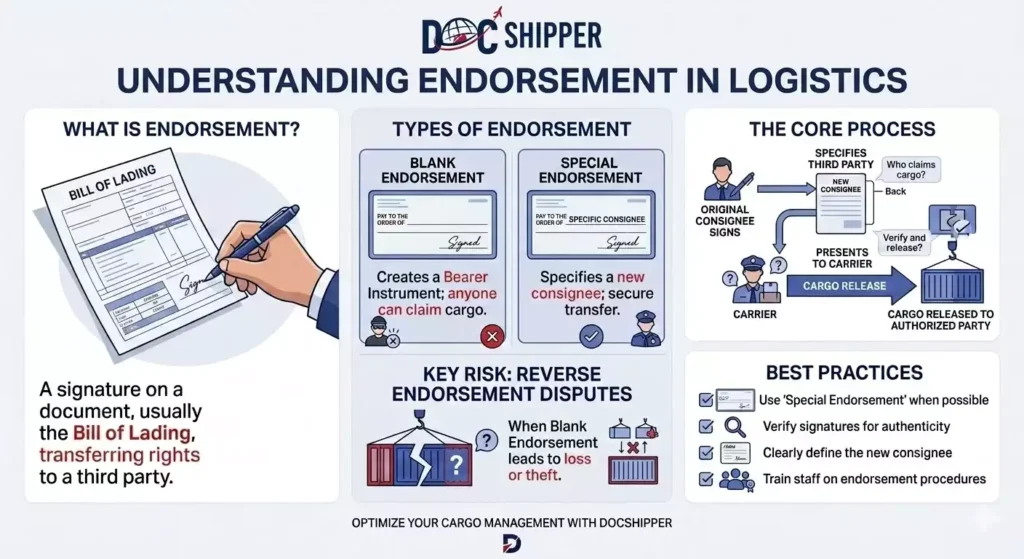
Endorsement is the legal act of transferring ownership or rights of a negotiable instrument (such as a bill of lading or promissory note) by signing the back of the document. In international logistics, it enables the transfer of goods' title from one party to another, facilitating trade finance and secure transactions across borders.Introduction
Many importers and exporters struggle to understand how ownership of goods actually transfers during international shipments. A container arrives at the port, but who legally owns the cargo inside? The answer often lies in a simple signature on the back of a document.
Endorsement serves as the cornerstone of negotiable instruments in global trade. It transforms a shipping document from a mere receipt into a tradable asset, enabling banks to finance transactions and buyers to take possession of goods thousands of miles away.
Key characteristics of endorsement in logistics:
- Legally transfers title and ownership rights
- Requires proper signature and identification
- Varies by endorsement type (blank, special, restrictive)
- Essential for letters of credit and documentary collections
- Creates liability chain for all endorsing parties
Legal Mechanisms & Types of Endorsement
Understanding endorsement mechanics is crucial for risk mitigation in international transactions. The Uniform Commercial Code (UCC) and international conventions like the UNCITRAL Model Law govern these transfers, but practical application varies by jurisdiction.
The blank endorsement represents the simplest form. The holder signs the document without specifying a recipient, making it transferable by mere delivery. This method offers maximum flexibility but carries significant security risks—whoever physically possesses the document can claim ownership.
A special endorsement (or full endorsement) names the specific party to whom rights are transferred. The endorser writes “Pay to the order of [Name]” followed by their signature. This method creates a clear audit trail and limits unauthorized transfers.
Restrictive endorsement limits further negotiation by including phrases like “For deposit only” or “Pay to X only, not transferable.” Banks commonly use this method to prevent fraudulent rerouting of funds or goods.
The qualified endorsement adds “without recourse” to limit the endorser’s liability. While this protects the endorser from future claims, it makes the instrument less attractive to subsequent holders who assume greater risk.
At DocShipper, we systematically verify endorsement validity on bills of lading before releasing shipments, ensuring compliance with both banking requirements and customs regulations. Our legal team reviews endorsement chains to prevent documentation disputes that could delay cargo release by weeks.
Practical Examples & Trade Finance Data
Consider a textile shipment from Bangladesh to France valued at $150,000. The exporter ships under a negotiable bill of lading with their bank named as consignee. The bank endorses the document to the French importer’s bank, which then endorses it to the final buyer.
Industry data reveals critical patterns:
| Endorsement Type | Usage Rate | Fraud Risk | Processing Time |
|---|---|---|---|
| Blank Endorsement | 18% | High | 1-2 hours |
| Special Endorsement | 67% | Low | 4-6 hours |
| Restrictive Endorsement | 15% | Very Low | 8-12 hours |
Case Study: An electronics manufacturer in South Korea needed urgent financing for a $2.3 million shipment to Germany. Their freight forwarder issued an endorsed bill of lading to the manufacturer’s bank, which immediately provided 80% of the invoice value. The bank then endorsed the document to the German buyer’s bank against payment confirmation.
The endorsement chain created three critical benefits: immediate liquidity for the exporter ($1.84 million), payment guarantee for both banks, and conditional delivery for the importer pending final payment verification.
Key financial implications:
- Letter of credit transactions require endorsement in 94% of cases
- Improper endorsement causes cargo release delays averaging 7-10 business days
- Documentary collection relies on endorsement for $1.2 trillion in annual trade
- Digital endorsement adoption currently sits at only 8% globally
- Banks reject documents with endorsement errors in 23% of first presentations
Conclusion
Endorsement remains the fundamental mechanism for transferring ownership in international trade, bridging legal systems and enabling trillion-dollar cargo movements annually. Mastering its proper execution prevents costly delays and protects all parties in the transaction chain.
Need assistance with complex endorsement requirements or trade documentation? Contact DocShipper’s specialists for expert guidance on your international shipments.
📚 Quiz
Test Your Knowledge: Endorsement
What is the primary function of endorsement in international trade?
Which type of endorsement offers maximum flexibility but carries the highest security risk?
A French importer receives a bill of lading marked "to order of Bank XYZ" for electronics from Taiwan. Can the carrier release the cargo directly to the importer upon arrival?
🎯 Your Result
📞 Free Quote in 24hFAQ | Endorsement: Definition, Types & Concrete Examples in International Trade
Banks will reject the document and require re-endorsement by an authorized signatory. This typically delays cargo release by 5-7 business days while the correct party provides proper endorsement. Many shipping lines charge demurrage during this period, adding $100-300 per day to costs. Always verify signature authority before endorsing to avoid these delays.
Electronic endorsement is legally valid under the UNCITRAL Model Law on Electronic Transferable Records, but practical adoption remains limited. Platforms like Bolero and essDOCS enable digital endorsement, yet only 8% of global trade uses these systems. Most banks still require physical documents with wet signatures, particularly outside major trade corridors.
Liability typically falls on the carrier who released the goods without proper endorsement verification. However, if the endorsement itself was fraudulent, the party who made the improper endorsement bears primary responsibility. Marine insurance may cover losses, but claims can take 6-18 months to resolve. This is why carriers conduct thorough endorsement verification before cargo release.
No. Only negotiable bills of lading require endorsement for ownership transfer. Straight bills of lading (non-negotiable) name a specific consignee and cannot be endorsed—the carrier releases goods directly to the named party upon identity verification. Sea waybills, used in 35% of containerized shipments, also do not require endorsement as they are non-negotiable transport documents.
Legally, there is no limit to endorsement frequency. However, each additional endorsement increases processing complexity and fraud risk. Banks typically scrutinize documents with more than three endorsements, and some refuse documents with excessive endorsement chains. Best practice limits endorsement to necessary parties only—typically exporter to bank, bank to importer's bank, then to final consignee.
Endorsement in blank (blank endorsement) involves only the endorser's signature without naming a recipient, making the document transferable by delivery. Endorsement in full (special endorsement) specifies the transferee's name, restricting transfer to that named party only. Banks prefer endorsement in full for security reasons, while blank endorsement offers flexibility for commodity traders who may sell goods in transit.
Once a proper endorsement transfers ownership and the document reaches the endorsee, reversal requires consent from all subsequent holders. If the goods haven't been delivered and all parties agree, they can execute a reverse endorsement chain. However, this rarely occurs in practice—disputes usually result in legal proceedings rather than consensual reversal. Prevention through careful verification is far more practical than attempting reversal.
Air waybills (AWBs) are non-negotiable documents and cannot be endorsed. The airline releases cargo to the named consignee upon identity verification, regardless of whether the shipper paid in full. This creates different risk profiles—exporters using air freight typically require payment before shipment or use secure payment methods. The lack of endorsement capability makes AWBs unsuitable for letter of credit transactions requiring title transfer.
Valid endorsement requires: original bill of lading with unbroken signature chain, each endorser's corporate authorization documents, identification verification for individual endorsers, and sometimes notarization depending on jurisdiction. Banks maintain endorsement verification procedures requiring company seals, officer identification, and signature comparison against banking records. Missing any element can invalidate the entire endorsement chain.
When multiple shippers share a container (LCL shipment), the freight forwarder issues separate house bills of lading to each shipper, which can be individually endorsed. The master bill of lading covering the entire container is typically issued to the forwarder or NVOCC. Each house bill endorsement transfers only that shipper's portion of goods, not the entire container contents. This enables multiple concurrent ownership transfers within one physical shipment.
Dangerous goods bills of lading follow standard endorsement procedures, but require additional certifications remain attached throughout the endorsement chain. The shipper's dangerous goods declaration and material safety data sheets must accompany endorsed documents. Some jurisdictions require licensed hazmat handlers to verify endorsements before cargo release. Failure to maintain proper hazmat documentation with the endorsed bill can result in cargo abandonment and substantial fines.
A "to order" bill of lading designates the consignee as "to order" or "to order of [bank name]," making it fully negotiable through endorsement. This is the standard format for letter of credit transactions, enabling banks to control cargo release pending payment. The shipper or named party must endorse the document to transfer ownership. Approximately 45% of ocean bills of lading are issued "to order," compared to straight consignment format.
Need Help with
Logistics or Sourcing ?
First, we secure the right products from the right suppliers at the right price by managing the sourcing process from start to finish. Then, we simplify your shipping experience - from pickup to final delivery - ensuring any product, anywhere, is delivered at highly competitive prices.


Fill the Form
Prefer email? Send us your inquiry, and we’ll get back to you as soon as possible.
Contact us




