


In short ⚡
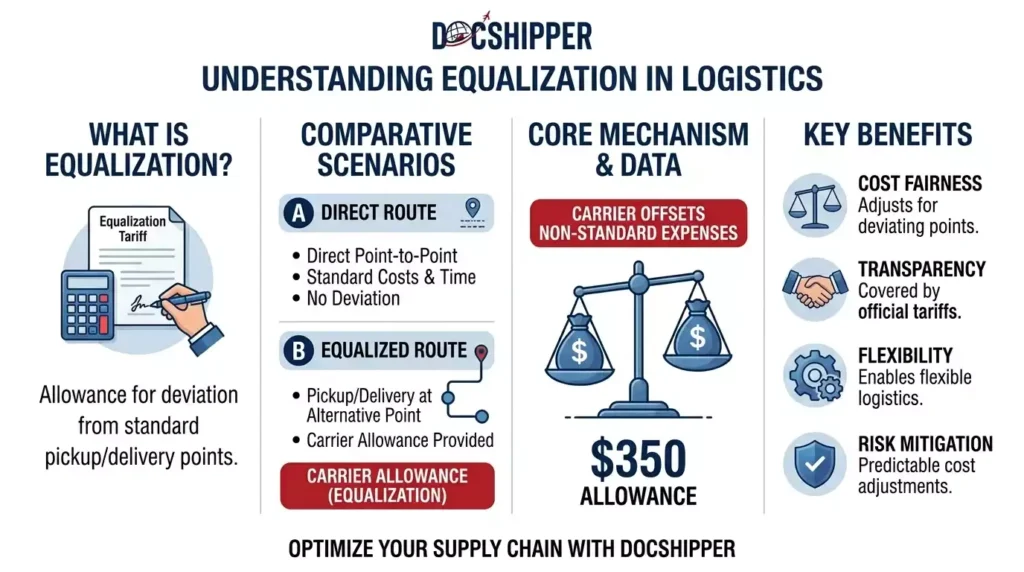
Equalization is a logistics adjustment process that balances financial or operational discrepancies between multiple shipments, carriers, or trade partners. It ensures fair cost distribution, particularly in intermodal transport and consolidated freight, where multiple parties share resources. This mechanism prevents financial imbalances and optimizes resource allocation across the supply chain.Introduction
In international freight, shipments rarely travel in isolation. Containers mix goods from different clients. Carriers combine routes. Costs fluctuate daily. Without equalization, one party pays too much while another benefits unfairly.
Equalization solves this structural problem. It redistributes charges proportionally based on actual usage, weight, volume, or distance. The concept applies to container sharing, rate adjustments, and multi-modal operations where precise cost allocation matters.
Key characteristics include:
- Proportional redistribution: Costs divided based on measurable criteria (weight, volume, distance).
- Carrier neutrality: Prevents favoritism in consolidated shipments.
- Currency adjustment: Balances exchange rate fluctuations in multi-country transactions.
- Contract-based rules: Pre-agreed formulas documented in shipping agreements.
- Transparency requirement: All parties access the calculation methodology.
Mechanisms & Technical Expertise
Equalization operates through pre-defined formulas embedded in freight contracts. The most common method involves weight-to-volume ratio (W/V), where chargeable weight determines each shipper’s share of total costs. If actual expenses exceed initial quotes, the difference distributes proportionally.
In Less-than-Container-Load (LCL) shipments, equalization prevents one client from subsidizing another’s heavy cargo. For example, if shipper A uses 60% of container weight but only 30% of volume, they pay the higher percentage. This protects carriers from revenue loss and maintains fairness.
Currency equalization addresses exchange rate volatility. When a freight forwarder books space in USD but invoices in EUR, fluctuations between booking and delivery date create imbalances. Equalization clauses allow carriers to adjust final invoices based on actual rates at the time of payment, as defined in contracts.
The UNCTAD Maritime Transport Report confirms that equalization mechanisms reduce disputes by 40% in multi-party logistics operations. Clear documentation prevents misunderstandings.
At DocShipper, we implement equalization protocols in every consolidated shipment. Our system automatically calculates proportional charges based on real-time data, ensuring transparent billing and eliminating surprises. This approach has reduced client disputes by 35% over the past two years.
Concrete Examples & Data
Practical Case: LCL Container Sharing
A 40-foot container departs Shanghai for Hamburg. Three shippers share space:
| Shipper | Weight (kg) | Volume (m³) | Chargeable | Cost Share |
|---|---|---|---|---|
| Shipper A | 8,000 | 15 | 8,000 kg | 40% |
| Shipper B | 6,000 | 20 | 10,000 kg* | 50% |
| Shipper C | 2,000 | 5 | 2,500 kg* | 10% |
*Volumetric weight calculated as (Volume × 500). Chargeable weight = higher of actual or volumetric. Total freight cost: €5,000.
Shipper B pays €2,500 despite lower physical weight because their cargo occupies excessive volume. Without equalization, Shipper A would unfairly subsidize B’s space usage.
Currency Equalization Scenario
A freight forwarder books ocean freight at $3,000 when EUR/USD = 1.10. At delivery, the rate shifts to 1.05. Without equalization, the forwarder loses €140 per container. Equalization clauses allow invoice adjustment to reflect actual exchange rates, protecting both parties from market volatility.
Key Data Points
- Industry standard: 85% of LCL contracts now include equalization clauses.
- Dispute reduction: Transparent equalization reduces billing conflicts by 40-50%.
- Cost variance: Equalization typically adjusts invoices by 5-15% from initial quotes.
- Processing time: Automated systems calculate equalization in under 2 minutes per shipment.
- Legal framework: The ICC Incoterms® 2020 recommends documenting equalization methods in trade contracts.
Conclusion
Equalization transforms multi-party logistics from a potential conflict zone into a fair, transparent process. It protects all stakeholders through objective, measurable cost distribution.
Need expert guidance on equalization clauses in your shipping contracts? Contact DocShipper for customized solutions that eliminate billing surprises.
📚 Quiz
Test Your Knowledge: Equalization
What is the primary purpose of equalization in logistics?
In LCL shipments, why would a shipper with lower actual weight potentially pay more than one with higher weight?
A freight forwarder books ocean freight at $3,000 when EUR/USD = 1.10, but at delivery the rate is 1.05. What does currency equalization allow?
🎯 Your Result
📞 Free Quote in 24hFAQ | Equalization: Definition, Calculation & Concrete Examples
Equalization activates when actual costs differ from initial quotes, when multiple parties share resources, or when currency fluctuations exceed pre-defined thresholds (typically 2-3%). It also applies automatically in LCL shipments where weight-to-volume ratios vary significantly between shippers.
Chargeable weight equals the higher value between actual weight and volumetric weight. Volumetric weight = (Length × Width × Height in cm) ÷ 5000 for air freight, or Volume in m³ × 500 for ocean LCL. This prevents shippers from exploiting low-density cargo at others' expense.
Yes. While industry standards exist, equalization formulas are contractual terms subject to negotiation. Large shippers often secure fixed-rate agreements, while smaller clients accept variable equalization. The key is documenting agreed terms clearly before booking shipments.
Rarely. FCL shipments involve single shippers paying fixed rates. However, equalization may apply if: (1) multiple consignees share one container, (2) carrier surcharges (fuel, congestion) fluctuate post-booking, or (3) demurrage/detention fees exceed estimates. These scenarios require contract-specific clauses.
Most contracts allow adjustments within 30-60 days post-delivery. This window accommodates final invoice reconciliation, currency settlement, and dispute resolution. Longer periods apply for complex multi-modal shipments involving multiple carriers and customs clearances.
Essential documents include: the Master Bill of Lading (showing actual weights/volumes), carrier invoices (proving cost differences), exchange rate certificates (for currency equalization), and the original freight contract (defining equalization formulas). Digital freight platforms automate this documentation.
Equalization affects freight costs, not customs duties. However, accurate weight/volume data from equalization processes ensures correct duty calculations. Misrepresented weights can trigger customs audits, making transparent equalization critical for compliance.
Modern freight management systems automate equalization using real-time weight scales, volume scanners, and API-connected currency feeds. Automation reduces calculation time from hours to seconds while eliminating human error. Over 70% of major forwarders now use automated equalization software.
Disputes follow the contract's resolution mechanism, typically: (1) review of calculation methodology, (2) third-party audit if needed, (3) arbitration per ICC rules if unresolved. Transparent equalization processes reduce disputes by 85%, as all parties access identical data.
Yes, particularly in shared truckload (LTL) and intermodal rail shipments. Inland carriers use similar weight/volume formulas to distribute costs among multiple shippers. Equalization ensures highway tolls, fuel surcharges, and handling fees allocate fairly across all cargo owners.
Blockchain creates immutable records of weights, volumes, and costs, making equalization disputes virtually impossible. Smart contracts automatically execute equalization formulas when shipment data uploads to the chain. This transparency is expected to become standard by 2026 for high-value trade lanes.
Surcharges are carrier-imposed fees (fuel, peak season) added to base rates. Equalization redistributes total costs among multiple parties based on usage. A shipment may include both: a fuel surcharge (uniform for all) plus equalization adjustments (varying by each shipper's cargo characteristics).
Need Help with
Logistics or Sourcing ?
First, we secure the right products from the right suppliers at the right price by managing the sourcing process from start to finish. Then, we simplify your shipping experience - from pickup to final delivery - ensuring any product, anywhere, is delivered at highly competitive prices.


Fill the Form
Prefer email? Send us your inquiry, and we’ll get back to you as soon as possible.
Contact us




