


In short ⚡
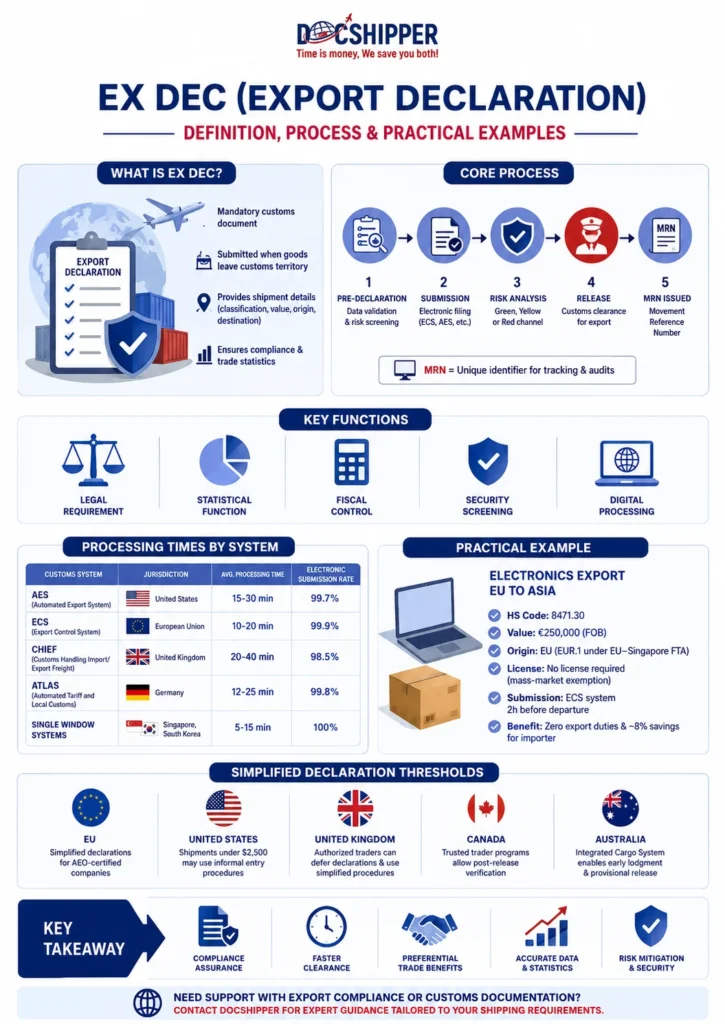
The Ex Dec (Export Declaration) is a mandatory customs document submitted to authorities when goods leave a territory's customs jurisdiction. It provides detailed information about the shipment, including classification, value, origin, and destination, enabling regulatory compliance and export statistics collection.
Introduction
Many exporters underestimate the complexity of export declarations, treating them as mere formalities. This oversight frequently results in shipment delays, penalties, or even cargo seizures. In international logistics, the Ex Dec serves as the legal gateway for goods exiting a customs territory.
Whether shipping electronics from Rotterdam, textiles from Shanghai, or machinery from Hamburg, every commercial export requires proper declaration. The document enables customs authorities to monitor trade flows, enforce trade policies, and collect vital economic statistics.
Key characteristics of Export Declarations include:
- Legal requirement: Mandated by national customs legislation and international conventions
- Statistical function: Provides data for national trade statistics and economic analysis
- Fiscal control: Ensures correct application of export duties, VAT exemptions, and licensing requirements
- Security screening: Facilitates risk assessment for prohibited or restricted goods
- Digital processing: Increasingly submitted through electronic customs systems (AES, CHIEF, ATLAS)
Regulatory Framework & Processing Mechanisms
The export declaration framework operates within strict regulatory parameters established by both national customs authorities and international organizations. In the European Union, the Union Customs Code (UCC) governs all export declarations, requiring submission before goods physically leave the customs territory.
The declaration must contain mandatory data elements including the exporter’s identification, consignee details, commodity classification (HS code), customs value, country of destination, and transportation mode. These elements enable customs authorities to assess compliance with export controls, dual-use regulations, and trade embargoes.
Processing follows a standardized sequence. First, the pre-declaration phase involves data validation through automated systems. Customs software checks for completeness, logical consistency, and risk indicators. High-risk shipments trigger manual examination or documentary verification.
Next comes the release decision. Standard consignments receive immediate clearance through green channel procedures. Suspicious declarations enter yellow (documentary check) or red (physical inspection) channels. This risk-based approach balances trade facilitation with security enforcement.
The Movement Reference Number (MRN) serves as the declaration’s unique identifier throughout its lifecycle. This alphanumeric code links the declaration to physical cargo movement, enabling real-time tracking and post-clearance audits. At DocShipper, we systematically monitor MRN status to anticipate potential clearance issues before they impact shipping schedules.
Critical procedural aspects include customs valuation methods, which must align with WTO Valuation Agreement principles. Transaction value typically forms the basis, but related-party transactions or intellectual property licensing may require adjustments. Incorrect valuation exposes exporters to penalties and shipment holds.
Finally, preferential origin declarations require special attention. Exporters claiming preferential treatment under free trade agreements must provide origin certificates or make approved exporter declarations. These procedural requirements directly affect duty rates in destination countries, making accuracy essential for competitive pricing.
Practical Examples & Comparative Data
Understanding export declaration requirements becomes clearer through practical scenarios reflecting real-world logistics challenges. Consider the differences across major trade jurisdictions and commodity categories.
Comparative Processing Times by System
| Customs System | Jurisdiction | Average Processing Time | Electronic Submission Rate |
|---|---|---|---|
| AES (Automated Export System) | United States | 15-30 minutes | 99.7% |
| ECS (Export Control System) | European Union | 10-20 minutes | 99.9% |
| CHIEF (Customs Handling Import/Export Freight) | United Kingdom | 20-40 minutes | 98.5% |
| ATLAS (Automated Tariff and Local Customs) | Germany | 12-25 minutes | 99.8% |
| Single Window Systems | Singapore, South Korea | 5-15 minutes | 100% |
Case Study: Electronics Export from EU to Asia
A European electronics manufacturer ships 500 laptops valued at €250,000 from Frankfurt to Singapore. The export declaration process unfolds as follows:
- Step 1 – Classification: Laptops classified under HS code 8471.30 (portable automatic data processing machines weighing ≤10kg)
- Step 2 – Valuation: Transaction value of €250,000 declared, including packaging but excluding international freight (FOB Incoterm)
- Step 3 – Origin determination: EU preferential origin claimed under EU-Singapore FTA, requiring EUR.1 movement certificate
- Step 4 – License verification: Dual-use check confirms no encryption license required (mass-market exemption applies)
- Step 5 – Declaration submission: Filed via ECS system 2 hours before cargo departure, MRN received within 12 minutes
The exporter benefits from zero export duties and enables the Singapore importer to claim preferential duty rates, reducing landed costs by approximately 8% compared to non-preferential treatment.
Simplified Declaration Thresholds
Many jurisdictions offer simplified procedures for low-value or authorized economic operators:
- EU: Simplified declarations available for AEO-certified companies, with periodic summary declarations
- United States: Shipments under $2,500 may use informal entry procedures with reduced data requirements
- United Kingdom: Authorized traders can defer declaration submission and use simplified frontier declarations
- Canada: Trusted trader programs allow post-release verification instead of pre-departure checks
- Australia: Integrated Cargo System enables early lodgment with provisional release authorization
At DocShipper, we leverage these facilitation programs to accelerate clearance for eligible clients, reducing documentation overhead while maintaining full compliance with regulatory requirements.
Conclusion
The Export Declaration remains the foundational document for all commercial exports, serving regulatory, statistical, and security functions simultaneously. Mastering its requirements ensures smooth customs clearance, compliance assurance, and competitive advantage through preferential trade agreements.
Whether navigating complex dual-use regulations, claiming origin preferences, or managing multi-country consolidations, proper declaration management prevents costly delays and penalties. Need support with export compliance or customs documentation? Contact DocShipper for expert guidance tailored to your shipping requirements.
📚 Quiz
Test Your Knowledge: Ex Dec (Export Declaration)
1. What is the primary legal function of an Export Declaration?
2. Who bears legal responsibility for the accuracy of export declaration data?
3. A manufacturer ships electronics valued at €180,000 from Germany to Singapore under an EU-Singapore FTA. Which statement correctly describes the declaration requirements?
🎯 Your Result
📞 Free Quote in 24hFAQ | Ex Dec (Export Declaration): Definition, Process & Practical Examples
Export declarations derive their legal authority from national customs laws, which implement international conventions such as the Revised Kyoto Convention and WTO Trade Facilitation Agreement. The European Union's Union Customs Code and the United States' Export Administration Regulations establish specific procedural requirements. These frameworks mandate that commercial goods exceeding minimum thresholds must be formally declared before export, creating legal documentation of the transaction for customs, statistical, and security purposes.
Timing requirements vary by jurisdiction but generally require pre-departure submission. The EU mandates declaration lodgment before goods exit the customs territory, typically 1-24 hours before departure depending on transport mode. The United States requires Electronic Export Information filing at least 2 hours before vessel departure for sea freight, and before loading for air shipments. Some jurisdictions accept post-departure declarations for low-value or authorized trader programs, but standard commercial exports require advance submission.
The exporter of record bears primary legal responsibility for declaration accuracy and completeness. This party may be the actual manufacturer, trading company, or freight forwarder acting under power of attorney. Customs brokers or licensed agents can file on behalf of exporters but do not assume liability for data accuracy. The exporter remains accountable for misclassification, undervaluation, or false statements, facing potential penalties including monetary fines, shipment seizure, and criminal prosecution for intentional violations.
Post-submission corrections follow jurisdiction-specific procedures. Most electronic systems allow amendment before cargo release, typically without penalty if initiated promptly. After release, formal amendment procedures apply, requiring written justification and supporting documentation. Minor errors may be corrected administratively, while material inaccuracies might trigger retroactive duties, interest charges, or penalties. Customs authorities generally distinguish between genuine mistakes and deliberate misrepresentation, with proportionate enforcement responses. Proactive self-disclosure typically receives more favorable treatment than errors discovered through audits.
Export declarations are regulatory documents submitted to customs authorities, while commercial invoices are contractual documents between buyer and seller. Declarations contain customs-specific data (tariff classification, statistical codes, procedure codes) not present on invoices. Invoices reflect commercial terms agreed between parties, whereas declarations must conform to customs valuation rules which may adjust invoice prices. Both documents are essential but serve distinct purposes—invoices establish commercial terms, declarations enable regulatory compliance and trade monitoring.
Consequences range from administrative penalties to criminal prosecution depending on severity and intent. Typical penalties include fixed fines (€500-€5,000 in EU jurisdictions), percentage-based charges (2-40% of goods value in the US), shipment detention costs, and potential cargo abandonment. Repeated violations may result in loss of trade facilitation privileges, suspension of export licenses, or criminal charges for smuggling. Beyond direct penalties, undeclared exports create VAT compliance issues and jeopardize preferential origin claims, multiplying financial exposure across the supply chain.
Most jurisdictions establish minimum thresholds below which simplified or exempt procedures apply. The EU requires declarations for commercial goods exceeding €1,000 statistical value, though all exports need customs supervision. The United States mandates Electronic Export Information for shipments over $2,500 per Schedule B code, except to Canada. Personal effects, gifts, and humanitarian aid often receive preferential treatment with reduced requirements. However, strategic goods, controlled commodities, and shipments to embargoed countries require declarations regardless of value.
Authorized Economic Operator status provides significant procedural benefits without eliminating declaration requirements. AEO-certified exporters access simplified declaration procedures, reduced data sets for routine shipments, and priority processing during peak periods. They qualify for reduced inspection rates (typically 1-5% versus 10-15% for standard operators) and benefit from mutual recognition agreements enabling expedited clearance in partner countries. However, AEO status demands rigorous internal controls, accurate recordkeeping, and compliance history maintenance. The certification represents a strategic investment for high-volume exporters.
Commodity descriptions must be sufficiently detailed to enable accurate classification without examining the goods. Vague terms like "parts," "accessories," or "samples" are inadequate. Declarations should specify material composition, function, commercial designation, and technical characteristics relevant to tariff classification. For example, "electronic components" should become "printed circuit boards, unassembled, for smartphone manufacturing." Regulatory descriptions must match invoice terminology while adding classification-relevant detail. Inconsistencies between declaration and supporting documents trigger verification requests and potential delays.
Post-departure declarations violate standard customs procedures in most jurisdictions and constitute illegal exportation. Authorities typically require immediate notification of undeclared exports, followed by retrospective declaration submission with penalty assessment. The exporter must prove the inadvertent nature of the omission and demonstrate remedial measures to prevent recurrence. Deliberate export without declaration constitutes smuggling, triggering criminal investigation. Some jurisdictions accept late declarations for low-value goods or authorized traders under exceptional circumstances, but this remains discretionary rather than procedural entitlement.
Temporary export declarations establish conditional release with reimport obligations, typically using ATA Carnets or temporary admission procedures. These declarations suspend normal export formalities, exempting goods from export duties and VAT while requiring return within specified periods (usually 12-24 months). Applications include trade show exhibits, professional equipment, and samples. Permanent exports follow standard declaration procedures with no reimport expectation, triggering definitive VAT zero-rating and statistical recording. Misuse of temporary procedures for permanent exports results in duty assessment, penalties, and potential criminal liability.
Incoterms allocate commercial risks and costs between buyer and seller but do not supersede customs law responsibilities. EXW terms place declaration filing responsibility on the buyer (if they hold exporter status), while FCA, FOB, and CFR terms typically assign this duty to the seller. However, customs legislation determines who must be the exporter of record regardless of Incoterm selection. The seller generally remains the legal exporter in their jurisdiction even under EXW, though practical filing may be delegated. Clear contractual clarification prevents disputes over declaration responsibilities and associated costs.
Need Help with
Logistics or Sourcing ?
First, we secure the right products from the right suppliers at the right price by managing the sourcing process from start to finish. Then, we simplify your shipping experience - from pickup to final delivery - ensuring any product, anywhere, is delivered at highly competitive prices.


Fill the Form
Prefer email? Send us your inquiry, and we’ll get back to you as soon as possible.
Contact us




