


In short ⚡
An Export Compliance Program (ECP) is a structured framework designed to ensure businesses comply with international trade regulations, export controls, and sanctions laws. It establishes internal procedures to screen transactions, classify goods, and prevent unauthorized exports to restricted parties or countries, thereby minimizing legal risks and penalties.
Introduction
Many exporters face penalties—sometimes reaching millions—simply because they underestimate the complexity of export regulations. An Export Compliance Program (ECP) addresses this gap by creating a systematic approach to navigate legal obligations.
In today’s interconnected supply chains, governments worldwide impose strict controls on dual-use goods, technology transfers, and destinations under sanctions. Whether you’re shipping machinery to Asia or software to the Middle East, compliance failures trigger immediate consequences: seized shipments, suspended licenses, and criminal liability.
Key characteristics of an effective ECP include:
- Risk-based screening: Automated checks against restricted party lists (OFAC, BIS, UN).
- Product classification: Determining Export Control Classification Numbers (ECCN) or Schedule B codes.
- Documentation protocols: Maintaining records of licenses, end-user certificates, and transaction logs.
- Training programs: Educating staff on regulatory updates and red flags.
- Audit mechanisms: Regular internal reviews to identify vulnerabilities before authorities do.
Understanding ECP Components & Legal Framework
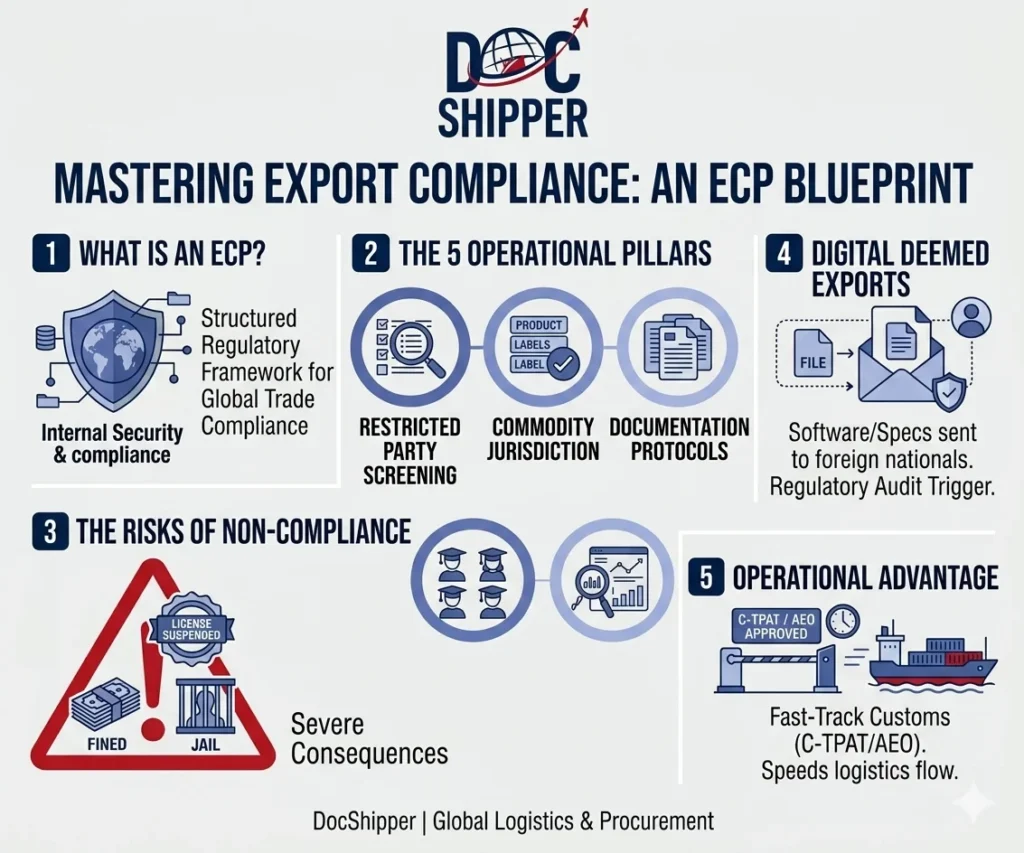
A robust Export Compliance Program rests on five pillars: management commitment, risk assessment, screening protocols, documentation, and continuous improvement. Without executive support, compliance becomes a checkbox exercise rather than a cultural priority.
The legal foundation varies by jurisdiction. In the United States, the Export Administration Regulations (EAR) and International Traffic in Arms Regulations (ITAR) govern commercial and defense articles respectively. The European Union enforces the Dual-Use Regulation (EU 2021/821), while countries like China, India, and Brazil maintain their own frameworks.
Three critical mechanisms define operational compliance:
1. Restricted Party Screening: Every transaction must verify that buyers, intermediaries, and end-users aren’t listed on sanctions lists. The U.S. maintains over 20 watchlists, including the OFAC SDN List and BIS Denied Persons List. Automated software cross-references names, addresses, and vessel identifiers in real-time.
2. Commodity Jurisdiction: Determining whether goods fall under EAR, ITAR, or are subject to multilateral regimes like the Wassenaar Arrangement requires technical expertise. Misclassification leads to incorrect licensing—a common enforcement trigger.
3. License Determination: Once classified, exporters must assess if a license exception applies or if a formal application to authorities is necessary. Factors include destination, end-use, and customer type (military vs. civilian).
At DocShipper, we integrate these checks into our logistics workflows, ensuring that documentation aligns with regulatory requirements before cargo leaves the warehouse. Our compliance specialists conduct preliminary screenings to flag potential issues early.
Legal penalties underscore the stakes. Companies like ZTE and Huawei faced multi-billion dollar fines for violations. Individual employees can receive prison sentences up to 20 years under U.S. law for willful breaches.
Implementation Cases & Compliance Metrics
Consider a mid-sized electronics manufacturer exporting sensors to automotive clients in Southeast Asia. Without an ECP, the company inadvertently shipped dual-use components to a Malaysian distributor later linked to a sanctioned Iranian entity. The result: $3.2 million in fines, a three-year license suspension, and reputational damage.
After implementing an ECP, the company established these safeguards:
| ECP Component | Implementation Method | Outcome Metric |
|---|---|---|
| Automated Screening | Integrated software checks orders against 25+ watchlists within 5 seconds | 100% pre-shipment verification |
| Classification Database | Maintained catalog of ECCNs for 1,800+ SKUs with quarterly reviews | Zero misclassification incidents in 18 months |
| Training Program | Biannual workshops for sales, logistics, and engineering teams | 92% staff certification rate |
| Audit Trail | Digital repository retaining records for 7 years (per EAR requirements) | Passed government audit with no findings |
| Red Flag Protocol | Escalation matrix for unusual requests (e.g., cash payments, vague end-use descriptions) | Blocked 14 suspicious orders in year one |
Use Case: Technology Transfer to India
A software company planned to export encryption algorithms to a Bangalore-based partner. Initial screening flagged the partner’s CEO as a former employee of an entity on the BIS Entity List. The ECP team conducted enhanced due diligence, requested clarification on project end-use, and ultimately obtained a Special Comprehensive License (SCL) after demonstrating safeguards. The process took 90 days but prevented a violation that could have cost $1.1 million.
Industry Benchmarks:
- Companies with mature ECPs report 74% fewer shipment delays due to compliance holds.
- Average cost of implementing an ECP for SMEs ranges from $50,000 to $200,000 annually.
- ROI typically appears within 18 months through avoided penalties and faster customs clearance.
- The U.S. Bureau of Industry and Security processes approximately 24,000 license applications yearly, with denial rates around 1.8%.
At DocShipper, we assist clients in building tailored ECPs that align with their product portfolios and destination markets. Our end-to-end services include classification audits, software integration, and liaison with regulatory authorities to expedite license approvals.
Conclusion
An Export Compliance Program isn’t optional—it’s a strategic necessity for any business engaged in international trade. The complexity of global regulations demands proactive systems that adapt to geopolitical shifts and evolving sanction regimes.
Need guidance on building or auditing your ECP? Contact DocShipper to discuss customized compliance solutions.
📚 Quiz
Test Your Knowledge: Export Compliance Program (ECP)
What is the primary purpose of an Export Compliance Program (ECP)?
Which statement correctly describes a key component of an effective ECP?
A software company is exporting encryption algorithms to a partner in India. The partner's CEO previously worked for an entity on the BIS Entity List. What is the appropriate compliance action?
🎯 Your Results
📞 Free Quote in 24hFAQ | Export Compliance Program (ECP): Definition, Implementation & Practical Examples
Any business exporting controlled goods, technology, or software must implement an ECP. Triggers include shipping dual-use items, operating in regulated industries (defense, aerospace, energy), or serving international markets with sanctions exposure. Even seemingly innocuous products like industrial pumps or GPS devices may require controls depending on specifications and destinations.
Restricted party lists change daily. Leading compliance software updates databases in real-time, automatically pulling changes from OFAC, BIS, EU, and UN sources. Manual processes should refresh at minimum weekly, though this introduces unacceptable risk gaps. Best practice mandates automated, instantaneous screening for every transaction.
The Export Administration Regulations (EAR) govern commercial and dual-use items, managed by the Commerce Department's Bureau of Industry and Security. ITAR controls defense articles and services under the State Department's Directorate of Defense Trade Controls. ITAR requirements are stricter, requiring registration, higher fees, and more restrictive licensing. Misclassifying an ITAR item as EAR-controlled is a serious violation.
Scalable solutions exist. SMEs can start with cloud-based screening tools ($3,000-$10,000 annually), templates for standard operating procedures, and focused training modules. While Fortune 500 companies invest millions, a basic yet effective ECP can be established for $25,000-$75,000 in year one, with lower maintenance costs thereafter. Non-compliance costs far exceed these investments.
Warning signs include customers reluctant to provide end-use information, requests to ship to freight forwarders in third countries, orders inconsistent with the buyer's business, insistence on unusual payment methods (cash, third-party transfers), and evasive responses about final destinations. An effective ECP trains staff to recognize and escalate these indicators immediately.
Under U.S. EAR, records must be kept for five years from export date, transaction date, or date of submission to BIS for license applications. ITAR mandates five years as well. EU regulations require retention for three years minimum, though longer periods apply for defense-related items. Digital archiving systems ensure compliance while enabling quick retrieval during audits.
Accountability starts at the executive level—CEOs and boards face personal liability. Day-to-day responsibility typically falls to an Export Compliance Officer (ECO) or Empowered Official, supported by cross-functional teams from legal, operations, and sales. In smaller firms, these roles may be combined. The key is clear designation, adequate resources, and direct reporting lines to senior management.
Civil penalties under U.S. law reach $330,000 per violation or twice the transaction value. Criminal penalties include fines up to $1 million per violation and imprisonment up to 20 years. Companies also face administrative sanctions: license suspensions, denial of export privileges, and mandatory compliance audits. Remediation costs and reputational damage often exceed direct fines.
Absolutely. Software, technology data, and source code are subject to export controls, particularly encryption algorithms, network penetration tools, and certain AI applications. Even sending technical specifications via email to foreign nationals constitutes an export ("deemed export"). Cloud storage locations and remote access by foreign employees require careful analysis under ECP protocols.
Comprehensive sanctions regimes prohibit virtually all transactions with designated countries or sectors. ECPs must incorporate real-time monitoring of executive orders and OFAC updates, as sanctions can expand suddenly. This includes secondary sanctions—penalties for facilitating transactions with sanctioned parties even if the exporter has no direct dealings. Supply chain due diligence extends to sub-tier vendors and logistics providers.
Yes. Customs authorities prioritize compliant shippers. Programs like U.S. Customs' Customs-Trade Partnership Against Terrorism (C-TPAT) and the EU's Authorized Economic Operator (AEO) status offer reduced inspections and faster processing. A documented ECP is often a prerequisite for these certifications, creating competitive advantages beyond pure regulatory compliance.
Freight forwarders execute logistics but don't assume compliance responsibility—that remains with the exporter of record. However, experienced partners like DocShipper provide critical support: verifying export documentation accuracy, flagging potential license requirements, and ensuring shipment routing avoids sanctioned intermediaries. Selecting a compliance-aware logistics provider reduces errors that trigger regulatory scrutiny.
Need Help with
Logistics or Sourcing ?
First, we secure the right products from the right suppliers at the right price by managing the sourcing process from start to finish. Then, we simplify your shipping experience - from pickup to final delivery - ensuring any product, anywhere, is delivered at highly competitive prices.


Fill the Form
Prefer email? Send us your inquiry, and we’ll get back to you as soon as possible.
Contact us




:%20Definition,%20Implementation%20&%20Practical%20Examples)