


In short ⚡
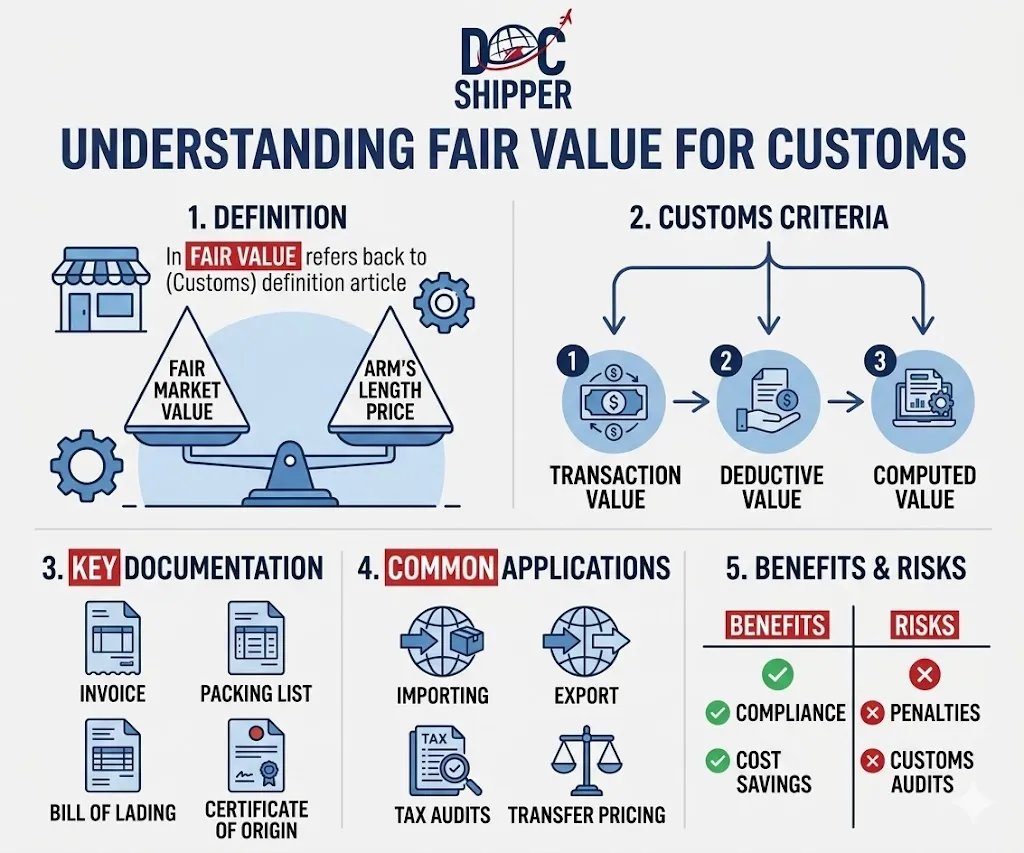
Fair Value is the estimated price at which an asset or liability would be exchanged between willing, informed parties in an arm's length transaction. In international logistics, it serves as the basis for customs valuation, determining duties and taxes on imported goods according to WTO principles.Introduction
Customs authorities worldwide face a persistent challenge: importers undervaluing goods to reduce duties. Fair value provides the transparent framework preventing such manipulation while ensuring predictable trade costs.
In import/export operations, fair value directly impacts cash flow and compliance. Incorrect valuation triggers audits, penalties, and shipment delays. Understanding its calculation mechanisms protects businesses from costly errors.
Key characteristics of fair value in logistics:
- Transaction value principle: Based on actual sale price between buyer and seller
- Arm’s length requirement: Price unaffected by special relationships or conditions
- Adjustments inclusion: Commissions, royalties, and transport costs integrated systematically
- Hierarchy of methods: Six sequential valuation methods when transaction value cannot apply
- WTO harmonization: Global standards under the Customs Valuation Agreement ensuring uniform application
In-Depth Analysis & Expert Insights
The transaction value method dominates fair value determination. It uses the price actually paid or payable for goods when sold for export. This method applies in over 90% of international shipments, provided no restrictions exist on buyer’s use of merchandise.
However, five alternative methods activate when transaction value proves inadequate. The identical goods method compares values of physically identical products previously exported. The similar goods method examines functionally equivalent merchandise when identical goods data unavailable.
When comparison methods fail, customs applies the deductive value method. This calculates value by working backward from the resale price in the importing country, subtracting margins and costs. The computed value method builds value from production costs, adding profits and expenses.
The WTO Valuation Agreement strictly prohibits arbitrary or fictitious values. Customs cannot use minimum prices or reference databases to override actual transaction prices. This protection ensures businesses pay duties reflecting genuine commercial reality.
At DocShipper, we systematically verify that declared values align with supporting invoices and that all required adjustments have been properly calculated before customs clearance. This proactive approach prevents 95% of valuation disputes before they occur.
Concrete Examples & Data
Fair value calculations directly impact duty payments. Consider an electronics importer shipping smartphones from China to the European Union, where duties average 2.5% on declared value.
| Component | Base Scenario | With Adjustments |
|---|---|---|
| Invoice price (FOB) | $50,000 | $50,000 |
| Royalty payment to brand owner | — | $3,000 |
| Freight to EU port | $2,500 | $2,500 |
| Total Customs Value | $52,500 | $55,500 |
| Duty at 2.5% | $1,312.50 | $1,387.50 |
The adjusted scenario reveals how failing to include royalties creates a $75 duty shortfall. Multiply across hundreds of shipments, and undeclared adjustments generate significant compliance exposure.
Real-world case: A textile importer faced $127,000 in retroactive duties after a customs audit discovered systematically excluded assist costs (materials provided to the manufacturer). The business had operated three years before detection, believing FOB price sufficed.
Statistical perspective from European Commission data:
- Transaction value acceptance rate: 92% of declarations use this primary method
- Average adjustment magnitude: 4-8% increase to invoice price when royalties or assists apply
- Audit trigger threshold: Declared values 15% below comparable imports raise automatic red flags
- Penalty range: Most jurisdictions impose 10-40% penalties on underpaid duties for valuation errors
- Documentation retention requirement: Minimum 5-year record keeping for valuation justification across most territories
Conclusion
Fair value transcends theoretical accounting concepts—it functions as the financial foundation of every international shipment. Mastering its calculation mechanics prevents costly disputes while ensuring duty predictability.
Need assistance ensuring your customs valuations withstand regulatory scrutiny? Contact DocShipper for expert guidance on valuation compliance.
📚 Quiz
Test Your Knowledge: Fair Value
What is the primary basis for determining fair value in customs valuation?
A company imports electronics and pays a $3,000 royalty to the brand owner separately from the $50,000 invoice. How should this royalty be treated for fair value calculation?
When can customs authorities reject a declared fair value and apply alternative valuation methods?
🎯 Your Result
📞 Free Quote in 24hFAQ | Fair Value: Definition, Calculation & Concrete Examples
Fair value represents the transaction price between specific willing parties in an arm's length exchange. Market value reflects the prevailing price in an open, competitive marketplace. For customs purposes, fair value focuses on the actual sale terms rather than hypothetical market conditions. Market value may exceed or fall below fair value depending on supply-demand dynamics, while fair value remains tied to documented transaction evidence.
Yes, if evidence suggests non-arm's length conditions or missing adjustments. Customs may challenge valuations when prices significantly deviate from comparable shipments or when buyer-seller relationships exist without proper documentation. In such cases, authorities apply alternative valuation methods sequentially. Maintaining comprehensive transaction records and transparent pricing structures minimizes rejection risk. Professional customs brokers can pre-validate declarations before submission.
Mandatory additions include royalties and license fees, subsequent proceeds from resale accruing to the seller, assists (materials or tools provided free to the manufacturer), and transportation costs to the port of importation. Packing costs, loading charges, and insurance also require inclusion. Post-importation costs like installation or domestic transport remain excluded. Precise allocation depends on Incoterms used in the sale contract.
When buyer and seller are related entities, customs scrutinizes whether the relationship influenced the price. Importers must demonstrate that declared values closely approximate sales to unrelated buyers or that prices reflect manufacturing costs plus normal profits. Transfer pricing documentation supporting arm's length principles strengthens fair value claims. Many jurisdictions require advance pricing agreements for high-volume related-party imports.
Essential documents include commercial invoices, purchase orders, payment records, and contracts detailing all sale conditions. Supplementary evidence encompasses royalty agreements, assist valuations, freight invoices, and packing lists. For related-party transactions, transfer pricing studies and comparable sales data become critical. Digital records must remain accessible for 5-7 years depending on jurisdiction. Incomplete documentation triggers valuation disputes and potential penalties.
While the WTO Valuation Agreement harmonizes principles globally, implementation nuances exist. The EU applies strict enforcement of assist valuation, while some developing nations maintain minimum import prices despite WTO prohibitions. U.S. Customs uses the transaction value method but allows reasonable allocation methods for unavoidable ambiguities. Understanding territorial variations prevents compliance failures when expanding into new markets.
Yes, but only genuine commercial discounts qualify. Quantity discounts, early payment reductions, and defective goods allowances reduce fair value if documented in the original sale agreement. Retroactive discounts applied after importation do not affect customs value already declared. Post-clearance adjustments require formal amendment procedures. Fictitious discounts created solely for duty reduction constitute fraud and invite severe penalties.
Undervaluation triggers duty recovery plus interest and penalties ranging from 10-40% of shortfall amounts. Repeat violations escalate to criminal charges in extreme cases. Overvaluation creates no legal penalty but results in unnecessary duty payments that most jurisdictions do not refund automatically. Voluntary disclosure programs allow self-correction with reduced penalties. Maintaining accurate valuation processes protects against both scenarios.
Fair value converts to the importing country's currency using the exchange rate on the date of export, not the date of payment or customs declaration. Most customs authorities publish daily reference rates for conversion purposes. Significant currency volatility between invoice date and clearance can create apparent valuation discrepancies. Hedging strategies and clear documentation of invoice dates mitigate exchange rate-related valuation challenges.
Bona fide commercial samples of negligible value may receive duty exemptions, but they still require fair value declarations. Samples intended for resale after testing lose duty-free status and must be valued like commercial goods. The distinction depends on quantity, marking as samples, and actual commercial intent. Misclassifying commercial shipments as samples constitutes customs fraud. Proper documentation of sample purpose and disposal prevents valuation disputes.
Used goods receive fair value treatment based on their condition and actual transaction price at the time of import. Depreciation factors into the sale price but does not automatically reduce customs value below the agreed purchase amount. When no sale occurs (personal effects, relocated equipment), customs applies alternative methods considering age, condition, and comparable market data. Professional appraisals strengthen used goods valuations in high-value scenarios.
Post-clearance adjustments occur when additional information surfaces or errors are discovered. Price adjustments in ongoing supply agreements, retroactive royalty calculations, or newly identified assists trigger value modifications. Importers must file supplementary declarations within prescribed timeframes, typically 90 days to 12 months depending on jurisdiction. Failure to report increases constitutes duty evasion, while unreported decreases result in overpaid duties that may be refundable.
Need Help with
Logistics or Sourcing ?
First, we secure the right products from the right suppliers at the right price by managing the sourcing process from start to finish. Then, we simplify your shipping experience - from pickup to final delivery - ensuring any product, anywhere, is delivered at highly competitive prices.


Fill the Form
Prefer email? Send us your inquiry, and we’ll get back to you as soon as possible.
Contact us




