


In short ⚡
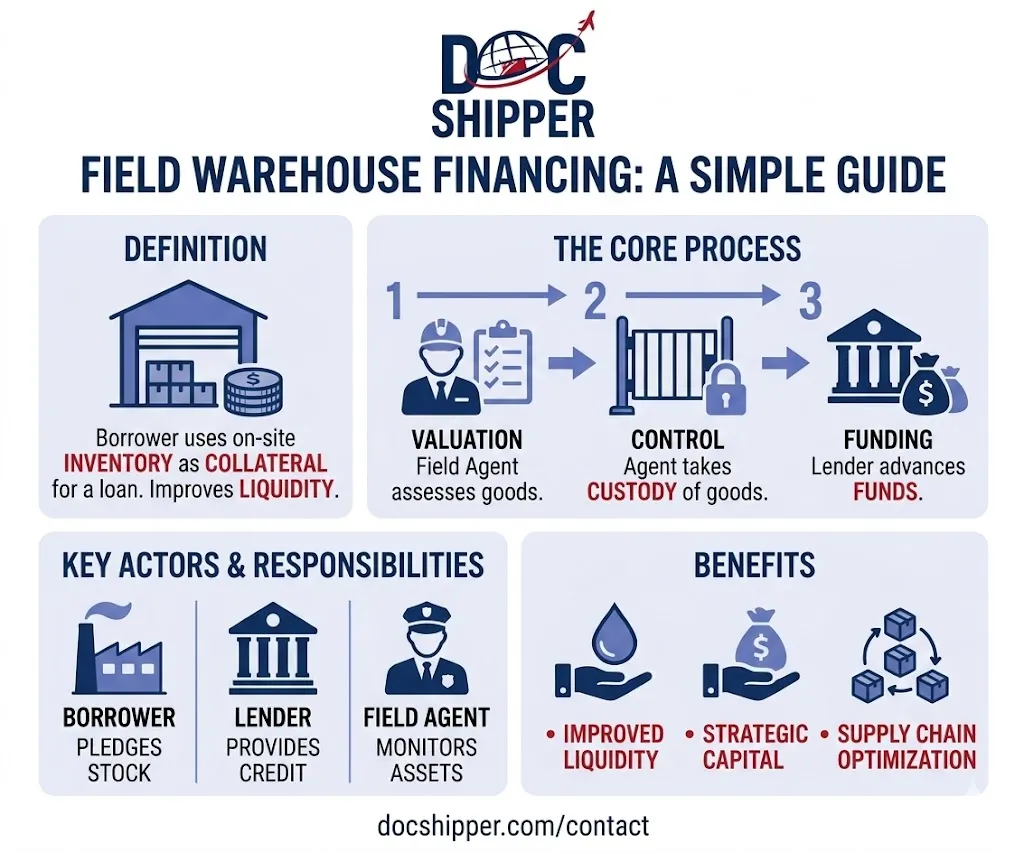
A field warehouse is a specialized storage facility established on or near a borrower's premises to secure inventory as collateral for financing. It operates under the control of an independent third-party warehouseman who issues warehouse receipts, enabling businesses to access working capital while maintaining possession of their goods.
Introduction
How can manufacturers and importers access immediate financing without physically moving their inventory? This challenge affects countless businesses struggling to balance cash flow with operational needs. The field warehouse solution provides a strategic answer.
In international trade and logistics, field warehousing creates a legally distinct storage area where goods become collateral for loans while remaining accessible for business operations. This financing mechanism bridges the gap between inventory investment and revenue realization.
Key characteristics include:
- Physical segregation: Inventory is clearly separated and marked within the borrower’s facility
- Third-party control: An independent warehouseman manages access and documentation
- Warehouse receipts: Negotiable documents proving ownership and securing lender interests
- On-site location: Goods remain at or near the borrower’s premises for operational efficiency
- Collateralized lending: Banks advance funds against the secured inventory value
Understanding Field Warehouse Operations & Legal Framework
The field warehouse arrangement creates a legal bailment where the borrower transfers custody—but not ownership—of inventory to a warehouse company. This custodian operates under strict legal authority to control access and release goods only upon lender approval or loan repayment.
The establishment process involves physical demarcation through fencing, signage, or locked areas that clearly separate field warehouse inventory from other goods. The warehouse operator maintains exclusive control over these designated spaces, often operating 24/7 during business operations.
From a legal perspective, field warehousing falls under the Uniform Commercial Code (UCC) Article 7 in the United States, which governs warehouse receipts and bills of lading. According to Cornell Law School’s Legal Information Institute, these documents create negotiable instruments that perfect the lender’s security interest.
The warehouse receipt mechanism serves as both proof of storage and a financial instrument. When issued, it represents the goods in storage and can be transferred to secure financing. Lenders hold these receipts as collateral, releasing them only when borrowers meet payment obligations or replacement conditions.
Inventory monitoring protocols require regular audits and reporting. The warehouse operator conducts periodic physical counts, quality inspections, and valuation assessments to ensure collateral maintains sufficient value relative to outstanding loans. At DocShipper, we coordinate with field warehouse operators to ensure seamless integration between your storage financing needs and international shipping schedules.
The release procedures typically involve the borrower requesting goods for sale or use, with the warehouseman verifying lender approval and issuing release orders. This controlled process protects lender interests while allowing business continuity. Payment arrangements may include per-unit releases, percentage-based payments, or full loan satisfaction requirements.
Practical Applications & Industry Data
Field warehousing proves particularly valuable in commodity-intensive industries where inventory represents significant capital investment. Agricultural processors, manufacturers, and importers commonly utilize this financing structure to manage seasonal fluctuations and extended production cycles.
Industry Usage Comparison
| Industry Sector | Typical Loan-to-Value | Average Duration | Primary Benefit |
|---|---|---|---|
| Agricultural Products | 60-75% | 6-9 months | Seasonal cash flow management |
| Manufacturing/Electronics | 50-70% | 3-6 months | Production cycle financing |
| Imported Goods | 65-80% | 4-8 months | Bridge financing until distribution |
| Wine & Spirits | 70-85% | 12-36 months | Aging period financing |
| Metals & Commodities | 75-90% | 2-4 months | High liquidity collateral |
Practical Use Case: Electronics Importer
A mid-sized electronics distributor imports $2 million worth of consumer products quarterly from Asian manufacturers. Traditional term financing required moving goods to public warehouses, adding transportation costs and delaying market access.
Field warehouse solution: The company established a field warehouse within their existing distribution center. The arrangement provided 70% advance ($1.4 million) against inventory value, with goods released proportionally as sales occurred.
Financial impact: The company saved approximately $45,000 annually in transportation and public warehouse fees while reducing inventory-to-sale cycle time by 5-7 days. Interest rates were competitive at prime plus 2-3%, significantly lower than unsecured credit lines.
Key Operational Advantages
- Immediate access: Goods remain on-site for faster order fulfillment and reduced logistics costs
- Lower financing costs: Secured lending typically offers 2-4% lower rates than unsecured alternatives
- Scalable solution: Financing adjusts automatically with inventory levels and seasonal demands
- Preserved relationships: Businesses can pay suppliers promptly while managing their own cash cycles
- Flexibility: Arrangements accommodate rotating inventory and partial releases based on sales patterns
Conclusion
Field warehousing transforms inventory from an immobile asset into active working capital, enabling businesses to optimize cash flow without sacrificing operational efficiency. This financing structure proves essential for companies managing significant inventory investments across international supply chains.
Need expert guidance on integrating field warehouse financing with your international logistics strategy? Contact DocShipper for customized solutions that align your financing, warehousing, and shipping operations.
📚 Quiz
Test Your Knowledge: Field Warehouse
What is the primary purpose of establishing a field warehouse?
Who controls access to inventory stored in a field warehouse?
An electronics importer has $1.8 million in inventory and needs immediate working capital. Which scenario correctly applies field warehouse financing?
🎯 Your Result
📞 Free Custom QuoteFAQ | Field Warehouse: Definition, Operations & Practical Examples
A field warehouse is established on or adjacent to the borrower's premises specifically for collateral control, while a public warehouse is an independent facility offering storage to multiple clients. Field warehouses provide on-site convenience and faster access, whereas public warehouses offer established infrastructure and may be more cost-effective for smaller inventory volumes. The legal structure and warehouse receipt mechanisms remain similar, but field warehouses integrate directly into the borrower's operational workflow.
Field warehouse financing involves multiple cost components: interest rates typically range from prime plus 1.5-4% depending on collateral quality and borrower creditworthiness. Warehouse operator fees average $0.15-0.50 per unit or 0.5-2% of inventory value monthly. Setup costs for physical segregation and legal documentation range from $5,000-25,000. Despite these expenses, businesses often find field warehousing more economical than unsecured credit lines or factoring arrangements when inventory values exceed $500,000.
Yes, field warehouses can handle perishable inventory with appropriate climate control and monitoring systems. Agricultural products, food items, and pharmaceuticals commonly use field warehouse arrangements. The warehouse operator implements first-in-first-out (FIFO) protocols and quality inspections to protect both borrower and lender interests. Release procedures accommodate time-sensitive distribution schedules, with some arrangements allowing pre-authorized releases for products approaching expiration dates. Insurance requirements typically increase for perishable goods.
Economic viability generally begins around $500,000 in inventory value due to setup costs and ongoing operator fees. Below this threshold, public warehouse arrangements or traditional asset-based lending may prove more cost-effective. However, businesses with consistent inventory levels above $1 million find field warehousing increasingly advantageous. The break-even point depends on factors including inventory turnover rates, financing duration, alternative financing costs, and the value of on-site access to goods.
Field warehouse arrangements require subordination agreements from existing lienholders or clear priority establishment through UCC filings. The warehouse receipt creates a possessory security interest that typically takes priority over previously filed blanket liens on inventory. Lenders conduct thorough due diligence on existing security interests before financing. Businesses must disclose all liens, and field warehouse lenders may require intercreditor agreements defining each party's rights and priorities in the collateral.
Upon default, the lender holding warehouse receipts gains legal authority to liquidate the collateral. The warehouse operator continues securing the goods while the lender arranges disposition through auction, private sale, or transfer to another buyer. Proceeds first satisfy outstanding loan balances, accrued interest, and liquidation costs, with any surplus returning to the borrower. The controlled environment of field warehousing typically results in higher recovery rates compared to uncontrolled inventory seizures, often reaching 70-90% of advance values.
Absolutely. Field warehouses commonly store commingled inventory from various international suppliers and countries of origin. The warehouse operator maintains detailed records tracking each shipment's origin, value, and release status. This capability proves particularly valuable for importers consolidating goods from multiple Asian, European, or Latin American manufacturers. Customs documentation and country-of-origin certificates are maintained as part of the warehouse records, ensuring compliance for subsequent distribution or export.
Typical establishment timeframes range from 2-6 weeks depending on facility complexity and lender due diligence requirements. Expedited arrangements can be completed in 7-10 days when the borrower has adequate existing infrastructure and clear inventory documentation. The process includes site inspection, legal documentation, physical segregation, inventory appraisal, and warehouse operator deployment. Businesses should initiate field warehouse discussions 45-60 days before anticipated financing needs to ensure smooth implementation.
Warehouse operators maintain comprehensive records including detailed inventory listings with product descriptions, quantities, and valuations; warehouse receipts issued to lenders; release orders authorized by lenders; periodic inspection reports and quality assessments; insurance certificates covering stored goods; and transaction logs tracking all movements in and out of the field warehouse. These documents create a complete audit trail satisfying both lender security requirements and potential regulatory inquiries. Digital systems increasingly replace paper records for real-time access and accuracy.
Most industries can utilize field warehousing, though lenders prefer tangible, non-perishable goods with established market values. Commodities, manufactured products, durable goods, and imported merchandise receive favorable consideration. Challenges arise with custom-manufactured items lacking secondary markets, highly perishable goods without immediate turnover, hazardous materials requiring special licensing, or inventory subject to rapid obsolescence. Financial services regulations may restrict field warehousing for certain controlled substances or regulated industries without additional compliance measures.
Field warehouse financing can include work-in-progress (WIP) inventory, though loan-to-value ratios typically decrease to 40-60% compared to 60-80% for finished goods. Lenders assess WIP based on market value in current condition rather than anticipated finished value. Manufacturers with consistent production cycles and predictable completion stages find WIP financing valuable for maintaining cash flow during extended manufacturing periods. The warehouse operator may conduct staged inspections as products move through production, adjusting collateral values and available financing accordingly.
Field warehouse arrangements accommodate just-in-time (JIT) systems through pre-authorized release protocols and electronic documentation. Manufacturers establish release parameters allowing the warehouse operator to release specified quantities based on production schedules without individual lender approvals. Digital integration enables real-time inventory tracking and automatic financing adjustments as goods move from field warehouse to production. This flexibility maintains JIT efficiency while preserving the security structure lenders require, though advance rates may decrease slightly to account for faster inventory turnover and associated risks.
Need Help with
Logistics or Sourcing ?
First, we secure the right products from the right suppliers at the right price by managing the sourcing process from start to finish. Then, we simplify your shipping experience - from pickup to final delivery - ensuring any product, anywhere, is delivered at highly competitive prices.


Fill the Form
Prefer email? Send us your inquiry, and we’ll get back to you as soon as possible.
Contact us




