


In short ⚡
Flexible Specialization is a production strategy combining customization capabilities with economies of scope, enabling manufacturers to efficiently produce varied product lines using adaptable machinery and skilled labor. This approach emerged as an alternative to mass production, allowing businesses to respond rapidly to changing market demands while maintaining competitive costs.
Introduction
Global supply chains face a persistent challenge: how to balance production efficiency with product diversity. Traditional mass production offers low unit costs but lacks adaptability. Custom manufacturing provides personalization but at prohibitive expenses.
Flexible Specialization resolves this dilemma by enabling manufacturers to produce differentiated goods economically. This strategy became critical as consumer preferences shifted toward personalized products and shorter product lifecycles.
In international logistics, this production model directly impacts:
- Inventory management – reduced stock requirements through on-demand production
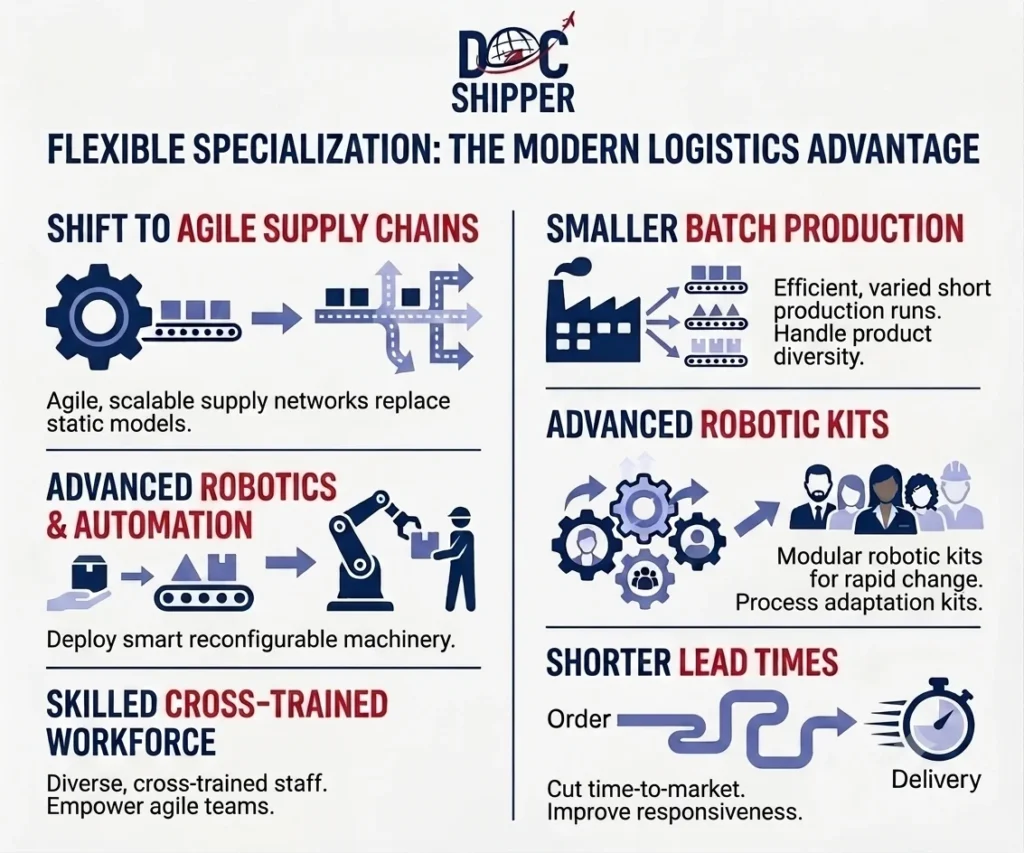
- Lead times – faster response to market fluctuations and customer orders
- Supply chain complexity – coordination between specialized suppliers and distributors
- Customs procedures – handling diverse product classifications and valuations
- Warehousing strategies – smaller batch sizes requiring optimized storage solutions
Mechanisms & Strategic Expertise
Flexible Specialization operates through modular production systems where machinery can be reconfigured rapidly. Unlike fixed assembly lines, these systems utilize programmable equipment and multi-skilled workers capable of switching between product variants.
The strategy relies on economies of scope rather than economies of scale. Manufacturers share resources across multiple product lines, reducing per-unit costs through efficient resource utilization rather than volume production. This approach requires significant upfront investment in adaptable technology and workforce training.
Network collaboration forms another cornerstone. Companies establish partnerships with specialized suppliers, creating industrial districts or clusters. These networks facilitate knowledge sharing and component standardization while maintaining product differentiation. The OECD reports that such collaborative structures enhance innovation capacity by 35-40% compared to isolated production.
From a logistics perspective, just-in-time procurement becomes essential. Flexible manufacturers maintain minimal inventories, relying on reliable supplier networks to deliver components precisely when needed. This reduces warehousing costs but demands sophisticated supply chain visibility and risk management.
At DocShipper, we frequently assist companies transitioning to flexible production models by coordinating their international supplier networks and optimizing their cross-border logistics flows. Our expertise ensures that material availability aligns with production schedules across multiple countries.
The regulatory dimension involves product certification complexity. Manufacturing diverse product lines may require multiple compliance certificates, origin certifications, and quality standards. Each product variant potentially faces different import regulations, tariff classifications, and documentation requirements across destination markets.
Implementation Models & Market Data
Three dominant implementation models characterize Flexible Specialization across industries:
| Model Type | Characteristics | Typical Industries | Batch Size Range |
|---|---|---|---|
| Craft-Based | High skilled labor, traditional techniques, limited automation | Luxury goods, artisanal products | 1-100 units |
| Technology-Intensive | Advanced machinery, CAD/CAM integration, robotics | Electronics, automotive components | 100-5,000 units |
| Hybrid Network | Outsourced specialized tasks, coordinated production | Fashion, furniture, industrial equipment | 500-10,000 units |
Use Case: Italian Textile District
The Prato textile district in Italy exemplifies flexible specialization success. Comprising 15,000 small firms, this network produces customized fabrics for global fashion brands. Individual companies specialize in specific processes (weaving, dyeing, finishing) while collaborating on orders.
Production data reveals their competitive advantage:
- Lead time – 3-4 weeks from design to delivery versus 8-12 weeks for mass producers
- Minimum order quantity – 200 meters compared to 5,000+ meters from volume manufacturers
- Product variations – average firm offers 80-120 fabric variants annually
- Export share – 65% of production reaches international markets, requiring sophisticated customs brokerage
For importers working with such suppliers, logistics becomes complex. Each shipment may contain multiple product codes and origin certificates. DocShipper manages these multi-SKU shipments by consolidating documentation and coordinating with specialized freight forwarders familiar with textile regulations.
Market research indicates that flexible specialization adoption accelerated post-2020. A manufacturing survey showed 43% of mid-sized manufacturers implemented some form of flexible production between 2020-2023, driven by supply chain disruptions and demand volatility. These companies reported inventory reductions of 25-30% while maintaining service levels.
Key performance indicators for flexible production systems include:
- Changeover time – duration to switch between product variants (target: under 30 minutes)
- Product mix flexibility – number of different products manufacturable without major retooling
- Delivery reliability – percentage of orders fulfilled within promised timeframe (benchmark: 95%+)
- Customization rate – proportion of orders requiring specification modifications
- Supplier network density – number of qualified specialized suppliers per component category
Conclusion
Flexible Specialization represents a strategic approach to manufacturing that prioritizes adaptability and product variety over pure volume efficiency. Its implementation demands integrated logistics planning, reliable supplier networks, and sophisticated customs management.
Need assistance coordinating flexible production supply chains across borders? Contact DocShipper for expert guidance on managing complex international logistics flows.
📚 Quiz
Test Your Knowledge: Flexible Specialization
Flexible Specialization is primarily defined as a production strategy that:
A key distinction of Flexible Specialization is that it relies on:
The Italian Prato textile district example demonstrates that flexible manufacturers typically offer minimum order quantities of:
🎯 Your Result
📞 Free Quote in 24hFAQ | Flexible Specialization: Definition, Implementation & Concrete Examples
Flexible specialization emphasizes small-batch production through skilled labor and adaptable machinery across entire product categories. Mass customization configures standardized components into personalized products within predefined options. Flexible specialization allows greater design freedom but typically involves higher per-unit costs than mass customization's modular approach.
Products from flexible manufacturing may fall under different HS codes depending on specifications, materials, and intended use. Each variant potentially faces different duty rates. Importers must classify each SKU accurately, sometimes requiring binding rulings from customs authorities. This complexity increases compliance costs and clearance timeframes compared to standardized mass-produced goods.
MOQs vary significantly by industry and model type. Craft-based producers may accept orders as small as 10-50 units. Technology-intensive flexible manufacturers typically require 200-1,000 units. Hybrid networks often set MOQs between 500-2,000 units. These thresholds remain substantially lower than mass production facilities requiring 10,000+ unit orders to achieve cost efficiency.
Fashion and apparel, luxury goods, specialized industrial equipment, custom electronics, furniture, and automotive aftermarket parts demonstrate highest adoption rates. These sectors share characteristics of rapidly changing consumer preferences, high product differentiation, and customers willing to pay premiums for customization. Commodity products with stable demand patterns show limited applicability.
Production lead times often decrease by 40-60% due to smaller batches and reduced queue times. However, total delivery time may increase if suppliers are geographically dispersed or if customization requires additional design iterations. The variability in specifications also complicates logistics planning, potentially creating scheduling challenges that offset production time savings.
Frequent product changes increase defect risks during transition periods. Standardized mass production benefits from process refinement over millions of identical units. Flexible manufacturers must implement robust quality systems capable of validating diverse specifications. Inspection protocols become more complex, requiring skilled personnel and sometimes specialized testing equipment for each product variant.
Yes, both approaches share waste reduction objectives. Flexible specialization applies lean concepts through quick changeovers, minimal inventories, and continuous improvement. The key difference lies in product variety emphasis versus standardization. Successful integration requires balancing setup time minimization with variety accommodation, often through modular design and standardized processes supporting diverse outputs.
Computer-aided design and manufacturing systems allow rapid product reconfiguration. Programmable machinery reduces changeover times from hours to minutes. Enterprise resource planning software coordinates complex production schedules across supplier networks. Additive manufacturing technologies enable economical small-batch production previously impossible. However, successful implementation still requires skilled human oversight and decision-making.
Preferential trade agreements facilitate flexible production networks by reducing tariffs on intermediate goods crossing borders multiple times during manufacturing. Rules of origin compliance becomes critical, as frequent design changes may alter material compositions affecting originating status. Free trade zones offer advantages for assembling components from multiple suppliers before final export.
Vendor-managed inventory arrangements with key suppliers reduce material holding costs. Consignment stock positioned near production facilities enables rapid response without ownership. Postponement strategies delay final customization until customer orders confirm specifications. Safety stock focuses on versatile components usable across product variants rather than finished goods. These approaches require transparent information sharing throughout supply chains.
This model demands multi-skilled workers capable of operating diverse equipment and adapting to specification changes. Training investments typically exceed those for specialized assembly line workers. However, employee satisfaction often increases due to varied tasks and skill development opportunities. Compensation structures frequently include skill-based pay components rewarding versatility and problem-solving capabilities.
Each shipment may require multiple commercial invoices covering different product categories, varied certificates of origin, and diverse compliance documentation. Packing lists become more detailed to specify individual SKU characteristics. Customs brokers must validate classifications for each variant. This administrative burden increases clearance costs and requires meticulous record-keeping to prevent delays or penalties.
Need Help with
Logistics or Sourcing ?
First, we secure the right products from the right suppliers at the right price by managing the sourcing process from start to finish. Then, we simplify your shipping experience - from pickup to final delivery - ensuring any product, anywhere, is delivered at highly competitive prices.


Fill the Form
Prefer email? Send us your inquiry, and we’ll get back to you as soon as possible.
Contact us




