


In short ⚡
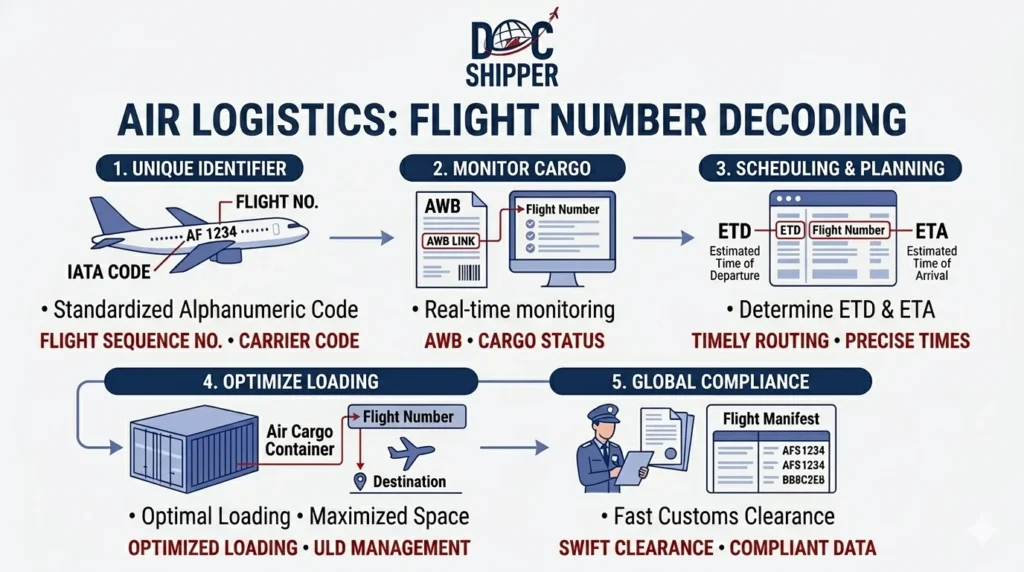
A flight number is a unique alphanumeric code assigned by airlines to identify specific scheduled flights between departure and arrival airports. Typically composed of a two-character airline code followed by 1-4 digits, it serves as the primary tracking identifier for cargo shipments, passenger bookings, and aviation logistics operations worldwide.
Introduction
In international logistics, confusion between flight numbers, tail numbers, and booking references causes daily operational delays. Freight forwarders searching for cargo often use incorrect identifiers, leading to missed connections and delivery failures.
The flight number stands as the universal language of air transport, enabling coordination between shippers, customs authorities, and ground handlers across time zones. Unlike aircraft registration numbers that identify physical planes, flight numbers represent scheduled commercial services appearing in global distribution systems.
Understanding this distinction matters critically for:
- Shipment tracking – Locating cargo in real-time across connecting flights
- Documentation accuracy – Completing air waybills and customs declarations properly
- Schedule coordination – Synchronizing warehouse operations with aircraft arrivals
- Regulatory compliance – Meeting advance notification requirements for controlled goods
- Cost optimization – Selecting direct versus multi-leg routing based on service frequencies
Structure & Aviation System Integration
The IATA flight designator system standardizes identification across 300+ airlines operating 100,000+ daily flights. The format follows strict conventions established by the International Air Transport Association, ensuring global interoperability.
Every flight number combines two mandatory components. The airline prefix uses either a two-letter IATA code (LH for Lufthansa) or three-letter ICAO code (DLH) depending on the documentation context. The numeric suffix ranges from 1 to 9999, with specific ranges often designated for geographic regions or service types.
Airlines assign numbers strategically rather than randomly. Eastbound and northbound flights traditionally receive even numbers, while westbound and southbound routes use odd numbers. Low numbers (1-999) typically indicate flagship routes or long-haul services, whereas regional shuttles occupy higher ranges (3000-7999).
Codeshare agreements complicate this system by allowing multiple airlines to market identical flights. A single aircraft might simultaneously operate as AF378 (Air France) and DL8508 (Delta), with both numbers valid for booking and tracking purposes. Freight forwarders must verify the operating carrier versus marketing carrier when coordinating pickups.
The system integrates with critical aviation databases including SITA’s flight information services and IATA’s Cargo-XML messaging standards. According to IATA documentation standards, air waybills must reference the operating flight number to ensure proper cargo handling at transit hubs.
At DocShipper, we cross-reference flight numbers against real-time tracking APIs to proactively notify clients of schedule disruptions, enabling contingency arrangements before cargo reaches bottlenecks.
Tracking Applications & Case Studies
Operational scenarios demonstrate why precise flight number usage prevents costly logistics errors. The following comparison illustrates typical routing decisions importers face when shipping electronics from Shenzhen to Rotterdam.
| Route Component | Direct Flight | Two-Leg Connection |
|---|---|---|
| Flight Numbers | CZ347 (single segment) | CZ381 + KL891 |
| Total Transit Time | 13h 20m | 18h 45m (4h layover) |
| Customs Clearance | Destination only | Possible inspection at Dubai |
| Lost Cargo Risk | 0.3% industry average | 1.8% at transfer points |
| Rate per kg | $4.80 | $3.20 (33% cheaper) |
A pharmaceutical importer shipping temperature-sensitive vaccines recently learned this distinction critically. Their booking referenced flight number EK303, but the actual operating flight was QF8303 (codeshare). When the Dubai handler searched only for Emirates cargo, the shipment missed its connection, remaining unrefrigerated for 11 hours beyond protocol limits.
Real-world tracking demonstrates the system’s precision. Entering “LH8386” into air cargo tracking platforms immediately reveals:
- Route – Frankfurt (FRA) to Chicago O’Hare (ORD)
- Equipment – Boeing 747-8F freighter aircraft
- Departure window – Daily service at 18:40 CET
- Cargo capacity – 112 tons available payload
- Current status – Actual departure/arrival times versus schedule
According to IATA’s 2024 cargo tracking standards, 89% of shipment visibility failures trace to incorrect flight number documentation in master air waybills. Shippers who verify operating carrier details before warehouse cutoff times reduce misrouting incidents by 73%.
DocShipper’s tracking dashboard consolidates flight status from 450+ airlines into unified notifications, automatically alerting clients when weather delays or mechanical issues affect their specific cargo flight rather than generic route advisories.
Conclusion
Mastering flight number conventions transforms air freight from reactive tracking to proactive logistics management. The difference between operating and marketing carriers directly impacts customs timing, insurance claims, and delivery reliability.
Need expert guidance on optimizing your air freight routing? Contact our logistics specialists for personalized shipment strategies.
📚 Quiz
Test Your Knowledge: Flight Number
What is the primary purpose of a flight number in air cargo logistics?
A pharmaceutical shipment is booked on EK303, but the operating carrier is actually QF8303. What common misconception does this scenario highlight?
When tracking time-sensitive cargo from Shenzhen to Rotterdam, which identifier should you use in the air waybill system?
🎯 Your Result
📞 Free Quote in 24hFAQ | Flight Number: Definition, Structure & Practical Examples
A flight number identifies a scheduled commercial service (e.g., BA107 London to Dubai daily), whereas a tail number is the unique registration code painted on an aircraft's fuselage (e.g., G-VIID). The same physical plane with tail number N12345 might operate different flight numbers throughout the day. Cargo tracking requires the flight number, not the aircraft registration.
Check your Master Air Waybill (MAWB) in the "Flight/Date" field, which lists the initial departure flight. For multi-leg shipments, subsequent flight numbers appear in the routing boxes. Your freight forwarder's booking confirmation also contains this information. Most carriers provide tracking via their website using either the AWB number or flight number combination.
No, each flight number designates one specific origin-destination pair per day. However, airlines reuse numbers for return legs (e.g., UA950 flies San Francisco to Shanghai, while UA951 operates the reverse). Some carriers rotate flight numbers seasonally when adjusting schedules, but the same number never simultaneously serves different city pairs on the same date.
Airline partnerships allow multiple carriers to sell seats or cargo space on a single aircraft. The operating carrier assigns the primary flight number, while partner airlines add their own marketing codes. A shipment on AF3452 (Air France) might physically travel on a Delta plane operating as DL265. Both numbers are valid for booking, but cargo handling follows the operating carrier's procedures.
IATA coordinates flight number allocation to prevent duplicates within the same airline. Carriers internally decide numbering schemes, often reserving low digits (1-99) for premium routes and high numbers (5000+) for regional services. Once assigned, the number remains consistent for that route unless schedule changes occur. Regulatory bodies like the FAA and EASA do not control numbering but require carriers to publish schedules accurately.
Airlines typically rebook cargo on the next available service to the same destination, assigning a new flight number. Your air waybill remains valid, but the "Flight/Date" field gets amended. Delays often trigger storage fees at the origin airport. Temperature-controlled or time-sensitive shipments may require expedited rebooking at additional cost. Most carriers notify freight forwarders automatically through EDI messaging systems.
Yes, but they differ from scheduled services. Charter operators use special designators, often starting with higher digits (e.g., 8000-9999 range). These flights don't appear in public schedules and require direct coordination with the charter company. For customs documentation, charter flight numbers must still comply with IATA formatting standards to ensure proper cargo manifesting.
Scheduled flight numbers are published 11-12 months in advance in airline timetables. However, actual aircraft assignment occurs 72 hours before departure. Cargo booking systems allow reservations once the schedule publishes, but specific weight allocations and loading confirmations happen 24-48 hours pre-flight based on passenger loads and other cargo commitments.
Yes, through multiple sources. Airlines offer proprietary tracking on their cargo portals, while third-party platforms like FlightAware and FlightRadar24 show live positions. Air waybill tracking integrates flight status with customs clearance updates. Real-time data typically includes departure/arrival times, current altitude and location, and gate information. GPS-enabled shipments provide additional granular tracking beyond basic flight information.
Letter suffixes (e.g., AA1234C) usually indicate service variations: 'C' for cargo-only flights, 'F' for freight-dedicated services, or 'X' for special charters. Some airlines use suffixes to distinguish between weekday and weekend schedules on the same route. In booking systems, these letters are critical—entering AA1234 instead of AA1234C might pull up a passenger flight with limited cargo capacity.
Not within the same day. A specific flight number operates once per 24-hour period for that route. Airlines do reuse numbers daily for regular schedules (e.g., LH400 Frankfurt-JFK departs every afternoon). However, if a flight is severely delayed into the next calendar day, the airline may reassign a new flight number to avoid confusion in tracking systems and manifest records.
The first two characters reveal the marketing carrier's IATA code, but not necessarily who operates the aircraft. Check the air waybill's "Carrier" field or search the flight number on airline websites—most display "Operated by [Partner Airline]" for codeshares. Aviation databases like OAG or Cirium provide detailed operating carrier information. This distinction matters for liability claims and baggage handling procedures.
Need Help with
Logistics or Sourcing ?
First, we secure the right products from the right suppliers at the right price by managing the sourcing process from start to finish. Then, we simplify your shipping experience - from pickup to final delivery - ensuring any product, anywhere, is delivered at highly competitive prices.


Fill the Form
Prefer email? Send us your inquiry, and we’ll get back to you as soon as possible.
Contact us




