


In short ⚡
FOB (Free on Board) is an international trade term (Incoterm) where the seller's responsibility ends once goods are loaded onto the shipping vessel at the port of origin. From this point, the buyer assumes all costs, risks, and responsibilities for transportation, including freight, insurance, and customs clearance at destination.Introduction
Confusion about FOB terms costs importers thousands in unexpected charges annually. Many businesses mistakenly believe FOB covers ocean freight or destination duties, leading to budget overruns and shipment delays. Understanding exactly where seller responsibility ends is crucial for accurate cost forecasting.
FOB represents a critical transfer point in international logistics where ownership, risk, and cost obligations shift from seller to buyer. This Incoterm has been standardized by the International Chamber of Commerce since 1936 and remains one of the most widely used shipping terms globally.
Key characteristics of FOB terms include:
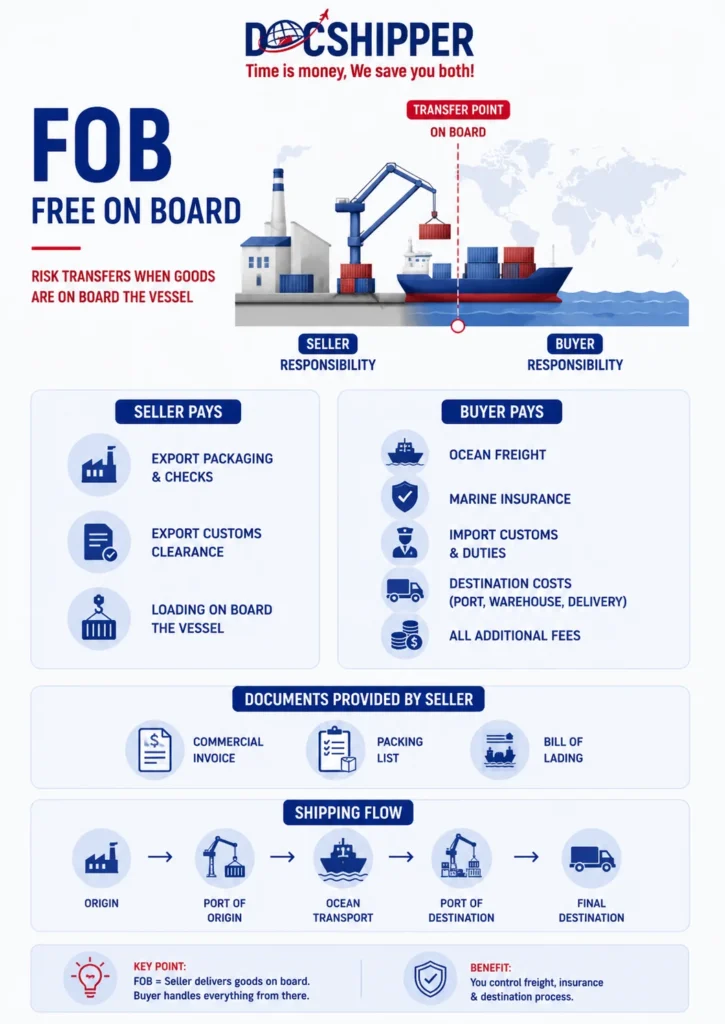
- Transfer point: Risk and cost shift when goods cross the ship’s rail at the named port of shipment
- Seller obligations: Export packaging, export clearance, and loading onto vessel at origin port
- Buyer obligations: Ocean freight, marine insurance, import customs, and all destination costs
- Documentation: Seller provides commercial invoice, packing list, and bill of lading
- Vessel type: Only applicable to sea and inland waterway transport
FOB Mechanics & Expert Insights
The FOB term must always specify the named port of shipment (e.g., “FOB Shanghai” or “FOB Long Beach”). This designation determines exactly where the seller’s delivery obligation ends and the buyer’s responsibility begins. Under the ICC Incoterms 2020 rules, FOB is exclusively for maritime transport.
The seller’s obligations under FOB include export documentation, ensuring goods meet export compliance requirements at origin. This covers export licenses, phytosanitary certificates, and certificates of origin when required. The seller must also arrange and pay for pre-shipment inspection if mandated by the origin country.
Loading responsibilities differ significantly from other Incoterms. Under FOB, the seller pays for loading goods onto the vessel, including terminal handling charges at origin (THC). However, the buyer assumes risk the moment goods are onboard, meaning any damage during loading falls to the buyer’s marine cargo insurance.
The bill of lading date becomes the critical legal moment when risk transfers. At DocShipper, we verify this date matches the actual loading to prevent disputes over damaged or lost cargo. Even a one-day discrepancy can affect insurance claims worth thousands.
Three common variations complicate FOB interpretations:
- FOB Stowed: Seller also pays for stowage and securing cargo in the vessel
- FOB Trimmed: Seller levels bulk cargo (grain, coal) in vessel holds
- FOB Liner Terms: Loading costs covered by ocean freight rate, not seller
For buyers, understanding hidden costs is essential. Beyond ocean freight, expect charges for destination port fees, customs brokerage, import duties, inland transportation, and warehousing. In the United States, Merchandise Processing Fees (0.3464% of cargo value) and Harbor Maintenance Fees add to landed costs.
Practical Examples & Cost Calculations
Consider a shipment of electronic components from Shenzhen to Los Angeles valued at $50,000. Under FOB Shenzhen terms, cost allocation breaks down as follows:
| Cost Element | Responsibility | Estimated Cost |
|---|---|---|
| Factory to port transport | Seller | $450 |
| Export customs clearance | Seller | $200 |
| Loading onto vessel (THC) | Seller | $280 |
| Ocean freight (20ft container) | Buyer | $2,800 |
| Marine cargo insurance | Buyer | $350 |
| Destination port fees | Buyer | $625 |
| Import customs & duties (6%) | Buyer | $3,000 |
| Customs brokerage | Buyer | $175 |
| Inland delivery to warehouse | Buyer | $380 |
Total seller costs: $930 | Total buyer costs: $7,330 (excluding product value)
Transit time significantly impacts working capital under FOB terms. A 25-day ocean voyage from Asia to the US East Coast means buyers carry inventory costs, currency risk, and cannot sell products during transit. Companies importing high-value electronics often lose $150-300 daily in opportunity costs.
Real-world scenario: A furniture importer negotiated FOB Vietnam for a container valued at $38,000. They budgeted only ocean freight ($3,200) but faced unexpected charges: destination terminal handling ($485), chassis rental ($220), port congestion fees ($350), and examination fees ($280). The actual landed cost exceeded projections by 22%.
At DocShipper, we’ve identified five critical factors that determine whether FOB is optimal for your shipment:
- Freight negotiation leverage: Large buyers with volume commitments secure 15-30% lower ocean rates
- Insurance requirements: High-value or fragile goods benefit from buyer-arranged comprehensive coverage
- Destination expertise: Buyers familiar with import regulations save 10-15% on clearance costs
- Container consolidation: LCL shipments under FOB allow buyers to combine multiple suppliers
- Payment terms: FOB invoices exclude freight, potentially reducing letter of credit amounts by 8-12%
Conclusion
FOB terms transfer maximum responsibility to the buyer while keeping initial purchase prices competitive. Success requires accurate budgeting for all post-loading costs and understanding precisely where seller obligations end at the origin port.
Need expert guidance on FOB shipments or cost optimization? Contact DocShipper’s logistics specialists for tailored import solutions.
📚 Quiz
Test Your Knowledge: FOB (Free on Board)
1. Under FOB terms, at which precise moment does risk transfer from seller to buyer?
2. A common misconception is that FOB covers ocean freight charges. Which statement correctly describes FOB cost responsibility?
3. Your company wants to ship electronics by air from China to the US and the supplier quotes "FOB Shanghai Airport." Is this appropriate usage of FOB terms?
🎯 Your Result
📞 Free Quote in 24hFAQ | FOB (Free on Board): Definition, Calculation & Practical Examples
FOB includes only the seller's costs to deliver goods onto the vessel at the origin port. This covers inland transport to port, export documentation, customs clearance fees, port handling charges, and loading expenses. It does not include ocean freight, destination charges, import duties, or insurance.
The buyer pays for all freight costs under FOB terms, including ocean transportation from the origin port to destination. The seller's payment responsibility ends when goods are loaded aboard the vessel. Buyers must arrange and pay separately for the shipping line, freight forwarder, or NVOCC services.
Risk transfers the moment goods pass the ship's rail at the port of shipment. In modern container shipping, this occurs when the container is loaded onto the vessel. Any damage, loss, or delay after this point is the buyer's responsibility, making marine cargo insurance essential for buyer protection.
No, FOB terms place no insurance obligation on either party. However, since the buyer assumes risk once goods are loaded, prudent buyers purchase marine cargo insurance. Typical coverage costs 0.3-0.7% of cargo value and protects against loss, damage, and general average contributions during ocean transit.
No, FOB is exclusively for sea and inland waterway transport according to Incoterms 2020. For air shipments, use FCA (Free Carrier) instead, where risk transfers when goods are handed to the air carrier. Using FOB for air freight creates contractual ambiguity and potential liability disputes.
Under EXW (Ex Works), the seller's only responsibility is making goods available at their facility. The buyer handles all transportation, export clearance, and loading. FOB requires the seller to clear export customs and deliver goods loaded onto the vessel, providing buyers with more convenience and lower logistical complexity.
Add the FOB price to ocean freight, marine insurance, destination port charges (THC, wharfage, documentation), customs duties and taxes, customs brokerage fees, inland transportation, and any quarantine or inspection costs. Use the formula: Landed Cost = FOB + Freight + Insurance + Duties + Destination Fees + Delivery.
The buyer or their freight forwarder arranges the bill of lading since they contract with the ocean carrier. However, the seller must provide necessary cargo details (weight, dimensions, HS codes) and may receive a copy for their records. The bill of lading serves as proof that the seller fulfilled delivery obligations.
Since risk transfers when goods cross the ship's rail, damage during loading becomes the buyer's responsibility. The buyer must file claims with their marine cargo insurer. This is why verifying loading completion and securing comprehensive insurance before the vessel departs is critical for buyer protection.
Yes, you can negotiate FOB variations like "FOB Stowed" (seller pays stowage costs) or request the seller arrange ocean freight at a discounted rate even though you pay it. Some suppliers offer "FOB + Freight Prepaid" where they book shipping but invoice you separately, leveraging their volume discounts while maintaining FOB risk transfer.
Most countries use transaction value (FOB price) as the customs valuation basis. Import duties are calculated on the FOB amount plus international freight and insurance to the port of entry. This CIF value (Cost, Insurance, Freight) determines your duty liability, typically 0-25% depending on product classification and trade agreements.
Sellers must provide a commercial invoice showing FOB value, packing list with cargo details, certificate of origin if applicable, and proof of export clearance. They may provide a dock receipt confirming delivery to the port. Buyers receive the ocean bill of lading directly from the carrier or freight forwarder they contracted.
Need Help with
Logistics or Sourcing ?
First, we secure the right products from the right suppliers at the right price by managing the sourcing process from start to finish. Then, we simplify your shipping experience - from pickup to final delivery - ensuring any product, anywhere, is delivered at highly competitive prices.


Fill the Form
Prefer email? Send us your inquiry, and we’ll get back to you as soon as possible.
Contact us




