



In short ⚡
Free Time is the complimentary period granted by a carrier or terminal operator for storing containers at the port or depot before demurrage charges begin. This grace period typically ranges from 3 to 7 days for imports and 5 to 10 days for exports, varying by shipping line, port congestion, and contractual agreements.Introduction
One of the most common cost overruns in international shipping occurs when importers misunderstand or overlook their container free time allocation. The moment your cargo arrives at the destination port, the clock starts ticking on storage fees that can quickly accumulate to hundreds or even thousands of dollars.
Free time serves as a critical buffer period in the logistics chain, allowing consignees and shippers to coordinate customs clearance, arrange inland transportation, and manage warehouse availability without incurring immediate penalties. Understanding how this period is calculated and negotiated can mean the difference between profitable operations and unexpected financial burdens.
- Container detention vs. demurrage: Free time applies to both concepts, with demurrage covering port/terminal storage and detention covering container usage outside the terminal
- Variability by trade lane: Asia-Europe routes typically offer 7-10 days, while transatlantic routes may provide 5-7 days depending on carrier policies
- Seasonal adjustments: Ports reduce free time during peak seasons (September-October for retailers) to improve container turnover
- Equipment type differences: Specialized containers (reefers, open-tops) often receive reduced free time due to higher demand
- Contractual negotiation leverage: High-volume shippers can negotiate extended free time as part of service contracts
Mechanisms & Commercial Implications
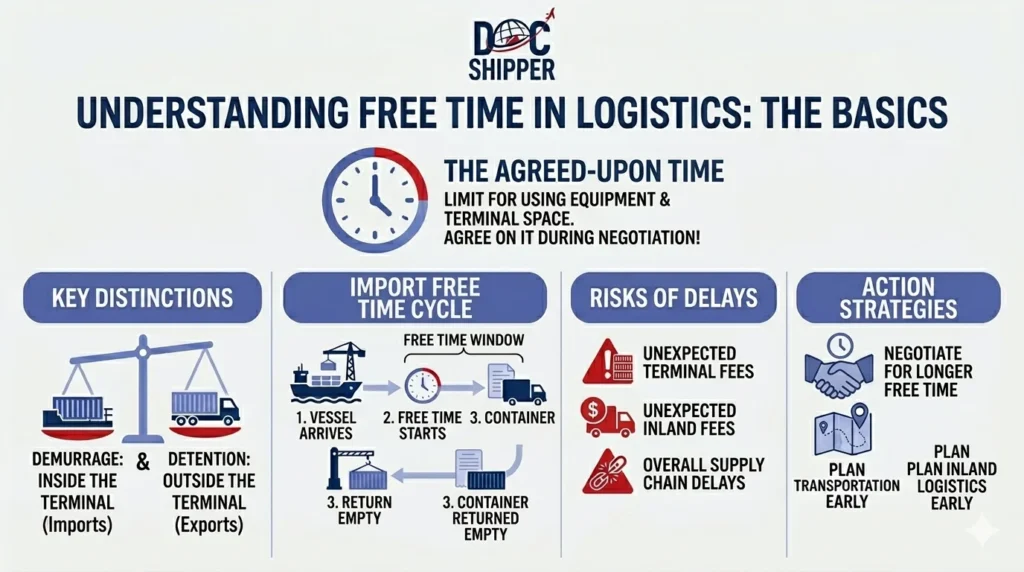
Free time begins counting from the container discharge date (for imports) or the gate-in date (for exports), not from the vessel arrival date. This distinction is crucial because vessel discharge operations can take 1-3 days depending on port congestion, meaning your actual free time window may be shorter than anticipated.
The calculation excludes weekends and public holidays in most carriers’ tariffs, though this practice varies. Mediterranean Shipping Company (MSC) and CMA CGM typically include weekends in their calendar-day calculations, while Maersk and Hapag-Lloyd often exclude non-working days for demurrage purposes. Always verify the specific terms in your Bill of Lading or service contract.
Terminal operators and shipping lines establish free time policies based on port efficiency metrics, equipment availability, and competitive positioning. According to UNCTAD’s Review of Maritime Transport 2023, average container dwell times at major ports range from 3.2 days (Singapore, Rotterdam) to 8.7 days (developing economy ports), directly influencing free time allocations.
The commercial strategy behind free time involves balancing customer service with asset utilization. Carriers lose revenue when containers sit idle beyond operational necessity, creating pressure to minimize grace periods. Conversely, overly restrictive policies drive shippers to competitors, especially in contract negotiations. At DocShipper, we systematically verify free time allocations against your shipping contracts and coordinate with terminals to maximize your complimentary period before charges apply.
Import free time typically triggers demurrage charges when exceeded, while export free time violations result in detention fees. The distinction matters: demurrage covers container storage at the terminal facility (carrier’s responsibility zone), whereas detention applies when you’ve removed the container from the port but haven’t returned it within the allowed timeframe. Current industry rates average $75-150 per container per day for standard equipment, escalating to $200-300 for specialized units.
Calculation Methods & Practical Cases
Understanding how free time is calculated requires examining the reference start date, the counting methodology (calendar days vs. working days), and the expiration timestamp. Most shipping lines use midnight as the cutoff, meaning a container picked up at 11:30 PM on the last free day avoids charges, while retrieval at 12:01 AM incurs a full day’s penalty.
| Scenario | Free Time Period | Calculation Method | Demurrage/Detention Rate |
|---|---|---|---|
| Import FCL – Singapore Port | 5 working days | Excludes Saturdays, Sundays, public holidays | $100/day (Days 6-10), $150/day thereafter |
| Export Reefer – Los Angeles | 3 calendar days | Includes all days from gate-in | $200/day (flat rate) |
| Import LCL – Hamburg | 7 calendar days | Includes weekends, stops on holidays | €85/day (progressive scale) |
| Export Standard – Shanghai | 10 working days | Excludes weekends and Chinese holidays | $75/day (Days 11-15), $125/day after |
Practical Case Study: A European electronics importer receives notification on Monday, March 4th that their container was discharged at Rotterdam on Friday, March 1st. Their carrier (Maersk) provides 5 working days free time excluding weekends. The timeline unfolds as follows:
- Day 1 (Friday, March 1): Container discharged – free time begins
- Weekend (March 2-3): Saturday and Sunday – not counted
- Days 2-5 (March 4-7): Monday through Thursday – working days counted
- Weekend (March 9-10): Not counted toward free time
- Last free day (March 8): Friday – must collect by midnight to avoid charges
- Demurrage begins (March 11): If container not removed, €100/day charges start
In this scenario, the importer has effectively 13 calendar days to retrieve the container despite only 5 working days of free time. Contrast this with a calendar-day calculation where weekends count: the same 5 days would expire by March 6th, reducing available time by 5 calendar days.
Extended Free Time Negotiation: Shippers moving 500+ TEU annually can typically negotiate 10-14 days free time in service contracts. Key leverage points include:
- Volume commitments across multiple trade lanes
- Willingness to accept less flexible vessel schedules
- Equipment repositioning cooperation (returning empties to carrier-specified depots)
- Long-term contract duration (2-3 years vs. spot bookings)
- Off-peak shipping patterns that improve carrier asset utilization
Conclusion
Mastering free time calculations protects your bottom line by preventing unnecessary demurrage and detention charges that erode shipment profitability. The difference between calendar-day and working-day methodologies alone can account for 40-60% variance in your actual grace period, making contractual clarity essential.
Need assistance optimizing your free time allocations or resolving unexpected charges? Contact DocShipper’s logistics specialists for expert guidance on carrier negotiations and cost management strategies.
📚 Quiz
Test Your Knowledge: Free Time
What does "Free Time" specifically refer to in international shipping?
When does the free time clock start ticking for import containers?
Your container was discharged on Friday with "5 working days" free time (weekends excluded). You arrive at the terminal on the following Tuesday at 12:30 AM to pick it up. What happens?
🎯 Your Result
📞 Free Quote in 24hFAQ | Free Time: Definition, Calculation & Practical Examples
FCL (Full Container Load) shipments typically receive longer free time (5-10 days) because you control the entire container. LCL (Less than Container Load) shipments often have shorter periods (3-5 days) since the cargo must be deconsolidated at a Container Freight Station (CFS) before pickup. The clock starts when your specific cargo is available for collection, not when the container is discharged.
Standard free time policies do not automatically pause for customs delays. However, you can request extensions by providing documentation such as customs hold notices, inspection requests, or missing document evidence. Approval is discretionary and depends on carrier relationships and the reason for delay. Force majeure events (port strikes, natural disasters) may qualify for automatic extensions under specific tariff provisions.
Most carriers charge a full day's demurrage or detention even if you exceed free time by minutes. The cutoff is typically midnight on the last free day. Some terminals offer grace periods of 2-4 hours, but this is not standard practice. To avoid charges, schedule pickups or returns at least 6 hours before the deadline to account for traffic, equipment issues, or documentation problems.
No—this varies by carrier tariff. European carriers often exclude Saturdays, Sundays, and national holidays, while Asian carriers typically use calendar-day calculations that include all days. US carriers present mixed practices. Always check the "Free Time Calculation Basis" clause in your Bill of Lading or service contract. The notation "5 working days" excludes non-working days, while "5 calendar days" includes all days.
For cargo transshipped through intermediate ports, free time usually begins at the final discharge port, not at transshipment hubs. However, if delays at the transshipment port cause extended storage, some carriers may start the clock there. Review your contract's "Through Bill of Lading" clauses to understand liability. Industry practice typically protects shippers from charges during carrier-controlled transshipment operations.
No—free time applies individually to each container. If you have 5 containers with 7 days free time each, you cannot use 35 total days across all units. Each container must be picked up or returned within its own free time window. Some carriers offer "pooled demurrage" programs for high-volume shippers, allowing charge offsets between early and late pickups, but this requires specific contractual arrangements.
The Equipment Interchange Receipt (EIR) showing the gate-out timestamp is your primary evidence. This document is generated when your trucker collects the container from the terminal. Keep copies of all EIRs with timestamps clearly visible. In disputes, terminal gate logs (accessible through carrier customer portals) provide secondary verification. Ensure your trucking company provides EIRs immediately after pickup to confirm compliance.
Demurrage applies when a container remains at the terminal beyond free time without being picked up (import) or when you deliver it to the terminal too early (export). Detention applies when you've taken the container outside the terminal but haven't returned it within the allowed timeframe. Demurrage typically ends when you remove the container; detention begins at that point and continues until you return the empty to a designated depot.
Limited negotiation is possible even for smaller shippers (20-50 TEU annually). Focus on relationship-building with specific carrier account managers and demonstrate consistent shipping patterns. Request extensions for individual shipments when you can provide advance notice of legitimate delays (warehouse strikes, unexpected inspection requirements). Joining shipper associations or using freight forwarders with consolidated volumes can also improve your negotiating position.
Standard dry container demurrage ranges from $75-150 per day for the first 5 days after free time, escalating to $150-250 per day thereafter. Reefer containers incur higher rates ($200-400 daily) due to power costs and equipment scarcity. Rates also vary by port—congested facilities like Los Angeles/Long Beach charge premium rates ($125-200/day) compared to less busy ports ($60-100/day). Always review your carrier's published tariff for exact rate structures.
Carrier policies vary significantly. Widely recognized force majeure events (hurricanes, earthquakes, port closures) may trigger automatic extensions announced via carrier advisories. Lesser disruptions (labor slowdowns, traffic congestion, equipment shortages) typically require individual extension requests with supporting documentation. Review your service contract's "Force Majeure" clause—some contracts specify automatic 3-5 day extensions for qualifying events, while others require formal applications.
When you request a container to be pre-pulled from the terminal stacks to expedite pickup (common practice to avoid long gate queues), free time calculation remains unchanged—it still begins from the discharge date, not the pre-pull date. However, some terminals charge separate pre-pull fees ($25-75) if the container isn't collected within 24-48 hours of the pre-pull request. This can create additional costs even within your free time window.
Need Help with
Logistics or Sourcing ?
First, we secure the right products from the right suppliers at the right price by managing the sourcing process from start to finish. Then, we simplify your shipping experience - from pickup to final delivery - ensuring any product, anywhere, is delivered at highly competitive prices.


Fill the Form
Prefer email? Send us your inquiry, and we’ll get back to you as soon as possible.
Contact us




