


In short ⚡
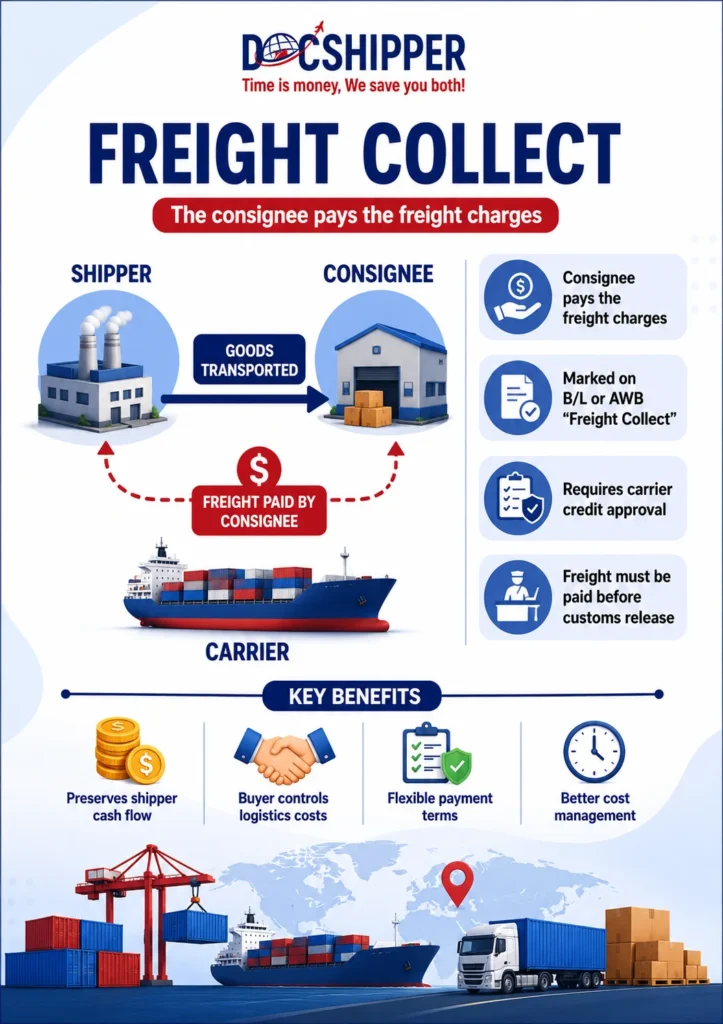
Freight Collect is a shipping term where the consignee (receiver) pays transportation charges upon delivery or after goods arrive at the destination. Unlike Freight Prepaid, where the shipper covers costs upfront, this payment method transfers financial responsibility to the buyer, impacting cash flow, customs clearance, and contractual obligations in international trade.
Introduction
Many businesses struggle with unexpected freight charges appearing at delivery, causing cash flow disruptions and customs delays. Understanding when and why Freight Collect applies prevents these surprises.
In international logistics, the payment method for transportation directly affects who controls shipment costs and timing. This distinction becomes crucial when negotiating Incoterms, managing budgets, or clearing customs.
- Payment responsibility: The receiver settles freight charges with the carrier, not the sender
- Cash flow impact: Allows shippers to transfer logistics costs to buyers, improving liquidity
- Customs implications: The consignee must pay freight before customs release in many jurisdictions
- Incoterms alignment: Typically associated with FOB, EXW, or FCA terms where buyer arranges transport
- Credit terms: Often requires pre-approved credit accounts between consignee and carrier
Payment Mechanisms & Legal Implications
Freight Collect operates through a deferred payment structure where the carrier invoices the consignee after delivery or upon cargo arrival. This differs fundamentally from prepaid models and creates specific obligations.
The legal framework governing Freight Collect varies by transport mode. Maritime shipments follow the Hague-Visby Rules or Hamburg Rules, which establish carrier liability regardless of payment method. Air freight operates under the Montreal Convention, while road transport adheres to CMR regulations.
From a customs perspective, many countries require proof of freight payment before releasing goods. The consignee must settle charges to obtain the delivery order or release documentation, creating a potential bottleneck if funds aren’t immediately available.
The bill of lading notation explicitly states “Freight Collect” or “Freight Payable at Destination,” establishing the contractual payment obligation. This document becomes crucial evidence if disputes arise about who owes transportation costs.
Credit arrangements present another layer. Carriers typically require pre-approved accounts with the consignee before accepting Collect shipments. Without established credit, they may demand payment guarantees or refuse the arrangement entirely. At DocShipper, we verify credit status with carriers before confirming Freight Collect terms to avoid last-minute complications.
Tax implications also differ by jurisdiction. Some countries apply VAT or GST to freight charges at different rates depending on whether services are domestic or international. The fiscal classification of transportation as a service can affect total landed costs significantly.
Practical Scenarios & Cost Comparisons
Understanding Freight Collect through real-world applications clarifies when this payment method makes financial and operational sense.
Scenario 1: Manufacturing Equipment from Germany to USA
A US manufacturer purchases €50,000 worth of machinery under FOB Hamburg terms. The shipping cost is €3,200.
| Payment Method | Shipper’s Cost | Consignee’s Cost | Cash Flow Impact |
|---|---|---|---|
| Freight Prepaid | €53,200 | €0 freight | Shipper advances capital |
| Freight Collect | €50,000 | €3,200 | Consignee pays on arrival |
In this case, Freight Collect preserves the German seller’s working capital while the US buyer controls logistics costs directly. The buyer benefits from potential carrier discounts through existing relationships.
Scenario 2: Fashion Goods from Vietnam to France
A French retailer orders garments valued at $25,000 under EXW Ho Chi Minh terms. Air freight costs $1,800.
- Buyer arranges transport: Contracts directly with carrier using Freight Collect terms
- Delivery timeline: 5-7 days air freight, payment due within 30 days of delivery
- Customs clearance: French customs requires proof of freight payment; 24-hour delay if funds not ready
- Cost control: Retailer negotiates $1,650 rate through volume agreement, saving $150 per shipment
- Documentation flow: Air waybill marked “Collect,” carrier invoices retailer post-delivery
Key Financial Considerations
The choice between Prepaid and Collect affects more than immediate payment timing:
- Currency exposure: Collect terms mean consignees pay in the carrier’s invoicing currency, potentially different from goods cost
- Credit terms: Carriers offer 15-30 day payment terms for approved accounts, improving buyer cash flow
- Audit trail: Separate freight invoices simplify cost allocation for accounting purposes
- Dispute resolution: If goods are damaged, the paying party (consignee) has direct recourse with the carrier
- Landed cost calculation: Buyers must factor freight into total acquisition cost for inventory valuation
At DocShipper, we analyze each client’s cash flow situation and carrier relationships to recommend the optimal freight payment structure. Our experience shows that Freight Collect reduces shipper costs by 3-5% on average while accelerating order processing times.
Conclusion
Freight Collect transfers transportation payment responsibility to the consignee, impacting cash flow, customs clearance, and contractual obligations. Understanding when to apply this method optimizes financial planning in international trade.
Need guidance on structuring freight terms for your shipments? Contact DocShipper for expert logistics consultation.
📚 Quiz
Test Your Knowledge: Freight Collect
Who is financially responsible for transportation charges under Freight Collect terms?
Which Incoterms naturally align with Freight Collect payment arrangements?
A French importer receives goods under Freight Collect terms but hasn't paid the carrier yet. What is the most likely consequence at customs?
🎯 Your Result
📞 Free Quote in 24hFAQ | Freight Collect: Definition, Calculation & Concrete Examples
Freight Prepaid means the shipper pays transportation charges before shipment, with costs typically included in the commercial invoice. Freight Collect requires the consignee to pay the carrier upon or after delivery. The choice affects who controls logistics costs, cash flow timing, and customs documentation requirements.
No. Freight Collect aligns naturally with buyer-responsible Incoterms like FOB, FCA, and EXW where the purchaser arranges transport. It contradicts seller-responsible terms like DDP or CIF, where the shipper must cover all transportation costs to the destination. Mixing incompatible payment methods and Incoterms creates contractual conflicts.
The carrier retains legal possession of the goods and can place them in bonded storage or warehouse them at the consignee's expense. The bill of lading serves as a contract obligating payment. After a grace period (typically 30-60 days), the carrier may auction goods to recover costs. This situation damages business relationships and creates additional storage fees.
Many jurisdictions require documentation that freight charges are paid or guaranteed before releasing imported goods. This ensures complete landed cost calculation for duty assessment. Consignees should arrange payment promptly or provide carrier credit documentation to avoid customs clearance delays. Requirements vary by country and transport mode.
Transportation costs typically form part of the customs value for duty calculation, regardless of payment method. With Freight Collect, importers must declare the freight amount even though it's invoiced separately. Accurate documentation of transportation costs ensures correct duty assessment and avoids penalties for undervaluation.
It's challenging. Most carriers require credit approval before accepting Collect shipments. Small businesses without shipping history may need to arrange cash-on-delivery (COD) freight payments, provide deposits, or work through freight forwarders with established credit. Building carrier relationships over time enables better Collect payment terms.
The bill of lading (ocean) or air waybill explicitly states "Freight Collect" or "Freight Payable at Destination" in the charges section. This notation legally obligates the named consignee to pay transportation costs. Supporting documents include the carrier's rate confirmation and any credit agreements between consignee and carrier.
Letters of credit typically specify freight payment responsibility. If documents show "Freight Prepaid" but the LC requires evidence of shipper payment, banks may reject the presentation. Conversely, Collect terms require the LC to accommodate separate freight settlement. Misalignment between payment terms and LC conditions causes documentary discrepancies and payment delays.
Exporters relinquish control over delivery timing if the consignee delays freight payment, potentially stranding goods at destination. If the buyer disputes the shipment quality, they may withhold freight payment as leverage. Additionally, exporters lose visibility into actual transportation costs, making it harder to quote competitive landed prices for future transactions.
Generally no. Freight rates are contractually agreed before shipment, documented in the booking confirmation and bill of lading. Post-shipment negotiations rarely succeed unless errors occurred in rate application. The consignee is legally obligated to pay the stated amount. Disputes typically require formal claims processes rather than negotiation.
In consolidations, the freight forwarder typically uses master bills with Freight Prepaid from shippers, then issues house bills with either Prepaid or Collect to individual consignees. Mixed payment terms within one container are possible, but require careful documentation. Each consignee pays their proportional freight share based on volume or weight.
Carriers invoice in their standard operating currency, which may differ from the goods transaction currency. For example, a US carrier might invoice in USD even if the underlying sale is in EUR. This creates currency exchange risk for consignees, who must budget for potential rate fluctuations between booking and payment dates, typically 30-45 days.
Need Help with
Logistics or Sourcing ?
First, we secure the right products from the right suppliers at the right price by managing the sourcing process from start to finish. Then, we simplify your shipping experience - from pickup to final delivery - ensuring any product, anywhere, is delivered at highly competitive prices.


Fill the Form
Prefer email? Send us your inquiry, and we’ll get back to you as soon as possible.
Contact us




