


In short ⚡
Fronthaul is the network segment connecting remote radio heads (RRHs) to baseband units (BBUs) in modern telecommunications infrastructure, particularly in Cloud-RAN (C-RAN) architectures. This critical link transmits digitized radio signals using protocols like CPRI or eCPRI, requiring ultra-low latency and high bandwidth to support 5G networks and IoT logistics applications.Introduction
Many logistics professionals confuse fronthaul with backhaul, yet this distinction becomes critical when implementing real-time tracking systems or smart warehouse connectivity. As supply chains adopt Industry 4.0 technologies, understanding network architecture determines operational efficiency.
In international shipping, fronthaul infrastructure enables instantaneous communication between IoT sensors, automated guided vehicles (AGVs), and centralized management systems. This connectivity layer directly impacts cargo visibility and customs clearance speed.
- Low latency requirements: Typically under 100 microseconds for 5G applications
- High bandwidth demands: Up to 10 Gbps per RRH connection using CPRI
- Centralized processing: Enables baseband pooling for cost optimization
- Transport protocols: CPRI, eCPRI, or Ethernet-based solutions
- Logistics applications: Port automation, warehouse robotics, last-mile tracking
Technical Architecture & Expertise
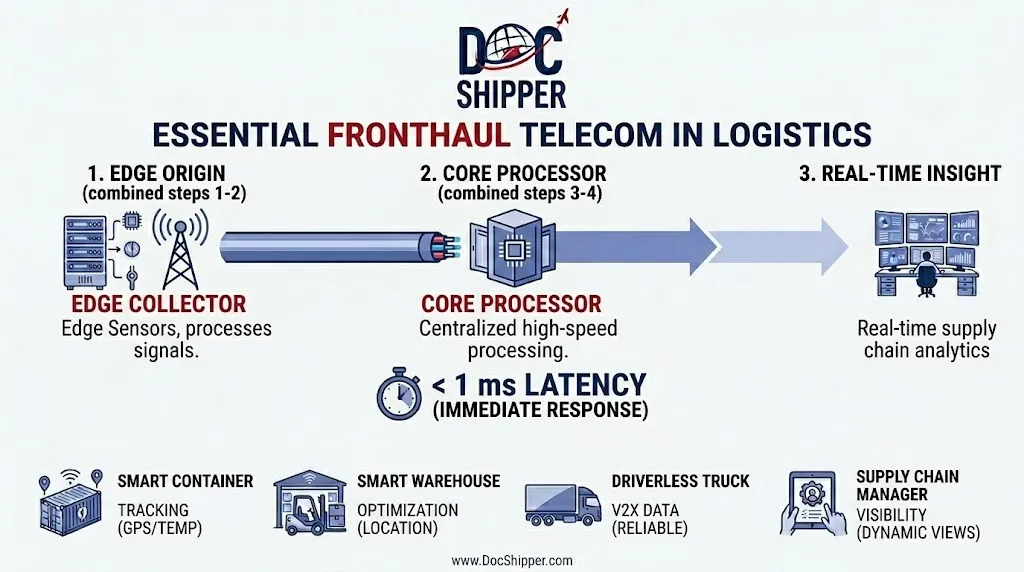
Fronthaul operates between two critical infrastructure components. The remote radio head sits near antennas in ports, warehouses, or distribution centers, converting analog radio signals to digital streams. The baseband unit resides in centralized data centers, processing these signals for network routing.
Traditional fronthaul uses the Common Public Radio Interface (CPRI), which transmits uncompressed IQ (In-phase/Quadrature) data. This approach requires massive bandwidth—a single 20 MHz LTE carrier demands approximately 2.5 Gbps. For logistics facilities spanning hundreds of acres, fiber optic infrastructure costs become prohibitive.
The evolution to eCPRI (enhanced CPRI) splits radio processing functions between RRH and BBU. Lower-layer processing occurs at the antenna site, reducing fronthaul traffic by 50-75%. This split architecture proves essential for containerized shipment tracking where thousands of sensors transmit simultaneously.
According to the International Telecommunication Union (ITU), fronthaul latency constraints differ by functional split. Option 8 (PHY-RF split) requires sub-250 microsecond round-trip time, while Option 7 (High-Low PHY split) tolerates several milliseconds—acceptable for most logistics applications.
At DocShipper, we evaluate warehouse network infrastructure during facility audits. Inadequate fronthaul capacity causes automated sorting systems to malfunction, delaying shipment processing by 15-30 minutes per incident. Our technical teams verify fiber optic specifications match C-RAN requirements before recommending distribution centers.
Practical Examples & Data
Real-world implementations demonstrate fronthaul’s impact on logistics efficiency. The Port of Rotterdam deployed 12 km of fronthaul fiber connecting 47 remote radio heads across terminal areas. This infrastructure supports 15,000 connected devices monitoring container movements, crane operations, and customs checkpoints.
| Architecture Type | Bandwidth Required | Latency (RTT) | Logistics Use Case |
|---|---|---|---|
| CPRI Option 8 | 9.8 Gbps (20 MHz carrier) | <100 μs | AGV collision avoidance |
| eCPRI Option 7-2 | 2.4 Gbps (20 MHz carrier) | <250 μs | Real-time package scanning |
| Ethernet Fronthaul | 1.5 Gbps (20 MHz carrier) | <1 ms | Inventory management systems |
| Open RAN Fronthaul | 0.8-1.2 Gbps (variable) | <3 ms | Customs documentation upload |
Case Study: Amazon Fulfillment Center (Phoenix, AZ)
A 2.3 million sq ft facility required fronthaul supporting 8,000 robotic units and 4,500 wireless sensors. The deployment team installed 94 RRHs connected via dark fiber to three centralized BBU pools. Peak traffic reaches 127 Gbps during holiday season, with average latency maintained at 78 microseconds.
Key implementation challenges included:
- Fiber management: 18 km of OM4 multimode fiber requiring fusion splicing every 300 meters
- Synchronization: GPS-disciplined oscillators ensuring ±50 ns timing accuracy across RRHs
- Redundancy: Dual-path routing with automatic failover under 20 ms
- Power consumption: BBU centralization reduced energy costs by $340,000 annually
- Scalability: Architecture supports 40% capacity expansion without infrastructure replacement
For international logistics operators, fronthaul dimensioning depends on shipment volume. A medium-sized container terminal processing 500,000 TEUs annually requires approximately 15-20 RRHs with aggregate fronthaul capacity of 180-240 Gbps to maintain operational continuity.
Conclusion
Fronthaul infrastructure forms the invisible backbone of modern logistics connectivity, directly influencing shipment visibility and operational velocity. As supply chains integrate autonomous systems and real-time analytics, proper network architecture becomes non-negotiable.
Need assistance evaluating fronthaul requirements for your logistics facility? Contact DocShipper for comprehensive infrastructure assessments and vendor-neutral recommendations.
📚 Quiz
Test Your Knowledge: Fronthaul
Question 1: What is the primary function of fronthaul in telecommunications infrastructure?
Question 2: Why does traditional CPRI fronthaul require massive bandwidth compared to eCPRI?
Question 3: A warehouse deploys automated guided vehicles (AGVs) requiring control loop response under 50ms. Which fronthaul architecture would be INAPPROPRIATE?
🎯 Your Result
📞 Free Personalized QuoteFAQ | Fronthaul: Definition, Architecture & Practical Examples
Fronthaul connects radio heads to processing units with strict latency requirements (sub-millisecond), while backhaul links core networks to internet gateways, tolerating 10-50 ms delays. In warehouses, fronthaul supports real-time robotics; backhaul handles data uploads to cloud platforms.
Standard gigabit Ethernet cannot meet CPRI bandwidth demands. You need 10 Gbps or 25 Gbps Ethernet with Quality of Service (QoS) configuration and precision timing protocol (PTP) support. eCPRI reduces requirements to 1-5 Gbps, making existing fiber potentially viable after assessment.
AGVs require control loop response under 50 milliseconds. Fronthaul latency above 250 microseconds causes navigation errors, collision risks, and throughput reduction of 12-18%. Critical systems implement fronthaul redundancy with automatic path switching to maintain safety margins.
Single-mode fiber (OS2) supports distances up to 40 km for CPRI, ideal for port environments. Multimode OM4 fiber works for 400-550 meters in warehouses. Cable selection depends on RRH-to-BBU distance, required bandwidth, and future upgrade paths to higher transmission rates.
Indirectly yes. Fronthaul enables real-time document transmission between cargo scanners, customs databases, and warehouse management systems. Inadequate capacity delays digital manifest updates by 5-15 minutes, potentially causing shipment holds at border crossings or inspection delays.
5G fronthaul demands timing accuracy within ±50 nanoseconds across all RRHs to prevent interference. Logistics applications tolerate ±500 ns for most use cases. Synchronization uses GPS disciplined oscillators or IEEE 1588v2 Precision Time Protocol over fronthaul links.
Fiber optic fronthaul remains weather-independent if properly sealed. RRH outdoor units require IP67 rating and operational temperature range of -40°C to +65°C. Port deployments include environmental monitoring; excessive heat (above 55°C) triggers automatic power reduction, lowering coverage radius by 15-20%.
Millimeter-wave wireless fronthaul (60-73 GHz bands) offers 10 Gbps capacity for 200-500 meter links, suitable for temporary facilities or retrofit scenarios. Reliability drops to 99.9% versus fiber's 99.99%, making it unsuitable for critical logistics operations requiring continuous connectivity.
Centralized C-RAN with CPRI fronthaul consumes 30-40% less power than distributed systems. A 50-RRH deployment uses approximately 85 kW for BBU pools versus 135 kW for standalone base stations. eCPRI reduces RRH power by 15% through localized processing, totaling 72 kW system-wide.
Each fronthaul link supports 5,000-10,000 low-bandwidth IoT devices (temperature sensors, RFID readers) or 500-800 video cameras at 4K resolution. Warehouses requiring full cargo monitoring deploy 1 RRH per 8,000-12,000 sq ft, with fronthaul dimensioned for 150% peak traffic to accommodate seasonal surges.
Fiber optic links require annual inspection with optical time-domain reflectometer (OTDR) testing. RRH units need quarterly cleaning in dusty environments and biannual firmware updates. BBU pools undergo monthly performance audits. Proactive maintenance reduces fronthaul-related outages by 67% compared to reactive approaches.
Deploy single-mode fiber rated for 100 Gbps transmission and modular BBU architectures supporting software-defined radio upgrades. Over-provision fronthaul capacity by 200-300% of current requirements. This approach enabled early 5G adopters to avoid infrastructure replacement costs averaging $2.3 million per major facility during technology transitions.
Need Help with
Logistics or Sourcing ?
First, we secure the right products from the right suppliers at the right price by managing the sourcing process from start to finish. Then, we simplify your shipping experience - from pickup to final delivery - ensuring any product, anywhere, is delivered at highly competitive prices.


Fill the Form
Prefer email? Send us your inquiry, and we’ll get back to you as soon as possible.
Contact us




