


In short ⚡
Forwarder compensation refers to the fees and commissions earned by freight forwarders for organizing and managing international shipments. This remuneration covers services including customs clearance, carrier negotiation, documentation, and logistics coordination. Typically calculated as a percentage of freight costs or fixed rates per shipment, forwarder compensation ensures profitability while delivering value-added expertise to importers and exporters.Introduction
Many businesses struggle to understand how freight forwarders actually make money. The compensation structure often appears opaque, leading to confusion about hidden markups versus transparent service fees. In international trade, forwarder compensation directly impacts your total landed cost and supply chain efficiency.
Freight forwarders act as intermediaries between shippers and carriers, providing essential services that justify their compensation. Understanding their fee structures helps you negotiate better rates and select partners aligned with your business objectives.
Key aspects of forwarder compensation include:
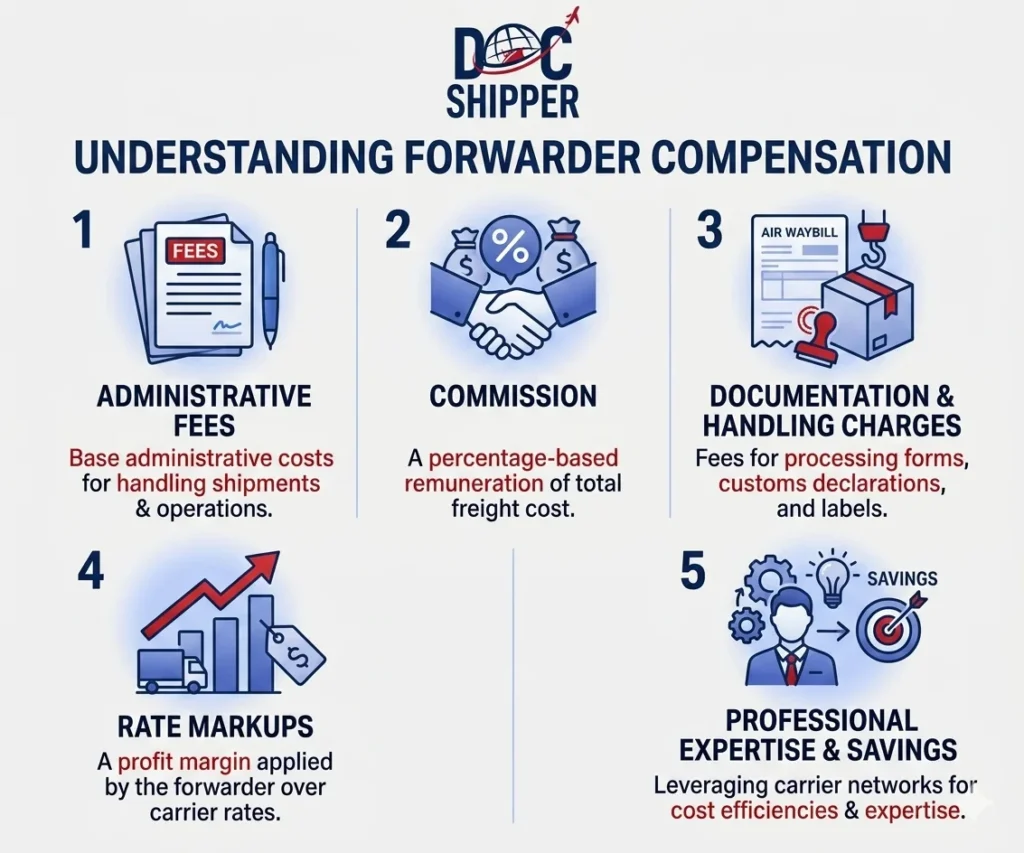
- Commission-based earnings from carrier relationships and volume negotiations
- Service fees for documentation, customs brokerage, and compliance
- Markup models applied to freight costs and ancillary charges
- Value-added services like cargo insurance, warehousing, and consolidation
- Technology fees for tracking systems, EDI integration, and visibility platforms
Compensation Mechanisms & Expertise
Forwarder compensation operates through multiple revenue streams that reflect the complexity of international logistics. The primary compensation model involves markups on freight costs, where forwarders negotiate bulk rates with carriers and charge clients a higher published rate. This differential typically ranges from 15% to 40% depending on trade lanes and service levels.
Commission structures represent another significant revenue source. Airlines and shipping lines often pay forwarders 5% to 7.5% commissions on freight revenue, incentivizing volume generation. These commissions sometimes get passed partially to clients through competitive pricing, particularly for large shippers.
The service fee approach has gained traction as clients demand transparency. Under this model, forwarders charge explicit fees for each service—customs clearance ($150-$450 per shipment), documentation ($75-$200), delivery orders ($50-$100)—while showing actual carrier costs separately. At DocShipper, we provide itemized invoicing that clearly separates carrier charges from our service fees, ensuring complete cost visibility for our clients.
Value-added services generate additional compensation beyond basic freight forwarding. These include cargo insurance (typically 0.5%-1.5% of cargo value), warehousing and distribution, purchase order management, and quality inspection services. Many forwarders develop specialization in sectors like pharmaceuticals or perishables, commanding premium rates for expertise.
According to World Trade Organization research, logistics services represent 10-15% of total trade costs in developed markets and up to 25% in emerging economies. Understanding performance-based compensation models—where forwarders earn bonuses for meeting delivery timelines or cost reduction targets—helps align incentives with client objectives.
Concrete Pricing Examples & Data
Real-world compensation structures vary significantly by shipment mode, volume, and complexity. The following examples illustrate typical pricing scenarios across different logistics situations.
Ocean Freight LCL Shipment (China to USA)
| Cost Component | Amount (USD) |
|---|---|
| Carrier base freight (2 CBM) | $180 |
| Forwarder markup (25%) | $45 |
| Documentation fee | $95 |
| Customs clearance | $250 |
| Delivery order processing | $75 |
| Total Forwarder Compensation | $465 |
Air Freight Express Shipment (Europe to Asia)
For a 100 kg urgent air shipment from Germany to Singapore, compensation breakdown typically follows this pattern:
- Airline cost: $4.50/kg = $450
- Forwarder markup: 35% = $157.50
- Security screening fee: $85
- Dangerous goods handling (lithium batteries): $200
- Export documentation: $120
- Total forwarder revenue: $562.50 (55.5% of carrier cost)
Full Container Load (FCL) Comparative Analysis
| Service Model | 40′ Container (Shanghai-Rotterdam) | Forwarder Revenue |
|---|---|---|
| Traditional Markup Model | Client pays: $3,200 | $480 (15% markup) |
| Transparent Fee Model | Carrier cost: $2,720 + Service fee: $350 | $350 flat fee |
| All-Inclusive Package | $3,450 (includes customs, delivery) | $730 bundled margin |
Industry data shows that forwarder gross margins average between 12% and 18% after accounting for operational costs, technology investments, and liability insurance. High-volume shippers often negotiate consolidated rates where forwarders accept lower per-shipment margins in exchange for guaranteed volume commitments.
At DocShipper, we adapt our compensation models to client preferences—whether you prioritize cost transparency, bundled simplicity, or performance-based pricing. Our technology platform provides real-time cost breakdowns, enabling informed decisions about service selection and budget allocation.
Conclusion
Forwarder compensation reflects the value of expertise, network access, and risk management in international logistics. Understanding these pricing mechanisms empowers shippers to negotiate effectively and select partners who align cost structures with business objectives.
Need guidance on optimizing your freight forwarding costs? Contact DocShipper for a transparent cost analysis tailored to your shipping profile.
📚 Quiz
Test Your Knowledge: Forwarder Compensation
What does forwarder compensation primarily cover in international logistics?
A client believes their forwarder's 25% markup on ocean freight is pure profit. What's the correct interpretation?
Your company ships 5 LCL containers monthly from China to the USA. Which compensation model would likely provide the best value?
🎯 Your Result
📞 Free Personalized QuoteFAQ | Forwarder Compensation: Definition, Calculation & Concrete Examples
Need Help with
Logistics or Sourcing ?
First, we secure the right products from the right suppliers at the right price by managing the sourcing process from start to finish. Then, we simplify your shipping experience - from pickup to final delivery - ensuring any product, anywhere, is delivered at highly competitive prices.


Fill the Form
Prefer email? Send us your inquiry, and we’ll get back to you as soon as possible.
Contact us




