


In short ⚡
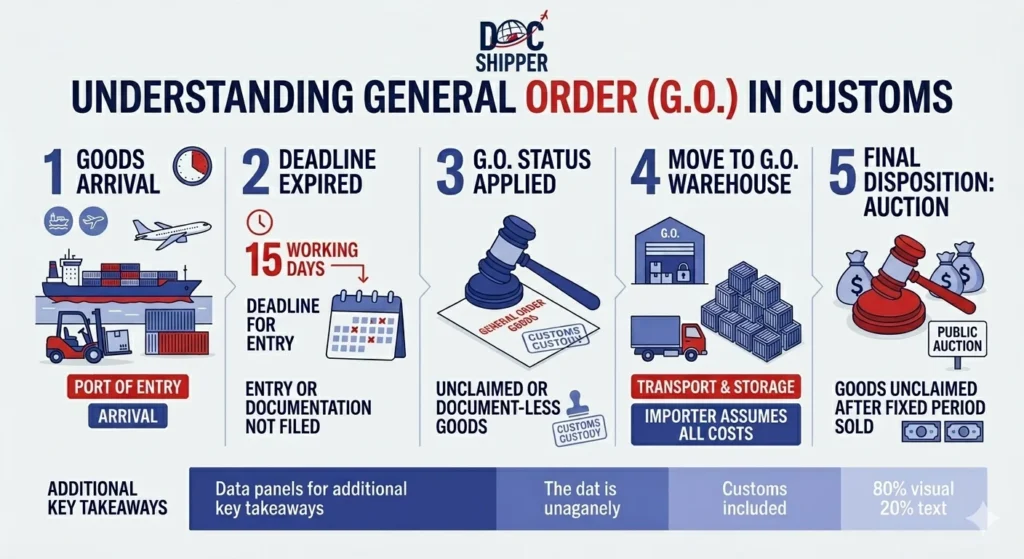
General Order (GO) is a U.S. Customs procedure whereby imported goods that are not claimed, not cleared, or not properly documented within a specified timeframe are transferred to a bonded warehouse under government custody. This mechanism protects revenue collection while allowing importers a grace period to resolve documentation or payment issues before potential auction or destruction.
Introduction
Every year, thousands of shipments entering U.S. ports face detention or storage penalties due to incomplete customs clearance. Many importers remain unaware of General Order procedures until their cargo is already transferred to a government bonded facility.
Understanding General Order is critical for international trade professionals. It directly impacts storage costs, liquidation risks, and supply chain continuity. This mechanism serves as both a safeguard for customs authorities and a last-resort option for importers facing documentation challenges.
Key characteristics of General Order include:
- Mandatory transfer timeline: Typically 15 calendar days from arrival at a U.S. port
- Bonded warehouse storage: Goods held under U.S. Customs and Border Protection (CBP) supervision
- Recovery window: Six-month period before potential government auction
- Cost accumulation: Daily storage fees charged to the importer or consignee
- Documentation resolution requirement: Proof of ownership and compliance necessary for release
In-Depth Understanding & Legal Framework
The General Order process is governed by 19 CFR Part 4 and Section 490 of the Tariff Act. When cargo remains unclaimed or improperly documented, CBP issues a General Order notice directing the carrier or terminal operator to transfer goods to an approved bonded facility.
The timeline begins upon vessel arrival or cargo availability for examination. If no entry is filed within the statutory 15-day window, the goods automatically enter General Order status. This applies equally to containerized freight, break-bulk shipments, and air cargo arriving at designated ports of entry.
Common triggers for General Order include:
- Missing or incomplete customs entry: ISF filings errors, wrong HS codes, or absent commercial invoices
- Unpaid duties and taxes: Insufficient bonds or payment disputes
- Regulatory holds: FDA, USDA, or other agency examinations pending clearance
- Abandoned shipments: Consignee refusal or business closure
- Document discrepancies: Bill of lading mismatches or forged certificates of origin
Once in General Order, the importer faces escalating storage charges calculated per day and per container or weight unit. These fees vary by bonded warehouse but typically range from $50 to $150 daily for standard containers. After six months, CBP may sell the goods at public auction to recover storage costs and duties.
At DocShipper, we monitor shipment status continuously and intervene before General Order triggers. Our customs brokerage team verifies documentation accuracy and bond sufficiency 72 hours prior to vessel arrival, preventing costly transfers.
Importers retain the right to petition for release during the six-month holding period. This requires submitting proof of ownership, paying accrued storage fees, and resolving the initial compliance issue. The process demands precise coordination between customs brokers, bonded warehouse operators, and CBP officers.
Practical Examples & Data
To illustrate General Order consequences, consider three real-world scenarios importers frequently encounter:
Scenario 1: Textile Importer – Documentation Delay
A Los Angeles-based fashion retailer imported 40-foot containers of apparel from Bangladesh. Due to an error in the manufacturer’s certificate of origin, CBP placed the shipment on hold for examination. The importer failed to correct documentation within 15 days.
| Timeline Event | Action Required | Cost Impact |
|---|---|---|
| Day 0: Vessel arrival | Entry filing deadline begins | $0 |
| Day 15: Entry not filed | Transfer to bonded warehouse | $1,200 transfer fee |
| Day 30: Document corrected | Release petition submitted | $2,250 storage (15 days × $150/day) |
| Day 35: CBP approval | Cargo released | Total: $3,450 + delayed delivery |
Scenario 2: Electronics Shipment – Unpaid Duties
A Miami electronics distributor imported smartphones from China but underestimated the customs bond value. CBP rejected the initial entry due to insufficient bond coverage. The importer took 22 days to secure additional bonding, triggering General Order.
Financial breakdown:
- Original shipment value: $180,000
- Required bond increase: $45,000
- Storage fees (22 days): $3,300
- Demurrage penalties: $2,800
- Administrative processing: $950
- Total unplanned costs: $7,050
Scenario 3: Abandoned Agricultural Products
A consignee importing organic coffee from Colombia ceased operations without notifying their freight forwarder. The shipment entered General Order and remained unclaimed for six months. CBP auctioned the cargo for $12,000, far below the $38,000 commercial value.
DocShipper’s proactive monitoring would have identified the consignee’s inactive status during pre-shipment verification, allowing alternative delivery arrangements before departure.
Comparative Analysis: Port-Specific GO Rates
| U.S. Port | Average Daily Storage | Transfer Fee | 30-Day Total Cost |
|---|---|---|---|
| Port of Los Angeles | $125/container | $1,100 | $4,850 |
| Port of New York/New Jersey | $150/container | $1,350 | $5,850 |
| Port of Savannah | $110/container | $950 | $4,250 |
| Port of Seattle | $135/container | $1,200 | $5,250 |
These figures demonstrate significant regional variation. West Coast ports generally impose higher fees due to congestion and bonded warehouse scarcity. Strategic planning and pre-clearance verification can eliminate these avoidable expenses entirely.
Conclusion
General Order represents a critical risk point in international logistics that demands proactive documentation management and customs compliance expertise. Understanding the 15-day window and six-month liquidation timeline enables importers to avoid unnecessary penalties and supply chain disruptions.
Need support navigating customs clearance challenges? Contact DocShipper for expert assistance with entry filing, bond management, and General Order resolution.
📚 Quiz
Test Your Knowledge: General Order (GO)
What is the primary definition of General Order in U.S. customs operations?
An importer believes General Order only applies to ocean freight and not air cargo. Is this correct?
A shipment arrived at Port of Los Angeles 12 days ago with incomplete documentation. What action should the importer take immediately?
🎯 Your Result
📞 Free Quote in 24hFAQ | General Order (GO): Definition, Process & Practical Examples
General Order is triggered when an importer fails to file a proper customs entry within 15 calendar days of cargo arrival at a U.S. port. Other causes include unpaid duties, missing documentation (commercial invoices, certificates of origin), regulatory holds from agencies like FDA or USDA, or consignee abandonment. CBP automatically transfers non-compliant shipments to bonded warehouses under government custody.
Goods can remain in General Order for six months from the date of transfer to the bonded warehouse. After this period, U.S. Customs and Border Protection may sell the cargo at public auction to recover storage fees and unpaid duties. Importers must petition for release and resolve all compliance issues before the six-month deadline expires to avoid permanent loss.
Storage fees vary by port and bonded warehouse, typically ranging from $50 to $150 per day per container. Major East Coast ports like New York/New Jersey charge higher rates ($150/day) compared to Gulf Coast facilities ($110/day). Additional costs include transfer fees ($950-$1,350), examination charges, and demurrage penalties. A 30-day General Order hold can easily exceed $5,000 for a single container.
Yes, importers can petition for release during the six-month holding period. The process requires submitting proof of ownership, correcting the original compliance issue (missing documents, unpaid duties), and paying all accrued storage fees. Working with a licensed customs broker expedites the release process, as they can coordinate between CBP, bonded warehouse operators, and relevant regulatory agencies.
Yes, General Order procedures apply to all modes of transport entering the United States, including air freight, ocean cargo, and ground shipments. Air cargo follows the same 15-day entry filing requirement. However, air shipments often incur higher daily storage rates ($75-$200 per day) due to specialized handling requirements and limited bonded warehouse space at airport facilities.
The legal responsibility falls on the importer of record or consignee listed on the entry documents. If no entry exists, liability may extend to the carrier or freight forwarder. However, contractual agreements (Incoterms, bill of lading terms) ultimately determine financial responsibility. Importers should verify their customs broker has proper power of attorney to act on their behalf before shipment arrival.
Customs detention is a temporary hold placed on goods for examination or verification, typically lasting 5-10 days without storage penalties. General Order is a formal transfer to bonded warehouse custody after the 15-day entry deadline expires. Detention allows resolution before transfer costs begin, while General Order incurs immediate daily storage fees and requires formal petition for release.
Perishable goods (fresh produce, pharmaceuticals, frozen products) receive expedited handling under CBP guidelines. If the importer cannot resolve compliance issues quickly, CBP may authorize immediate disposal to prevent health hazards. In some cases, goods are destroyed within 48-72 hours rather than transferred to bonded storage. Importers dealing with perishables must maintain 24/7 communication with their customs broker during clearance.
Prevention requires meticulous pre-shipment preparation: accurate HS code classification, complete commercial invoices, valid certificates of origin, sufficient customs bonds, and timely ISF filing (10+2 rule). Engaging a customs broker 7-10 days before vessel arrival allows document review and correction. Real-time shipment tracking and proactive communication with consignees further reduce General Order risk to near zero.
Limited exemptions exist for government shipments, diplomatic cargo, and certain humanitarian aid under specific CBP programs. Military equipment and official government imports may receive extended clearance timelines. Commercial shipments rarely qualify for exemptions. However, CBP may grant case-by-case extensions for extraordinary circumstances (natural disasters, port closures) if petitioned before the 15-day deadline expires.
After six months in General Order, CBP publishes auction notices on government surplus websites. Auctions typically occur quarterly and include detailed cargo descriptions, weights, and minimum bids. Winning bidders must pay immediately and arrange pickup within 10 days. Original importers lose all ownership rights once auctioned. Sale proceeds cover storage fees and duties first; any surplus may be refunded to the original consignee if claimed within one year.
Release requires a complete customs entry (CBP Form 3461 or 7501), commercial invoice, packing list, bill of lading, and applicable permits (FDA, USDA, DOT). Additionally, importers must provide proof of bond sufficiency, payment confirmation for all duties and fees, and a formal release petition to CBP. The bonded warehouse requires a delivery order signed by CBP before releasing physical custody of the goods.
Need Help with
Logistics or Sourcing ?
First, we secure the right products from the right suppliers at the right price by managing the sourcing process from start to finish. Then, we simplify your shipping experience - from pickup to final delivery - ensuring any product, anywhere, is delivered at highly competitive prices.


Fill the Form
Prefer email? Send us your inquiry, and we’ll get back to you as soon as possible.
Contact us




:%20Definition,%20Process%20&%20Practical%20Examples)