



In short ⚡
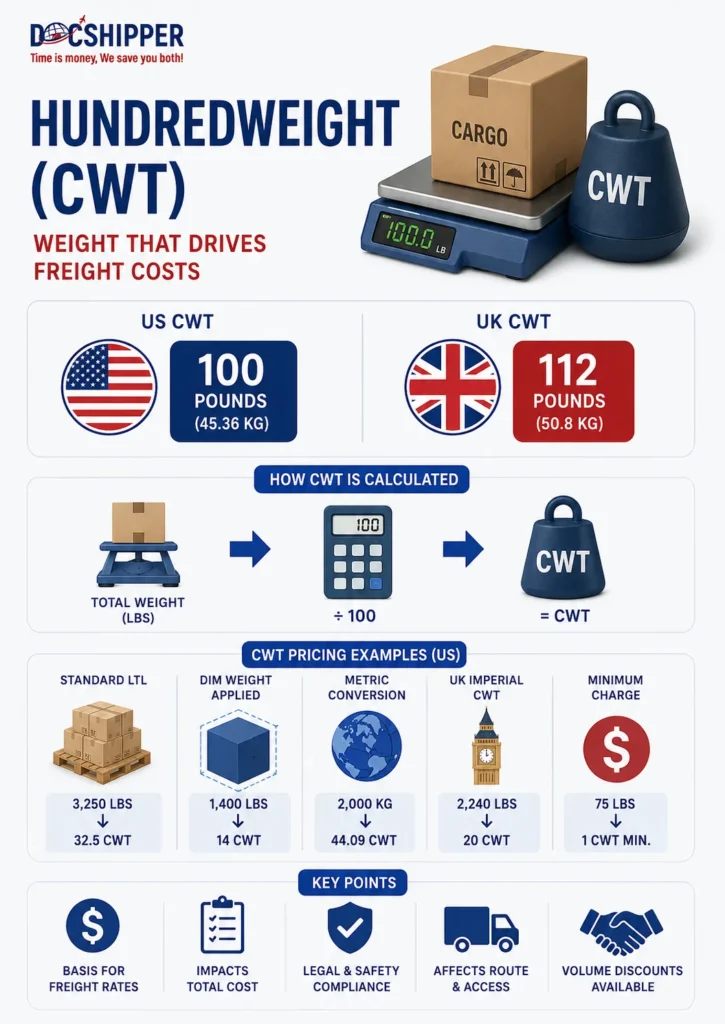
The hundredweight (CWT) is a traditional unit of mass used primarily in shipping and freight logistics to calculate transportation costs. In the United States, one hundredweight equals 100 pounds (45.36 kg), while in the UK, it represents 112 pounds (50.8 kg). Understanding CWT is essential for accurate freight cost estimation and invoice verification in international trade.
Introduction
Confusion between American and British measurement systems creates frequent billing disputes in international logistics. Shippers often receive unexpected charges because they misunderstand how carriers calculate CWT-based rates.
The hundredweight remains a cornerstone metric in North American freight pricing, particularly for Less-than-Truckload (LTL) shipments. Understanding this unit prevents costly errors and enables accurate budget forecasting.
Key characteristics of CWT in logistics:
- Dual standards: US CWT (100 lbs) versus UK/Imperial CWT (112 lbs)
- Rate structure foundation: LTL carriers base pricing on cost per CWT
- Weight threshold impact: Shipments crossing CWT boundaries trigger different rate classes
- Dimensional weight consideration: Carriers may apply CWT to adjusted weight, not actual weight
- Discount mechanisms: Volume shippers negotiate reduced rates per CWT
Understanding CWT in Freight Operations
Freight carriers developed the hundredweight system to standardize pricing across variable shipment sizes. The rate per hundredweight allows carriers to quote consistent prices while accounting for weight-based handling complexity.
The US short hundredweight (100 pounds) dominates American logistics networks. When shipping from Asia to North American destinations, forwarders convert metric weights to CWT for final-mile pricing. A 500 kg shipment equals approximately 11.02 CWT in the US system (1,102 lbs ÷ 100).
The UK long hundredweight (112 pounds), though less common today, still appears in Commonwealth shipping documentation. This creates complications when coordinating transatlantic shipments. At DocShipper, we verify which CWT standard applies to your specific trade lane to prevent billing surprises.
Carriers apply dimensional weight pricing when shipments occupy excessive space relative to actual weight. If dimensional weight exceeds actual weight, the CWT calculation uses the higher figure. This practice, governed by NMFTA classification rules, significantly impacts lightweight, bulky cargo like furniture or electronics packaging.
The freight class system interacts directly with CWT pricing. The National Motor Freight Classification (NMFC) assigns commodities to classes 50-500 based on density, handling, stowability, and liability. Lower classes receive lower rates per CWT. Understanding your product’s freight class prevents overpayment and ensures accurate quotes.
Calculation Methods & Real-World Examples
Calculating freight costs using CWT requires converting total shipment weight into hundredweight units, then multiplying by the carrier’s rate. The formula depends on which measurement system applies to your shipment route.
Practical calculation scenarios:
| Scenario | Actual Weight | CWT Calculation | Rate/CWT | Total Cost |
|---|---|---|---|---|
| Standard LTL (US) | 3,250 lbs | 3,250 ÷ 100 = 32.5 CWT | $45.00 | $1,462.50 |
| Dimensional Weight Application | 800 lbs (DW: 1,400 lbs) | 1,400 ÷ 100 = 14 CWT | $52.00 | $728.00 |
| Metric Conversion (Import) | 2,000 kg (4,409 lbs) | 4,409 ÷ 100 = 44.09 CWT | $38.50 | $1,697.47 |
| UK Imperial CWT | 2,240 lbs | 2,240 ÷ 112 = 20 CWT | £42.00 | £840.00 |
| Minimum Charge Threshold | 75 lbs | 1 CWT minimum applied | $65.00 | $65.00 |
Use Case: Electronics Manufacturer Export
A California-based electronics manufacturer ships 15 pallets of tablet computers to Toronto. Each pallet weighs 220 pounds, totaling 3,300 pounds. The carrier quotes $42.50 per CWT for freight class 85.
Calculation: 3,300 lbs ÷ 100 = 33 CWT × $42.50 = $1,402.50 base freight. Additional fuel surcharges (18%) and customs processing fees apply separately. The shipper initially budgeted based on volumetric estimates, but actual CWT calculation revealed a $230 difference. DocShipper’s pre-shipment verification would have identified this discrepancy during quote validation.
Critical Considerations for CWT Pricing:
- Rounding practices: Most carriers round up partial hundredweights (8.3 CWT becomes 9 CWT)
- Accessorial charges: Liftgate service, residential delivery, and inside delivery add fixed fees beyond CWT rates
- Freight class verification: Incorrect class declarations trigger re-weigh/re-class fees averaging $75-150
- Density thresholds: Shipments below 6 lbs/cubic foot typically face dimensional weight pricing
- Volume discount tiers: Shippers exceeding 10,000 lbs monthly qualify for 15-25% reduced CWT rates
Conclusion
Mastering hundredweight calculations prevents budget overruns and enables strategic carrier negotiations. The CWT system, though traditional, remains fundamental to North American freight economics and directly impacts your landed costs.
Need assistance optimizing your freight costs or verifying CWT-based quotes? Contact DocShipper for expert logistics support tailored to your shipping requirements.
📚 Quiz
Test Your Knowledge: Hundredweight (CWT) in Freight Logistics
What is the primary difference between US hundredweight (CWT) and UK hundredweight?
When do freight carriers apply dimensional weight instead of actual weight for CWT pricing?
A textile importer ships 2,500 pounds of fabric from Los Angeles to Chicago. The carrier quotes $48.00 per CWT. What is the correct freight cost calculation?
🎯 Your Result
📞 Free Quote in 24hFAQ | Hundredweight (CWT): Definition, Calculation & Practical Examples
The US hundredweight (short CWT) equals 100 pounds or 45.36 kilograms, while the UK hundredweight (long or imperial CWT) equals 112 pounds or 50.8 kilograms. The US system dominates international logistics, but Commonwealth trade lanes occasionally use imperial measurements. Always verify which standard your carrier applies to avoid a 12% calculation discrepancy.
Carriers compare actual weight against dimensional weight (calculated as Length × Width × Height ÷ Dimensional Factor, typically 139 for domestic US shipments). The higher value determines billable weight. Low-density shipments like pillows or packaging materials almost always trigger dimensional weight pricing, increasing effective CWT costs significantly.
These are identical measurements—"per 100 lbs" and "per CWT" mean the same thing in US logistics. Carriers use the terms interchangeably. International forwarders sometimes specify "per 100 lbs" for clarity when working with metric-system clients unfamiliar with the CWT abbreviation.
LTL carriers predominantly use CWT pricing, while Full Truckload (FTL) carriers typically charge flat rates per shipment regardless of weight (within maximum limits). Air freight uses different metrics like chargeable weight per kilogram. Ocean freight relies on container rates or cubic meter pricing. The shipping mode determines the pricing structure.
The National Motor Freight Classification assigns each commodity a class from 50 to 500 based on density, handling difficulty, liability, and stowability. Lower classes (denser, easier-to-handle goods) receive lower rates per CWT. A class 50 shipment might cost $25/CWT while class 400 (fragile, low-density items) could reach $95/CWT on the same lane.
Most carriers round up to the next full hundredweight. A 3,250-pound shipment becomes 33 CWT (not 32.5). Some carriers offer "exact CWT" pricing for high-volume customers, billing 32.5 CWT precisely, but this requires negotiated contracts. Standard tariffs almost universally apply rounding-up policies.
Absolutely. Shippers with consistent volume (typically 5,000+ pounds monthly) qualify for contract rates 20-40% below published tariffs. Leverage annual shipping volume, consistent lane commitments, and competitive quotes during negotiations. Third-party logistics providers like DocShipper access pre-negotiated volume rates unavailable to individual shippers.
Use this formula: Kilograms × 2.2046 ÷ 100 = US CWT. For example, 1,000 kg × 2.2046 = 2,204.6 lbs ÷ 100 = 22.046 CWT (typically rounded to 23 CWT). Online conversion tools automate this, but understanding the calculation helps verify carrier invoices and identify billing errors.
Yes. Most LTL carriers impose minimum charges equivalent to 1-2 CWT even for lighter shipments. A 50-pound package might be billed at the 1 CWT rate ($45-75 depending on lane). This makes parcel carriers more economical for shipments under 150 pounds, while LTL becomes cost-effective above that threshold.
Expect fuel surcharges (15-25% of base rate), accessorial fees for special services (liftgate, residential delivery, inside pickup), and potential re-class/re-weigh fees if declared information proves inaccurate. Customs brokerage, documentation fees, and destination charges apply to international shipments. Total costs typically exceed base CWT charges by 35-50%.
LTL makes economic sense when your CWT-based cost falls below the FTL flat rate (usually around 10,000-12,000 lbs depending on lane). Calculate total LTL cost including accessorials and compare against FTL quotes. Exclusive truck use, faster transit, and reduced handling damage risk justify FTL premiums for time-sensitive or fragile shipments even at lower weights.
Significantly. A shipment from Los Angeles to Phoenix might cost $30/CWT, while the same goods to Miami could run $65/CWT due to distance, lane density, and backhaul availability. Cross-border shipments to Canada or Mexico add 15-30% to domestic CWT rates. Always request lane-specific quotes rather than assuming uniform pricing.
Need Help with
Logistics or Sourcing ?
First, we secure the right products from the right suppliers at the right price by managing the sourcing process from start to finish. Then, we simplify your shipping experience - from pickup to final delivery - ensuring any product, anywhere, is delivered at highly competitive prices.


Fill the Form
Prefer email? Send us your inquiry, and we’ll get back to you as soon as possible.
Contact us




:%20Complete%20Definition%20&%20Guide%20for%202026)