


In short ⚡
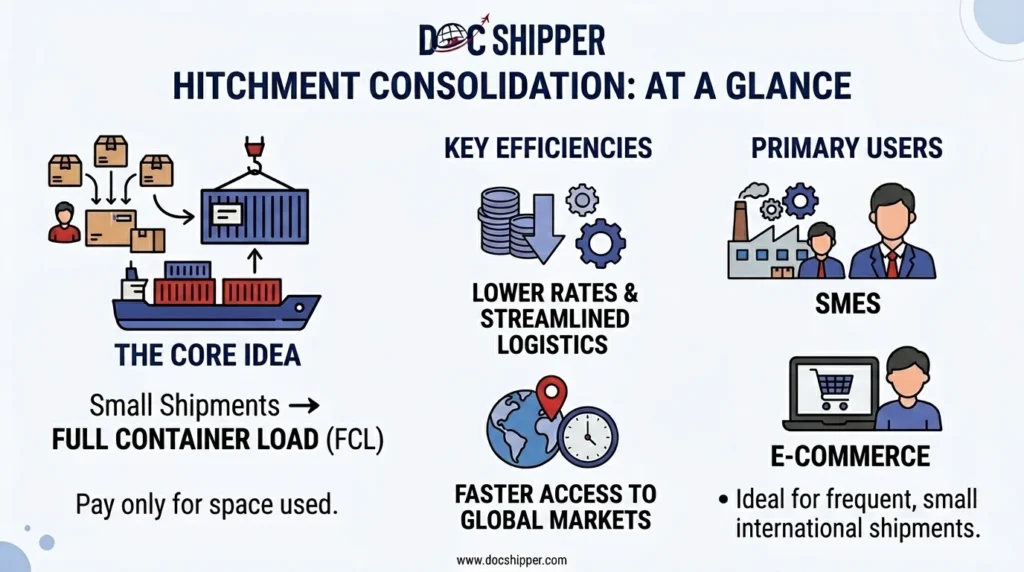
Hitchment is a logistics practice allowing shippers to consolidate multiple small shipments into a single container or vehicle, reducing per-unit transportation costs. This method optimizes freight capacity by combining goods destined for the same region or route, enabling businesses to share transportation expenses while maintaining delivery efficiency.
Introduction
Many importers struggle with high transportation costs when their shipment volumes don’t justify booking an entire container. The traditional choice between expensive air freight and slow, underutilized ocean containers creates a painful dilemma for mid-sized businesses.
Hitchment emerges as a strategic solution in international trade, particularly relevant for companies dealing with irregular shipping volumes or testing new markets. This consolidation approach bridges the gap between full container loads (FCL) and less-than-container loads (LCL).
- Cost efficiency: Distributes freight expenses across multiple shippers or shipments
- Flexibility: Enables smaller businesses to access international markets without volume constraints
- Speed optimization: Faster than waiting to accumulate full container volumes
- Risk distribution: Shares customs clearance and handling processes
- Environmental impact: Maximizes container utilization, reducing carbon footprint per unit shipped
Understanding Hitchment Mechanics & Applications
The hitchment process operates through freight consolidation hubs where logistics providers aggregate compatible shipments. Unlike standard LCL services, hitchment specifically targets planned routes and established shipping schedules, creating predictable cost structures.
From a legal perspective, hitchment arrangements require clear documentation regarding liability boundaries. Each shipper maintains individual bills of lading, but shares the master bill for the consolidated container. The World Customs Organization guidelines emphasize that each party remains independently responsible for their cargo’s customs compliance.
Container optimization algorithms determine hitchment feasibility. Freight forwarders analyze weight distribution, dimensional characteristics, and commodity compatibility. Hazardous materials, temperature-sensitive goods, and high-value items typically require separate handling protocols.
The pricing mechanism differs fundamentally from spot-rate shipping. Hitchment costs calculate based on volumetric weight (whichever is greater between actual weight and dimensional weight). Most providers apply a minimum chargeable weight threshold, typically 100 kg for ocean freight and 45 kg for air hitchment services.
Transit time implications vary significantly. While hitchment adds 3-7 days compared to direct FCL shipping due to consolidation delays, it remains 40-60% faster than waiting to accumulate full container volumes. At DocShipper, we coordinate hitchment schedules to minimize consolidation waiting periods, ensuring your goods move efficiently through our global network.
The deconsolidation process at destination ports introduces additional considerations. Import duties and clearance procedures apply individually to each shipment within the consolidated container. Delays affecting one shipper’s cargo can occasionally impact the entire container’s release, making partner selection critical.
Cost Analysis & Real-World Scenarios
Understanding hitchment economics requires examining concrete financial comparisons. The savings potential varies based on route density, commodity type, and shipment frequency.
Comparative Cost Scenario: Shanghai to Hamburg
| Shipping Method | Volume | Total Cost | Cost per CBM | Transit Time |
|---|---|---|---|---|
| FCL (20ft) | 33 CBM | $2,800 | $85 | 28 days |
| Hitchment | 8 CBM | $920 | $115 | 32 days |
| Standard LCL | 8 CBM | $1,280 | $160 | 35 days |
| Air Freight | 8 CBM | $3,200 | $400 | 5 days |
This comparison reveals hitchment delivers 28% cost savings versus standard LCL while adding only 4 days to transit time. For the 8 CBM shipment, choosing FCL would waste 25 CBM of paid capacity.
Real-World Use Case: Electronics Importer
A European retailer sources consumer electronics from three Taiwanese suppliers quarterly. Individual shipment volumes range from 5-12 CBM, making FCL economically unfeasible.
Challenge: Each supplier ships independently, resulting in three separate LCL shipments per quarter at $145/CBM average.
Hitchment Solution: The retailer coordinates a consolidated hitchment schedule, combining all three suppliers’ goods into predetermined monthly shipments.
Results:
- Freight costs reduced by $18,400 annually (31% savings)
- Customs clearance simplified to one process instead of three
- Inventory predictability improved through scheduled departure dates
- Supplier relationships strengthened through coordinated production planning
Key Decision Factors
Hitchment proves most effective when:
- Shipment frequency: Regular but sub-container volumes (3-15 CBM typical sweet spot)
- Route density: High-traffic lanes with multiple weekly consolidation opportunities
- Commodity type: Non-perishable, standard-handling goods without extreme temperature requirements
- Time sensitivity: Moderate urgency allowing 3-7 day consolidation windows
- Supply chain maturity: Established procurement patterns enabling predictable shipping schedules
Industry data indicates hitchment adoption has grown 127% since 2019, primarily among mid-market importers seeking to balance cost efficiency with delivery reliability. DocShipper’s consolidation network spans 47 countries, enabling us to identify hitchment opportunities that traditional forwarders might overlook.
Conclusion
Hitchment represents a sophisticated logistics strategy that transforms shipping economics for businesses operating between LCL and FCL volumes. By understanding consolidation mechanics and cost structures, importers unlock substantial savings while maintaining operational flexibility.
Need expert guidance on optimizing your shipping strategy? Contact DocShipper for a customized consolidation analysis tailored to your supply chain requirements.
📚 Quiz
Test Your Knowledge: Hitchment
What is the primary definition of hitchment in logistics?
How does hitchment differ from standard LCL (Less-than-Container Load) shipping?
A European electronics retailer ships 8 CBM quarterly from Taiwan. Which shipping method would be most cost-effective based on the Shanghai-Hamburg comparison?
🎯 Your Result
📞 Free Personalized QuoteFAQ | Hitchment: Definition, Calculation & Practical Examples
Most freight forwarders require a minimum of 1 CBM (cubic meter) or 100 kg for ocean hitchment. Air hitchment typically starts at 45 kg. Shipments below these thresholds usually incur minimum charge fees that negate consolidation benefits. The optimal hitchment range spans 3-15 CBM for ocean freight and 100-500 kg for air services.
While both involve shared container space, hitchment operates on predetermined schedules with committed shipper partnerships, whereas LCL aggregates random shipments opportunistically. Hitchment typically offers 15-30% lower rates than LCL due to reduced handling complexity and predictable routing. Transit times for hitchment average 2-5 days faster because consolidation occurs on fixed schedules rather than waiting for container fill rates.
Dangerous goods classifications (IMO/IATA) generally prohibit hitchment for safety and regulatory reasons. Exceptions exist for low-risk categories (Class 9 miscellaneous) when properly documented and segregated. Most consolidators exclude batteries, flammables, compressed gases, and corrosives from hitchment programs. Specialized hazmat consolidators exist but charge premium rates that eliminate typical hitchment cost advantages.
Liability follows individual bills of lading within the master container. Cargo insurance remains shipper-specific, with claims processed independently. Container damage affecting multiple shipments triggers proportional liability assessments based on cargo positioning and proximate cause analysis. Comprehensive marine insurance covering consolidation scenarios is essential—standard policies may exclude shared-container risks.
Ocean hitchment requires 7-14 days advance booking for optimal consolidation positioning. Air hitchment typically needs 3-5 days notice. Rush hitchment (48-72 hours) exists but commands 25-40% premium pricing. Establishing scheduled hitchment arrangements with quarterly commitments unlocks preferential rates and guaranteed space allocation during peak seasons.
Dimensional restrictions apply based on container type and consolidation methodology. Standard hitchment accommodates palletized cargo up to 2.4m height and 1,500 kg per pallet. Machinery, vehicles, or items exceeding these parameters require specialized break-bulk services. Weight distribution regulations mandate that no single consolidated item exceeds 40% of total container weight to maintain stability.
Asia-Europe, Asia-North America, and intra-Asia routes provide the highest consolidation frequencies with 15-30% cost advantages. Emerging markets and low-density routes (Africa, South America) offer limited hitchment options due to irregular vessel schedules. Transatlantic routes show moderate hitchment availability with 10-20% savings compared to standard LCL.
Each shipper within a consolidated container maintains separate customs entries with individual HS codes, duties, and clearance requirements. The master bill facilitates container release, but individual house bills govern duty assessment. Delays in one shipper's documentation can temporarily hold the entire container at destination, making pre-clearance preparation critical for hitchment efficiency.
Multi-supplier consolidation represents a primary hitchment application, particularly effective when sourcing from geographic clusters (Pearl River Delta, Yangtze River region). This requires coordinating production schedules and establishing a single consignee for simplified customs processing. Trade compliance regulations demand accurate supplier identification on commercial invoices regardless of consolidation arrangements.
Essential documents include individual commercial invoices per shipper, packing lists detailing contents and weights, house bills of lading, and a master bill covering the consolidated container. Certificate of origin, import licenses, and product-specific certifications (FDA, CE, FCC) remain individually required. Consolidators typically mandate digital documentation submission 72 hours before container stuffing.
Modern consolidators provide container-level tracking via master bill number and individual shipment tracking through house bill references. Real-time visibility systems show consolidation status, departure confirmations, and deconsolidation schedules. GPS-enabled containers offer location precision, though granular tracking at the individual shipment level within consolidated cargo remains technologically limited until deconsolidation occurs.
Peak shipping seasons (August-October for retail inventory buildup) reduce hitchment availability by 30-50% as shippers book full containers. Rates increase 15-35% during these periods due to capacity constraints. Chinese New Year creates 3-4 week consolidation gaps requiring advance planning. Counter-seasonal hitchment (January-March, post-holiday) offers optimal rates with 20-40% discounts versus peak periods and abundant consolidation slots.
Need Help with
Logistics or Sourcing ?
First, we secure the right products from the right suppliers at the right price by managing the sourcing process from start to finish. Then, we simplify your shipping experience - from pickup to final delivery - ensuring any product, anywhere, is delivered at highly competitive prices.


Fill the Form
Prefer email? Send us your inquiry, and we’ll get back to you as soon as possible.
Contact us




