


In short ⚡
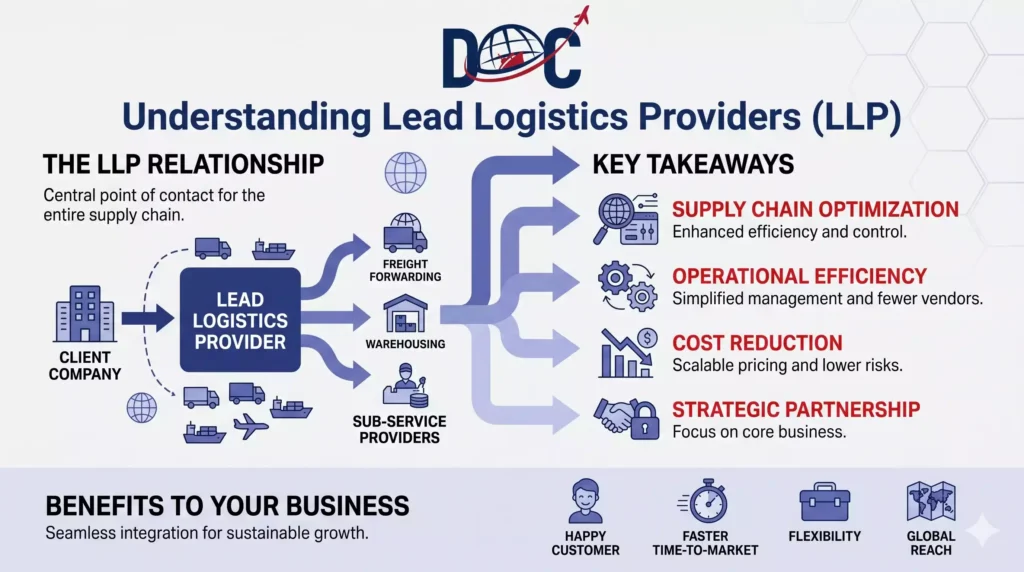
A Lead Logistics Provider (LLP) is a strategic logistics partner that orchestrates and manages multiple third-party logistics providers (3PLs) on behalf of a shipper. Unlike traditional 3PLs, an LLP acts as the central coordinator of the entire supply chain, optimizing operations across carriers, warehouses, and freight forwarders while maintaining direct accountability to the client.
Introduction
Many companies struggle with fragmented logistics operations involving dozens of service providers. Communication gaps, inconsistent performance, and lack of visibility create inefficiencies that erode margins and customer satisfaction.
The Lead Logistics Provider model emerged to solve this coordination crisis. By centralizing supply chain management under one strategic partner, businesses gain operational coherence without building internal logistics infrastructure.
Key characteristics of an LLP arrangement include:
- Single point of accountability for all logistics operations
- Network orchestration across multiple specialized 3PLs
- Technology integration providing end-to-end supply chain visibility
- Strategic optimization rather than transactional execution
- Risk management and compliance oversight across borders
This model particularly benefits companies with complex international operations, multiple product lines, or rapid growth trajectories requiring scalable logistics solutions.
In-Depth Analysis & Strategic Expertise
The LLP operates fundamentally differently from traditional logistics providers. Rather than owning trucks or warehouses, the LLP functions as an integrator and optimizer of existing logistics assets.
The core responsibilities include carrier selection and management, where the LLP evaluates, negotiates with, and monitors performance of freight forwarders, ocean carriers, and last-mile providers. This eliminates the burden of managing dozens of vendor relationships individually.
A critical function is supply chain design and network optimization. The LLP analyzes shipment patterns, inventory positioning, and distribution routes to recommend structural improvements. This strategic layer differentiates LLPs from purely operational 3PLs.
Technology integration represents another distinctive capability. LLPs deploy unified platforms that aggregate data from disparate systems—ERPs, warehouse management systems, customs portals—into single dashboards providing real-time visibility across the entire supply chain.
The compliance and risk management dimension is particularly valuable for international trade. According to World Trade Organization reports, customs regulations across major trading nations evolve constantly, creating compliance complexity that LLPs navigate through specialized expertise.
At DocShipper, we often collaborate with LLPs to execute specific international shipments while they maintain overall supply chain orchestration. This partnership model ensures clients benefit from specialized execution expertise within a coordinated strategic framework.
Concrete Examples & Industry Data
Understanding the LLP model becomes clearer through practical implementation scenarios and quantified business impacts.
Use Case: Consumer Electronics Manufacturer
A European electronics brand manufacturing in Southeast Asia faced coordination challenges managing 12 separate logistics providers across ocean freight, customs brokerage, European distribution, and reverse logistics.
After engaging an LLP, results within 18 months included:
- 23% reduction in total logistics costs through consolidated negotiations
- 40% improvement in on-time delivery performance
- Single dashboard replacing 8 different tracking systems
- 65% faster customs clearance through standardized documentation
Comparative Model Analysis
| Characteristic | Traditional 3PL | Lead Logistics Provider |
|---|---|---|
| Scope | Specific services (transport, warehousing) | End-to-end supply chain orchestration |
| Asset Model | Owns/leases physical assets | Asset-light; coordinates other providers |
| Client Relationship | Transactional vendor | Strategic partner |
| Technology Focus | Internal operations optimization | Integration across multiple systems |
| Pricing Model | Per-transaction or volume-based | Management fee + performance incentives |
Financial Impact Data
Industry research from supply chain consultancies indicates:
- 15-30% cost savings typically achieved through LLP consolidation within first two years
- 50-70% reduction in administrative burden related to logistics management
- Average ROI of 250% over three-year LLP engagement periods
- Inventory reduction of 20-35% through improved visibility and coordination
The LLP model proves particularly effective for companies with annual logistics spend exceeding $10 million or those managing more than five active 3PL relationships simultaneously.
Conclusion
The Lead Logistics Provider model transforms fragmented supply chain operations into coordinated strategic assets. By centralizing accountability while leveraging specialized provider networks, LLPs deliver both cost efficiency and operational excellence.
Need guidance on structuring your logistics operations or implementing supply chain coordination? Contact DocShipper for expert consultation tailored to your international trade requirements.
📚 Quiz
Test Your Knowledge: Lead Logistics Provider (LLP)
What is the primary function of a Lead Logistics Provider (LLP)?
Which characteristic best distinguishes an LLP from a traditional 3PL?
A European electronics manufacturer managing 12 separate logistics providers across ocean freight, customs, and distribution would benefit from an LLP primarily because:
🎯 Your Result
📞 Free Personalized QuoteFAQ | Lead Logistics Provider (LLP): Definition, Functions & Concrete Examples
The terms are often used interchangeably, though some define 4PL as broader strategic consulting beyond operational coordination. Both involve managing multiple 3PLs, but 4PL may include supply chain redesign and technology implementation as primary services. The functional distinction varies by provider, making specific capability assessment more important than label.
Initial setup ranges from 3-6 months for basic coordination to 12-18 months for full integration including technology deployment and complete network optimization. Timeline depends on supply chain complexity, number of existing providers, and geographic scope. Most organizations begin seeing measurable benefits within the first 6 months.
No. LLPs operate under governance structures defining decision authority, escalation procedures, and approval thresholds. Clients retain strategic control while delegating operational execution. Well-structured LLP contracts include performance metrics, audit rights, and exit provisions ensuring accountability without micromanagement.
Companies with annual logistics spend above $10 million typically achieve the best ROI. However, rapidly scaling businesses or those entering new markets may benefit earlier. The key indicator is operational complexity—multiple 3PLs, international operations, or specialized handling requirements—rather than absolute company size.
Compensation models vary but typically combine management fees (percentage of logistics spend or fixed retainer) with performance-based incentives tied to cost savings, delivery metrics, or inventory efficiency. Some arrangements include gain-sharing mechanisms where the LLP receives a portion of savings generated beyond baseline performance.
Yes. Leading LLPs coordinate global networks including customs brokerage, freight forwarding, domestic distribution, and last-mile delivery. This integrated approach provides particular value for companies with complex international supply chains requiring compliance management across multiple regulatory jurisdictions.
Professional LLP contracts include defined KPIs, performance review cycles, and remediation procedures. Most agreements allow for performance improvement plans, fee adjustments, or contract termination with transition assistance. Careful provider selection and clear performance metrics minimize these risks.
Not necessarily. Effective LLPs assess current provider performance and may retain high-performing partners while replacing underperformers. The transition is typically phased, allowing business continuity while optimizing the provider network. Some specialized 3PLs with unique capabilities often remain within the LLP-coordinated network.
The LLP acts as neutral coordinator with contractual authority to resolve operational conflicts. This includes standardizing communication protocols, defining service handoffs, and establishing escalation procedures. By maintaining direct contracts with all providers, the LLP enforces performance standards and resolves issues without client involvement.
Most LLPs provide cloud-based platforms requiring minimal client IT infrastructure. Integration typically involves API connections to existing ERP and order management systems. The LLP handles technical integration with individual 3PL systems, consolidating data into unified dashboards. Implementation complexity depends on legacy system capabilities and data standardization requirements.
Yes. Well-structured LLP agreements include flexibility mechanisms for tactical adjustments within defined parameters. Strategic changes (new markets, major carrier switches) typically require formal amendments, while operational modifications (route optimization, carrier substitutions) occur through regular governance processes without contract changes.
Reputable LLPs implement enterprise-grade security protocols including encrypted data transmission, role-based access controls, and regular security audits. Contracts should specify data ownership, protection standards, and compliance with regulations like GDPR. The LLP acts as data steward, enforcing security standards across all network participants while maintaining client confidentiality.
Need Help with
Logistics or Sourcing ?
First, we secure the right products from the right suppliers at the right price by managing the sourcing process from start to finish. Then, we simplify your shipping experience - from pickup to final delivery - ensuring any product, anywhere, is delivered at highly competitive prices.


Fill the Form
Prefer email? Send us your inquiry, and we’ll get back to you as soon as possible.
Contact us




:%20Definition,%20Functions%20&%20Concrete%20Examples)