


In short ⚡
A leg is a distinct segment of a shipment's journey between two specific points in the transportation chain. In international logistics, a shipment typically involves multiple legs—from factory to port, ocean transit, and final delivery—each requiring separate documentation, carriers, and cost calculations. Understanding legs is essential for accurate freight costing, transit time estimation, and supply chain visibility.
Introduction
Many importers struggle to understand why their shipping quote contains five different line items. The confusion stems from not recognizing that international freight isn’t a single journey—it’s a sequence of distinct legs.
Each leg represents a separate transport phase with its own carrier, mode, cost structure, and potential delays. Missing this distinction leads to budget overruns, missed delivery windows, and supply chain disruptions.
In modern logistics, the leg concept enables:
- Granular cost tracking – isolate expenses by transport segment
- Multimodal optimization – combine sea, air, rail, and road efficiently
- Risk management – identify where delays or damage most commonly occur
- Carrier accountability – clarify responsibilities across the supply chain
- Documentation compliance – match paperwork to each transport phase
Understanding Legs: Technical & Operational Depth
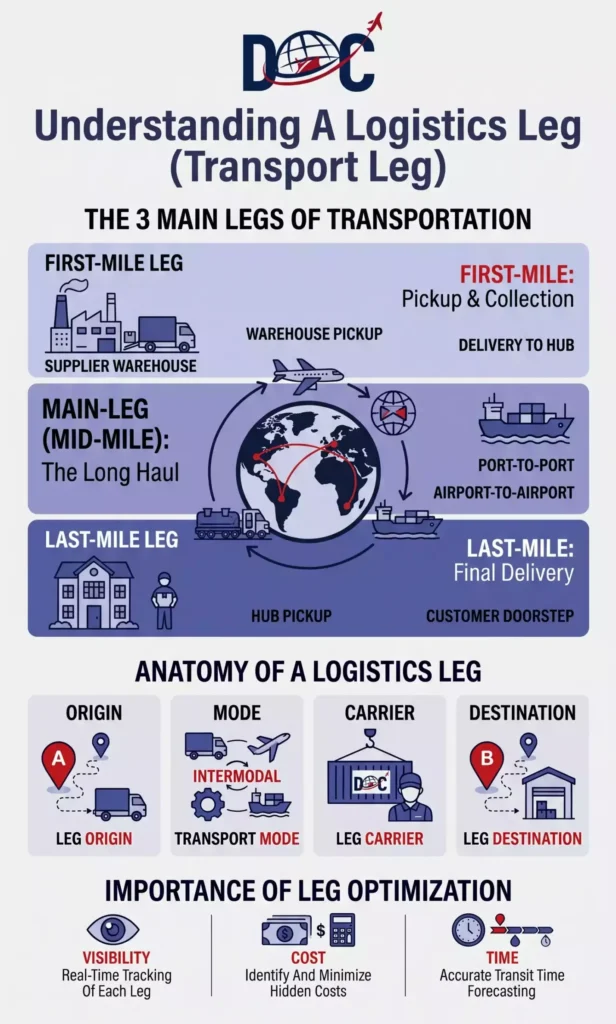
A leg is defined by its origin-destination pair and the transport mode used. For example, a shipment from Shanghai to Paris might include four legs: inland trucking to Shanghai port, ocean freight to Rotterdam, customs clearance, and final delivery to Paris.
The first-mile leg covers movement from supplier to export gateway. This often involves inland trucking, and delays here cascade through the entire journey. In China, factory-to-port legs can take 2-5 days depending on congestion and distance.
The main leg represents the primary long-haul segment—typically ocean or air freight. Ocean legs from Asia to Europe average 30-40 days, while air legs take 3-7 days. This leg usually accounts for 60-75% of total freight costs.
The last-mile leg handles delivery from arrival port to final destination. This phase is notoriously complex due to urban congestion, delivery windows, and recipient availability. At DocShipper, we coordinate last-mile timing with customs clearance to avoid storage fees.
Transshipment legs occur when cargo transfers between vessels at intermediate ports. A Shanghai-to-Miami shipment might transship through Busan or Long Beach, adding 5-10 days but reducing costs by 20-30% compared to direct services.
Each leg generates separate documentation: inland bills of lading, ocean bills of lading, air waybills, or CMR consignment notes for road transport. Legal liability transfers at each leg boundary, making clear documentation essential for insurance claims. The ICC Incoterms® define exactly where seller and buyer responsibilities shift between legs.
Concrete Examples & Data Analysis
Consider a use case: A textile importer ships 10 containers from Bangladesh to New York. The journey comprises four legs with distinct characteristics:
| Leg | Route | Mode | Duration | Cost/Container | Risk Factor |
|---|---|---|---|---|---|
| 1 | Factory to Chittagong Port | Truck | 3 days | $180 | Medium (road conditions) |
| 2 | Chittagong to Singapore | Ocean | 12 days | $850 | Low (direct service) |
| 3 | Singapore to New York | Ocean | 28 days | $2,400 | Medium (transshipment) |
| 4 | New York Port to Warehouse | Truck | 2 days | $320 | High (customs delays) |
Total journey: 45 days and $3,750 per container. Notice how the main ocean leg (Singapore-New York) represents 64% of costs but only contributes to 62% of delays.
A comparative scenario illustrates optimization potential. The same shipment using air freight for the main leg would restructure as:
- Factory to Dhaka Airport – Truck, 1 day, $200
- Dhaka to New York – Air, 18 hours, $8,500
- Airport to Warehouse – Truck, 1 day, $280
This reduces transit to 3 days but increases cost to $8,980 per container—a 139% premium. The decision hinges on inventory carrying costs versus freight premiums.
Key operational insights: First-mile and last-mile legs together account for just 11% of ocean freight transit time but cause 40-50% of delivery unpredictability. At DocShipper, we use GPS tracking on inland legs to provide real-time visibility where delays most commonly occur.
Conclusion
Understanding legs transforms freight management from guesswork to strategic planning. Each segment demands specific documentation, carrier selection, and contingency planning to maintain supply chain efficiency.
Need expert guidance on optimizing your multi-leg shipments? Contact DocShipper for comprehensive logistics support across all transport phases.
📚 Quiz
Test Your Knowledge: Leg in Logistics
What defines a "leg" in international logistics?
Which leg typically causes the most delivery unpredictability in international shipping?
A shipment moves from Shanghai factory → Shanghai port (truck) → Rotterdam port (ocean) → Paris warehouse (truck). How many legs does this shipment involve?
🎯 Your Result
📞 Free Quote in 24hFAQ | Leg in Logistics: Definition, Calculation & Concrete Examples
A route is the complete path from origin to destination, while a leg is one segment of that route. A Shanghai-to-London route might consist of four legs: factory pickup, ocean freight, customs clearance, and final delivery. Each leg has distinct carriers, documentation, and pricing.
Count each point where the cargo changes transportation mode or carrier. A typical door-to-door ocean shipment includes: inland trucking to port (leg 1), ocean freight (leg 2), destination port handling (leg 3), and final delivery trucking (leg 4). Transshipments add additional legs.
Different carriers, modes, and jurisdictions apply distinct pricing structures. Ocean freight rates depend on container type and route, while inland trucking charges by distance and weight. Customs clearance, port handling, and last-mile delivery each involve separate service providers with independent fee schedules.
Modern logistics platforms provide leg-by-leg visibility. Container tracking shows ocean leg movements, while GPS systems monitor inland trucking legs. At DocShipper, we consolidate data from all carriers to provide unified tracking across every transport segment in your supply chain.
Delays in earlier legs cascade through subsequent segments. A 3-day first-mile delay might cause you to miss a weekly vessel departure, adding 7 days to total transit. Buffer time between legs—particularly before ocean departures—mitigates these risks. Smart scheduling accounts for typical variability in each leg.
Incoterms define where cost and risk transfer between buyer and seller—often at leg boundaries. Under FOB terms, the seller covers first-mile legs to the export port, while the buyer handles ocean and destination legs. CIF extends seller responsibility through the main ocean leg.
No—air shipments typically involve three legs: ground transport to origin airport, air freight, and delivery from destination airport. While the air segment is fastest, delays often occur during ground legs. Airport congestion and customs processing add variability to first-mile and last-mile phases.
Each leg generates specific paperwork. Inland trucking requires delivery notes or CMR consignment notes. Ocean legs need bills of lading. Air legs use air waybills. Customs clearance—often treated as a separate administrative leg—requires commercial invoices, packing lists, and certificates of origin. Incomplete documentation at any leg causes delays.
Transshipments add 5-10 days on average. Cargo must be unloaded, stored, and reloaded onto connecting vessels. However, transshipment routes often cost 20-30% less than direct services. The trade-off between speed and cost depends on your inventory carrying expenses and customer delivery expectations.
Yes—using a single carrier for multiple legs often reduces total costs through bundled pricing. For example, a freight forwarder might offer combined first-mile pickup and ocean freight at lower rates than booking separately. However, specialized providers sometimes offer better service for specific legs like customs clearance or last-mile delivery.
Last-mile delivery causes the most unpredictability. Urban congestion, limited delivery windows, and recipient availability create frequent delays. Customs clearance—sometimes considered part of the last-mile leg—adds regulatory complexity. First-mile legs in developing regions also present challenges due to infrastructure limitations and documentation errors.
LCL (less-than-container-load) shipments involve additional legs at origin and destination for consolidation and deconsolidation. Your cargo moves from supplier to consolidation warehouse (leg 1), then through standard ocean routing (legs 2-3), before deconsolidation at destination (leg 4) and final delivery (leg 5). FCL eliminates intermediate handling legs.
Need Help with
Logistics or Sourcing ?
First, we secure the right products from the right suppliers at the right price by managing the sourcing process from start to finish. Then, we simplify your shipping experience - from pickup to final delivery - ensuring any product, anywhere, is delivered at highly competitive prices.


Fill the Form
Prefer email? Send us your inquiry, and we’ll get back to you as soon as possible.
Contact us




