


In short ⚡
Freight consolidation is a logistics strategy that combines multiple smaller shipments from different shippers into a single container or vehicle to optimize transportation costs, reduce carbon footprint, and improve delivery efficiency. This method allows businesses to share space and expenses while maintaining regular shipping schedules.Introduction
Many small and medium-sized businesses face a common dilemma: their cargo volumes are too small to justify booking an entire container, yet express shipping proves prohibitively expensive. This gap creates inefficiencies, inflated costs, and missed competitive advantages in international trade.
Freight consolidation emerges as the strategic solution, enabling importers and exporters to access Full Container Load (FCL) rates while shipping Less than Container Load (LCL) volumes. By pooling shipments, businesses transform logistics from a cost burden into a competitive advantage.
Key characteristics of freight consolidation include:
- Cost optimization: Shared transportation expenses reduce per-unit shipping costs by 30-60%
- Scheduled departures: Regular consolidation cycles ensure predictable transit times
- Warehouse coordination: Centralized facilities manage cargo collection, sorting, and distribution
- Customs efficiency: Grouped shipments simplify documentation and clearance procedures
- Environmental impact: Reduced empty space and fewer trips lower carbon emissions significantly
Consolidation Mechanisms & Expertise
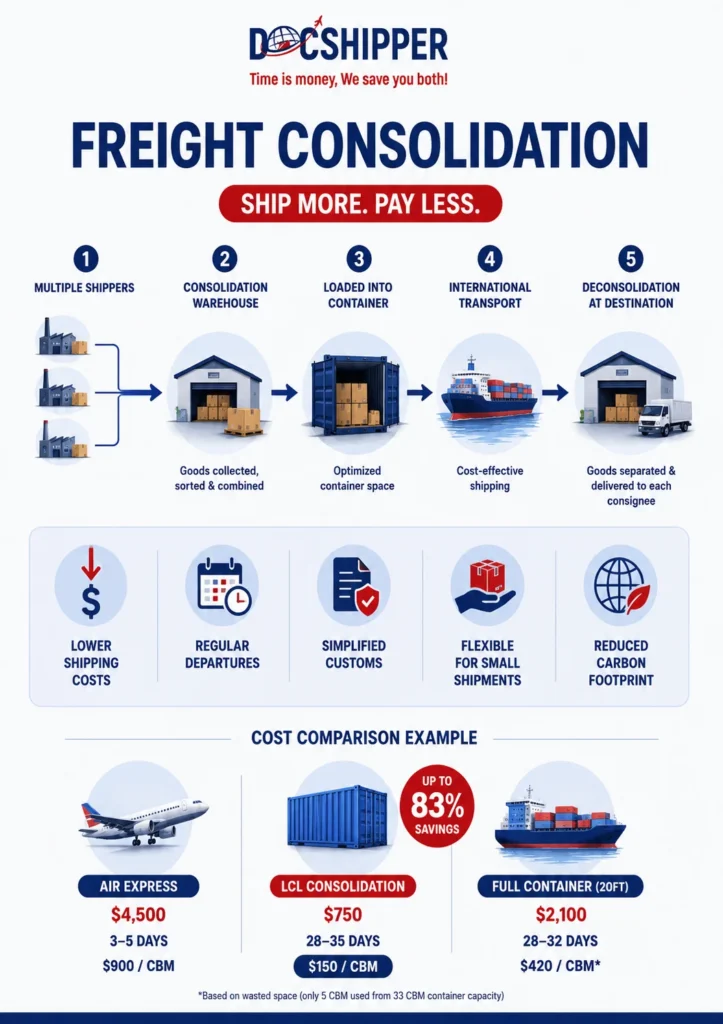
The freight consolidation process operates through a sophisticated network of consolidation warehouses strategically located near major ports and manufacturing hubs. These facilities serve as temporary storage points where cargo from multiple shippers accumulates until reaching optimal container capacity.
Two primary consolidation models dominate international logistics. Buyer’s consolidation occurs when a single importer combines purchases from various suppliers into one shipment, maintaining complete control over timing and routing. Conversely, carrier consolidation involves freight forwarders grouping shipments from different customers heading to the same destination, offering economies of scale but less individual control.
The deconsolidation process at destination represents the critical reverse operation. Upon arrival, consolidated containers undergo systematic unpacking at break-bulk facilities, where individual shipments are sorted, documented, and prepared for final delivery. This stage requires meticulous inventory management to prevent misrouting or delays.
Legal considerations vary significantly by jurisdiction. According to U.S. Customs and Border Protection, consolidated shipments must include accurate master bills of lading alongside individual house bills for each shipper. The Importer Security Filing (ISF) requirements apply to each beneficial cargo owner, not just the consolidator.
At DocShipper, we systematically verify consolidation eligibility before booking, ensuring your cargo compatibility with other shipments. Our warehouse teams conduct quality checks to prevent damage during loading and guarantee proper weight distribution within containers, which directly impacts ocean freight safety and compliance.
Documentation complexity increases with consolidation. Each shipment requires individual commercial invoices, packing lists, and certificates of origin, while the master consolidation manifest lists all participants. Errors in this documentation cascade into customs delays affecting all parties in the container.
Concrete Examples & Performance Data
Understanding consolidation economics requires examining real-world scenarios. The following comparison illustrates cost differences between shipping methods for a hypothetical 5 cubic meter shipment from Shanghai to Rotterdam:
| Shipping Method | Transit Time | Cost (USD) | Cost per CBM |
|---|---|---|---|
| Air Express | 3-5 days | $4,500 | $900 |
| LCL Consolidation | 28-35 days | $750 | $150 |
| Full Container (20ft) | 28-32 days | $2,100 | $420* |
*Based on wasted space; only 5 CBM utilized from 33 CBM container capacity
The data reveals 83% cost savings when choosing LCL consolidation over air freight, while avoiding the capacity waste inherent in booking a full container for small volumes.
Case Study: Electronics Importer Optimization
A UK-based electronics distributor importing smartphone accessories from multiple Chinese suppliers previously booked individual LCL shipments per supplier, resulting in fragmented arrivals and $12,000 monthly logistics costs. After implementing buyer’s consolidation through DocShipper’s Shenzhen warehouse, the company achieved:
- Monthly cost reduction to $7,200 (40% savings)
- Predictable bi-weekly container departures replacing erratic individual shipments
- Single customs clearance per container versus five separate processes
- Inventory planning improvements due to synchronized arrivals
- Carbon footprint reduction of approximately 2.3 tons CO₂ annually
Industry statistics from the International Federation of Freight Forwarders Associations indicate that 65% of SME importers utilize consolidation services regularly, with adoption rates increasing 18% annually as e-commerce businesses seek cost-effective international sourcing.
Performance benchmarks for consolidation services include warehouse dwell time (optimal: 3-7 days), consolidation frequency (weekly for major routes), and damage rates (industry standard: <0.5%). Premium consolidators like DocShipper maintain even stricter standards through dedicated handling protocols and cargo insurance verification.
Conclusion
Freight consolidation transforms small-volume international shipping from an economic challenge into a strategic advantage, delivering substantial cost savings while maintaining service reliability. Mastering this logistics approach enables businesses to compete globally regardless of shipment size.
Need expert guidance on consolidating your shipments? Contact DocShipper for customized consolidation solutions tailored to your trade lanes and volume requirements.
📚 Quiz
Test Your Knowledge: Freight Consolidation
What is the primary purpose of freight consolidation?
Which statement about consolidated shipments and customs clearance is correct?
A small electronics company needs to ship 4 CBM of goods from Shanghai to Los Angeles. Which shipping method would likely be most cost-effective?
🎯 Your Result
📞 Free Quote in 24hFAQ | Freight Consolidation: Definition, Process & Concrete Examples
Most consolidators accept shipments as small as 1 cubic meter (CBM) or 100 kilograms. However, economic benefits become significant above 2-3 CBM. Smaller volumes may incur minimum charges that reduce cost advantages. Consolidation works best when your cargo occupies 10-70% of a container, allowing shared space with other shippers while maintaining reasonable pricing.
Consolidated shipments typically add 3-7 days to total transit time due to warehouse collection periods and deconsolidation at destination. Direct LCL shipments might depart immediately but follow similar ocean transit durations. The tradeoff involves cost savings versus slight time extensions. Express consolidation services reduce waiting periods to 48-72 hours for premium routes.
Yes, multi-origin consolidation involves collecting goods from various supplier locations to a central warehouse before container loading. This requires coordinating domestic transportation to the consolidation point, adding inland freight costs. The strategy remains cost-effective when the combined savings from consolidated ocean freight exceed inland collection expenses, typically true for shipments over 5 CBM total volume.
Hazardous materials (IMDG Class 1-9) require segregated containers and cannot consolidate with general cargo. Strong-smelling goods (leather, rubber) should not share space with food or textiles. Temperature-controlled cargo needs dedicated reefer containers. Customs regulations also prohibit mixing certain commodity types, such as pharmaceuticals with food products, due to contamination risks and inspection protocols.
Each importer in a consolidated container remains responsible for their portion's customs clearance. The consolidator files the master bill of lading, while individual house bills enable separate customs entries. Customs brokers process entries independently per consignee, meaning one party's compliance issues don't necessarily delay others. However, physical container release requires all clearances to complete before deconsolidation begins.
Pricing typically uses volumetric weight (whichever is greater: actual weight or volume/6000 for air, volume/1000 for ocean). Charges include per-CBM ocean freight, origin consolidation handling ($50-150), destination deconsolidation ($75-200), documentation fees, and any applicable fuel surcharges. Total costs usually appear 40-60% below booking an entire container for small volumes, with exact savings depending on route and volume.
Standard carrier liability covers approximately $2.50 per kilogram for ocean freight under Hague-Visby Rules, insufficient for most commercial cargo. Shippers should purchase all-risk cargo insurance valuing 110% of invoice value plus freight. In consolidation, each party insures their portion separately. Group insurance through the consolidator may offer marginally better rates due to volume discounts on premiums.
Modern consolidators provide tracking at the house bill level, showing container movement plus estimated deconsolidation dates. Real-time GPS tracking follows the entire container, while granular item-level visibility appears after deconsolidation begins. Advanced platforms offer digital milestone updates including warehouse receipt, container loading, vessel departure, arrival, and individual delivery scheduling, typically through online portals or API integrations.
Goods arriving at the consolidation warehouse before the scheduled container loading date enter temporary storage, typically free for 3-5 days. Extended storage beyond free time incurs daily charges ($5-15 per CBM). Conversely, late-arriving cargo may miss the planned departure and wait for the next consolidation cycle, delaying your shipment by the cycle interval (usually 7-14 days on major routes).
Freight consolidation significantly reduces environmental impact by maximizing container space utilization and minimizing empty shipping movements. Studies indicate properly consolidated shipments reduce CO₂ emissions by 20-35% compared to multiple partial loads. A fully utilized container generates approximately 40 grams CO₂ per ton-kilometer versus 60+ grams for half-empty containers, making consolidation both economically and environmentally superior for small-volume shippers.
Required documents include commercial invoice detailing goods value, packing list specifying dimensions and weights, shipper's letter of instruction authorizing the forwarder, and applicable certificates (origin, quality, phytosanitary). The consolidator issues a house bill of lading for your portion while maintaining the master bill. Electronic submission through freight platforms streamlines this process, with most consolidators accepting PDF uploads 48-72 hours before container loading deadlines.
Hybrid strategies effectively balance urgency and cost by air shipping time-sensitive portions while consolidating regular inventory via ocean freight. Businesses often air express initial product launches or restocks, then transition to ocean consolidation for ongoing replenishment. This approach requires careful inventory management and demand forecasting but optimizes total logistics spend. Some advanced freight forwarders offer multi-modal consolidation combining both services under unified management.
Need Help with
Logistics or Sourcing ?
First, we secure the right products from the right suppliers at the right price by managing the sourcing process from start to finish. Then, we simplify your shipping experience - from pickup to final delivery - ensuring any product, anywhere, is delivered at highly competitive prices.


Fill the Form
Prefer email? Send us your inquiry, and we’ll get back to you as soon as possible.
Contact us




