


In short ⚡
Independent Action is a maritime shipping conference mechanism allowing individual carriers to deviate from collectively agreed freight rates or terms without requiring consortium approval. This flexibility enables shipping lines to respond rapidly to market conditions while maintaining membership in collaborative pricing agreements, balancing competitive pricing with operational cooperation.
Introduction
Many importers and exporters face confusion when shipping lines within the same conference suddenly offer different rates. This pricing divergence stems from independent action clauses embedded in maritime agreements. Understanding this mechanism is crucial for supply chain managers negotiating freight contracts.
In global shipping, conferences traditionally set uniform rates for specific routes. However, market volatility and competitive pressures necessitate flexibility. Independent action provisions emerged as the regulatory compromise between antitrust concerns and operational efficiency.
Key characteristics of independent action include:
- Unilateral rate adjustments without conference consensus
- Mandatory notice periods to other conference members
- Temporary or permanent deviations from established tariffs
- Competitive response mechanism preserving market dynamics
- Regulatory compliance framework under maritime law
Legal Framework & Strategic Mechanisms
Independent action operates within strict antitrust parameters established by maritime regulatory authorities. In the United States, the Federal Maritime Commission (FMC) governs these provisions under the Shipping Act. European regulations follow similar principles through EU competition law exemptions.
The mechanism requires carriers to provide advance notification to conference members before implementing divergent rates. Standard notice periods range from 5 to 30 days depending on the conference agreement and regulatory jurisdiction. This transparency prevents anti-competitive collusion while maintaining operational flexibility.
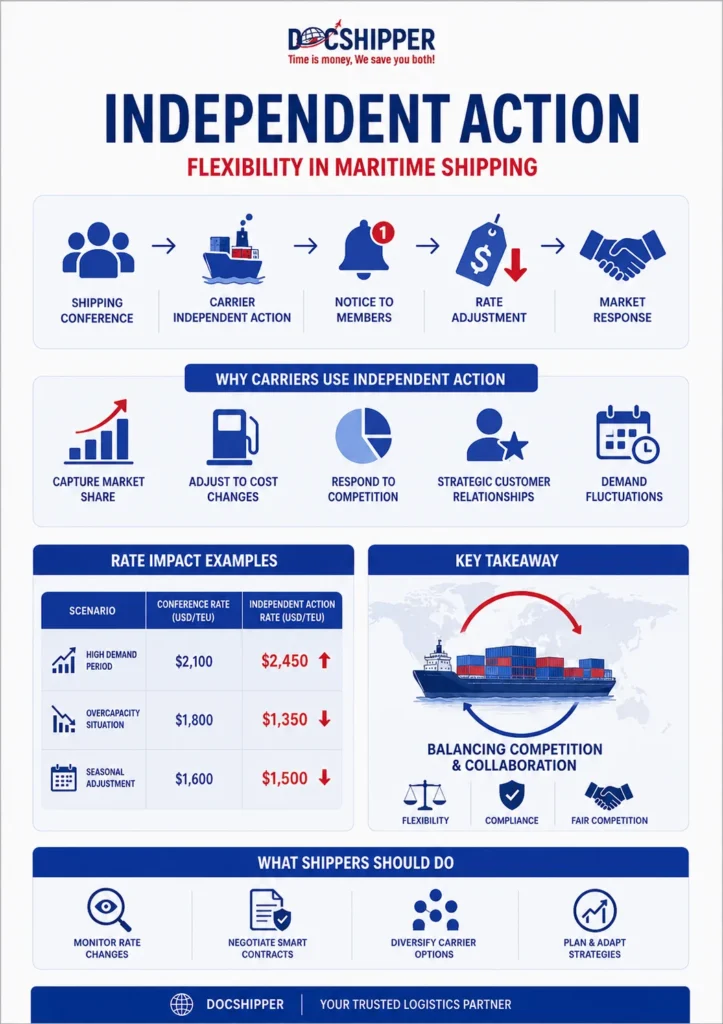
Strategic motivations for exercising independent action include capturing market share during demand fluctuations, responding to competitor pricing, adjusting for fuel cost variations, or addressing specific customer relationships. Carriers must balance short-term competitive gains against long-term conference stability.
The legal distinction separates permitted independent action from prohibited concerted practices. Carriers cannot coordinate independent actions or use the mechanism to circumvent competition law. Regulatory oversight ensures these clauses enhance rather than suppress market competition.
Contractual implications affect service contracts between shippers and carriers. Independent action clauses in conference agreements may override previously negotiated rates, introducing pricing uncertainty. At DocShipper, we systematically review these provisions when negotiating freight agreements to protect our clients from unexpected cost escalations.
Detailed regulatory frameworks are available through the Federal Maritime Commission and relevant maritime authorities worldwide.
Real-World Applications & Market Impact
Independent action significantly impacts freight rate volatility on major trade routes. Consider the Asia-Europe corridor, where conference rates traditionally ranged $1,200-$1,500 per TEU. When one carrier files independent action reducing rates to $950, competitors face immediate pressure to respond.
Case Study: Trans-Pacific Rate War (2023)
During Q2 2023, a major carrier invoked independent action on China-US West Coast routes, reducing rates by 28% below conference levels. Within 15 days, three additional carriers matched the reduction. The cascade effect demonstrated how independent action triggers rapid market adjustments, benefiting shippers but pressuring carrier profitability.
| Scenario | Conference Rate | Independent Action Rate | Impact |
|---|---|---|---|
| High Demand Period | $2,100/TEU | $2,450/TEU | Carrier premium pricing |
| Overcapacity Situation | $1,800/TEU | $1,350/TEU | Competitive undercutting |
| Seasonal Adjustment | $1,600/TEU | $1,500/TEU | Minor market correction |
Strategic implications for shippers:
- Rate volatility monitoring: Track independent action filings through carrier advisories and freight forwarder updates
- Contractual protections: Negotiate clauses limiting rate increases from independent actions
- Multi-carrier strategies: Diversify shipments to leverage competitive independent actions
- Timing considerations: Plan bookings around anticipated independent action periods
- Alternative routing analysis: Evaluate secondary routes where independent action creates pricing advantages
Industry data shows that approximately 35-40% of container shipments on major routes involve carriers utilizing independent action at any given time. This prevalence underscores the mechanism’s central role in modern maritime pricing dynamics.
Conclusion
Independent action represents the critical balance between collaborative rate-setting and competitive market forces in ocean freight. Understanding this mechanism empowers shippers to navigate pricing fluctuations and negotiate more favorable contracts.
Need expert guidance on freight rate negotiations and independent action clauses? Contact DocShipper for specialized logistics support tailored to your international shipping requirements.
📚 Quiz
Test Your Knowledge: Independent Action
What is the primary purpose of independent action in maritime shipping conferences?
Under U.S. maritime regulations, what prevents carriers from coordinating independent actions to manipulate freight rates?
A shipper receives notice that a carrier filed independent action reducing rates by 25% on the Asia-Europe route. What is the most strategic response?
🎯 Your Result
📞 Free Quote in 24hFAQ | Independent Action: Definition, Application & Practical Examples in International Trade
Carriers file independent action primarily in response to market overcapacity, competitive pressure, fuel cost changes, or strategic customer acquisition. The decision balances immediate revenue opportunities against potential conference relationship strain and long-term market positioning.
Notice periods typically range from 5 to 30 days depending on the specific conference agreement and regulatory jurisdiction. U.S.-governed conferences generally require 10 business days under FMC regulations, while other regions may have different timeframes specified in conference contracts.
Yes, shippers can absolutely negotiate rates based on independent action filings. Carriers offering reduced rates through this mechanism must honor those rates for all qualifying shipments during the independent action period, providing legitimate cost-saving opportunities for importers and exporters.
Independent action provisions primarily affect general tariff rates established by conferences. However, existing service contracts between individual shippers and carriers typically include clauses addressing how independent action may impact contracted rates. Contract specificity varies, making careful review essential.
Maritime regulatory authorities like the FMC actively monitor for coordinated behavior that would constitute illegal price-fixing. Independent actions must be genuinely unilateral decisions. Evidence of coordination results in substantial penalties, antitrust violations, and potential criminal prosecution under competition law.
Frequency varies significantly by route and market conditions. High-volume routes like Asia-Europe and Trans-Pacific see independent action filings weekly during volatile periods, while smaller trade lanes may experience them monthly or quarterly. Industry tracking shows sustained increases during overcapacity cycles.
Conference members receive formal notification of independent action filings, but public disclosure requirements vary by jurisdiction. In the United States, certain independent action information becomes public through FMC filings, while confidential service contract rates remain protected. Freight forwarders typically access this information through industry channels.
Direct retaliation violates antitrust provisions, but carriers can respond competitively through their own independent action filings. Conference agreements prohibit punitive measures against members exercising legitimate independent action rights. Regulatory oversight protects this competitive mechanism from suppression.
When multiple carriers independently reduce rates, the market experiences accelerated rate erosion, creating favorable conditions for shippers but challenging carrier profitability. Conversely, simultaneous rate increases rarely occur without coordination evidence, triggering regulatory scrutiny. The mechanism inherently drives competitive pricing dynamics.
Independent action can apply to base rates, surcharges, or both depending on the filing specifics. During peak seasons, carriers may use independent action to implement higher surcharges than conference levels, while in slack periods, they might waive conference-approved surcharges to attract cargo volume.
Non-conference carriers operate outside these provisions, setting rates independently by default. However, independent action by conference members often influences market rates broadly, creating competitive pressure that affects pricing across all carriers serving the same routes, regardless of conference membership status.
Shippers should preserve rate confirmation emails, booking confirmations referencing specific independent action filings, carrier advisory notices, and invoice documentation showing applied rates. This documentation proves contracted rates and supports dispute resolution if carriers attempt retroactive adjustments or claim rate errors.
Need Help with
Logistics or Sourcing ?
First, we secure the right products from the right suppliers at the right price by managing the sourcing process from start to finish. Then, we simplify your shipping experience - from pickup to final delivery - ensuring any product, anywhere, is delivered at highly competitive prices.


Fill the Form
Prefer email? Send us your inquiry, and we’ll get back to you as soon as possible.
Contact us




