


In short ⚡
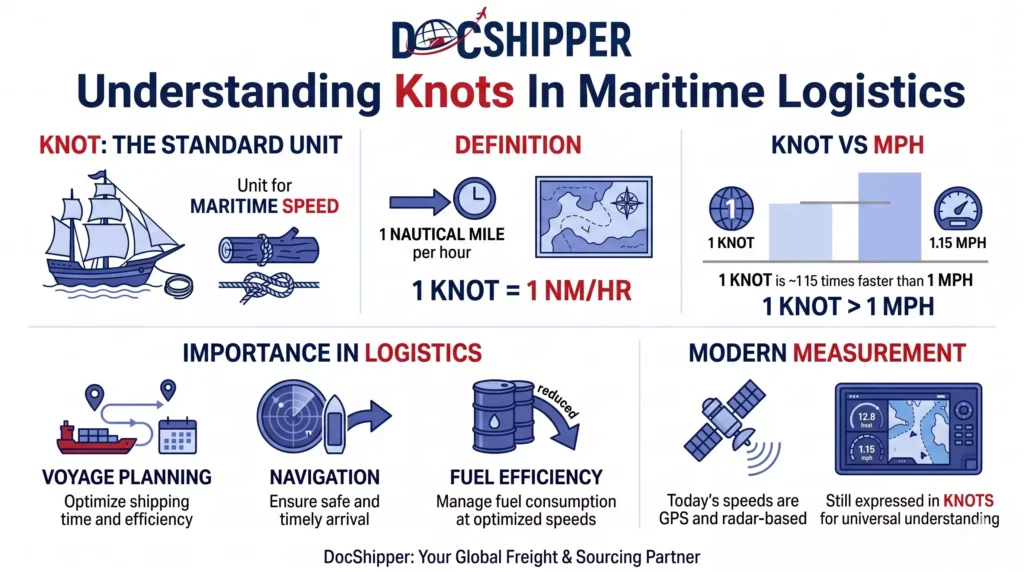
A knot is a unit of speed equal to one nautical mile per hour (1.852 km/h or 1.151 mph). It is the standard measurement for vessel speed in maritime transport and aviation, derived from historical navigation methods using knotted ropes. Understanding knots is essential for calculating transit times, fuel consumption, and delivery schedules in international shipping.
Introduction
Many importers and exporters confuse knots with kilometers or miles per hour, leading to inaccurate transit estimates. This miscalculation can disrupt supply chains and cost thousands in delayed shipments.
In maritime logistics, the knot remains the universal speed standard. Every shipping line, port authority, and freight forwarder uses this measurement to coordinate vessel movements globally.
Key characteristics of the knot system include:
- Standardization: Recognized by the International Maritime Organization (IMO) and aviation authorities worldwide
- Nautical mile basis: One knot equals exactly 1.852 kilometers per hour, based on Earth’s circumference
- Historical accuracy: Derived from 17th-century navigation using knotted ropes thrown overboard
- Practical application: Used for calculating ETAs (Estimated Time of Arrival) and fuel consumption rates
- Weather integration: Wind and current speeds also measured in knots for maritime forecasting
Technical Depth & Maritime Application
The knot measurement system originated from chip log navigation. Sailors would throw a wooden board (the chip) overboard attached to a rope with knots tied at regular intervals. They counted how many knots passed through their hands in a fixed time period.
Modern vessels use sophisticated GPS and speed log systems, but the knot remains unchanged. The nautical mile (1,852 meters) represents one minute of latitude, making navigation calculations align perfectly with maritime charts.
Conversion formulas are essential for logistics coordination:
- 1 knot = 1.852 km/h
- 1 knot = 1.151 mph
- 1 knot = 0.514 m/s
Container ships typically cruise at 18-25 knots, while bulk carriers operate at 12-15 knots. Speed directly impacts fuel consumption—modern ultra-large container vessels consume 200-300 tons of fuel daily at maximum speed.
The International Maritime Organization (IMO) has established slow steaming protocols to reduce emissions. Many carriers now operate at 16-18 knots instead of 22-24 knots, reducing fuel consumption by up to 30% but extending transit times by 2-4 days on transpacific routes. You can find detailed regulations on the IMO official website.
At DocShipper, we calculate precise ETAs by monitoring real-time vessel speeds and adjusting for weather patterns, ensuring our clients receive accurate delivery forecasts for their import/export operations.
Practical Examples & Shipping Data
Understanding knot calculations directly impacts shipping cost estimates and delivery planning. Here’s how speed affects real-world logistics scenarios:
Comparative Speed Analysis
| Vessel Type | Typical Speed (Knots) | Speed (km/h) | Shanghai-LA Transit |
|---|---|---|---|
| Ultra-Large Container Ship | 22 knots | 40.7 km/h | 14 days |
| Standard Container Ship | 18 knots | 33.3 km/h | 17 days |
| Bulk Carrier | 14 knots | 25.9 km/h | 22 days |
| Ro-Ro Vessel | 20 knots | 37.0 km/h | 15 days |
Use Case: Transit Time Calculation
A manufacturer needs to ship 500 CBM of electronics from Hamburg to New York (3,600 nautical miles). Their carrier offers two options:
- Fast service (20 knots): 3,600 nm ÷ 20 knots = 180 hours = 7.5 days
- Economy service (15 knots): 3,600 nm ÷ 15 knots = 240 hours = 10 days
- Cost difference: Fast service costs 18% more but saves 2.5 days
- Fuel impact: Slower speed reduces fuel consumption by approximately 25%
- Decision factor: Product value vs. time sensitivity determines optimal choice
Real-world data shows that 95% of container ships now operate below their maximum design speed to balance cost efficiency with delivery requirements. The average transpacific crossing speed has decreased from 24 knots in 2008 to 18 knots in 2024.
Weather conditions significantly affect actual speed. A vessel maintaining 20 knots in calm seas may slow to 12-15 knots in heavy weather, adding 2-3 days to transoceanic voyages.
Conclusion
The knot remains the fundamental speed measurement in maritime logistics, directly impacting transit times, costs, and environmental footprint. Accurate speed calculations enable precise delivery forecasting and optimal carrier selection.
Need expert guidance on shipping speed requirements or transit time optimization? Contact DocShipper for customized logistics solutions tailored to your import/export needs.
📚 Quiz
Test Your Knowledge: Knot
What does one knot represent in maritime navigation?
Why do maritime professionals use knots instead of kilometers per hour?
A container ship travels 3,600 nautical miles at 18 knots. How long will the journey take?
🎯 Your Result
📞 Free Quote in 24hFAQ | Knot: Definition, Calculation & Practical Examples in Maritime Logistics
Knots are based on nautical miles, which correspond to one minute of latitude on Earth's surface. This makes navigation calculations align perfectly with maritime charts and coordinates, providing more accurate positioning than land-based measurements. The system has been standardized internationally for over 400 years.
Divide the total distance in nautical miles by the vessel speed in knots to get hours of travel time. For example: 5,000 nautical miles ÷ 20 knots = 250 hours (approximately 10.4 days). Always add 1-2 days buffer for weather delays and port congestion.
Modern ultra-large container vessels can reach maximum speeds of 24-26 knots, though most operate at 18-22 knots for fuel efficiency. Specialized fast freight vessels and Ro-Ro ships may achieve 25-28 knots. Speed records exceed 30 knots but are impractical for cargo operations due to fuel costs.
Yes, significantly. Faster services typically cost 15-30% more than economy options. Express maritime services operating at higher speeds command premium rates due to increased fuel consumption and dedicated scheduling. Time-sensitive cargo like perishables or seasonal goods often justify these higher costs.
Slow steaming (reducing speed from 24 to 18 knots) can add 3-5 days to transpacific routes and 2-3 days to transatlantic crossings. However, it reduces fuel consumption by 20-30% and lowers carbon emissions. Most carriers now use slow steaming as standard practice outside peak seasons.
Yes. Vessel speed measured in knots refers to speed through water, not ground speed. Strong currents can add or subtract 1-3 knots from actual progress. The Gulf Stream, for instance, can provide a 2-knot boost eastbound or create a 2-knot resistance westbound across the Atlantic.
There is no difference—they are identical. One knot equals exactly one nautical mile per hour. The term "knot" is preferred in maritime contexts, while "nautical miles per hour" is sometimes used in technical documentation. Never say "knots per hour" as this is redundant and incorrect.
Heavy seas can reduce effective speed by 20-40%. A vessel maintaining 22 knots in calm conditions may slow to 14-16 knots in storm conditions for safety. Headwinds of 30-40 knots can reduce speed by 2-4 knots, while tailwinds provide minimal assistance due to vessel design and safety protocols.
Yes. Aviation universally uses knots for airspeed measurements. Commercial aircraft cruise at 400-500 knots, while cargo planes operate at 350-450 knots. Air traffic control, flight plans, and weather reports all use knots, maintaining consistency with maritime navigation standards established by international aviation authorities.
Modern AIS (Automatic Identification System) and GPS provide knot measurements accurate to within 0.1 knots. Real-time tracking platforms update every 1-5 minutes, allowing precise ETA calculations. However, vessels may report slightly different speeds based on whether they measure through water or over ground.
Most carriers find 16-19 knots optimal for balancing transit time and fuel efficiency. Below 15 knots significantly extends voyage duration, while above 22 knots dramatically increases fuel consumption with diminishing time savings. The "sweet spot" depends on vessel design, fuel prices, and market demand for speed.
Yes. Most ports impose speed limits of 5-12 knots in harbor areas and 8-15 knots in approach channels. These restrictions prevent wake damage, ensure maneuverability, and protect marine life. Violating speed limits can result in fines up to $50,000 and potential port access restrictions for repeated offenses.
Need Help with
Logistics or Sourcing ?
First, we secure the right products from the right suppliers at the right price by managing the sourcing process from start to finish. Then, we simplify your shipping experience - from pickup to final delivery - ensuring any product, anywhere, is delivered at highly competitive prices.


Fill the Form
Prefer email? Send us your inquiry, and we’ll get back to you as soon as possible.
Contact us




