


In short ⚡
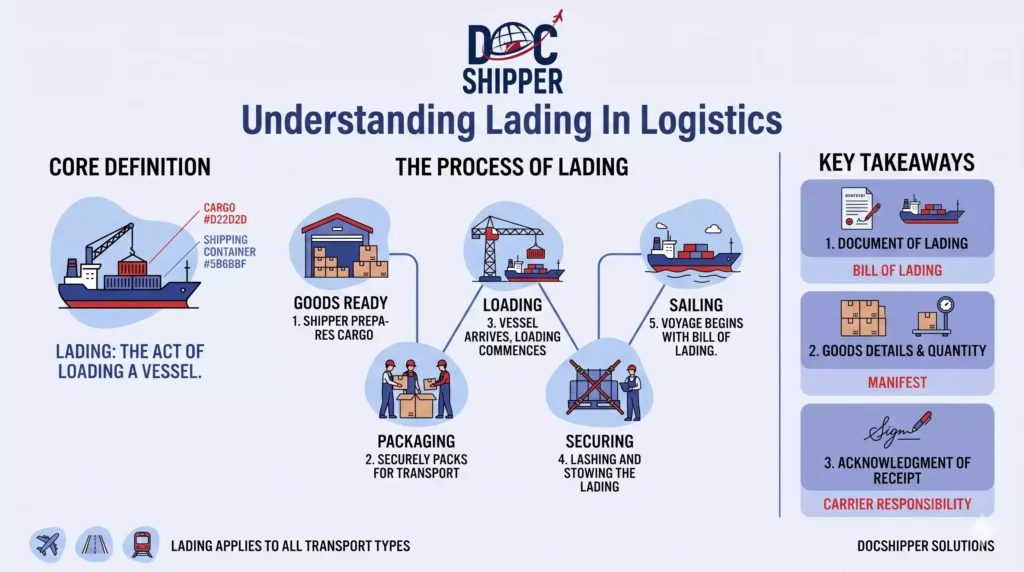
Lading refers to the cargo or freight loaded onto a vessel, truck, aircraft, or other means of transport for shipment. It encompasses the physical goods being transported and forms the basis of the bill of lading, a critical legal document that governs ownership, liability, and delivery rights in international trade.Introduction
One of the most common confusions in logistics is distinguishing between cargo, freight, and lading. While often used interchangeably, “lading” specifically refers to the act of loading goods and the goods themselves once loaded for transport. In international shipping, the accuracy of lading documentation directly impacts customs clearance, insurance coverage, and liability disputes.
Understanding lading is essential for exporters, importers, and freight forwarders. A single discrepancy between the physical lading and the bill of lading can trigger shipment delays, financial penalties, or cargo seizure. The term also governs the contractual relationship between shipper, carrier, and consignee.
- Legal Document: The bill of lading serves as proof of shipment, receipt, and title transfer.
- Cargo Description: Precise details (weight, dimensions, HS codes) prevent disputes and accelerate customs processing.
- Liability Scope: Defines the carrier’s responsibility from loading to delivery destination.
- Payment Trigger: Often required by banks before releasing funds in letter of credit transactions.
- Insurance Basis: Marine insurance policies calculate premiums based on lading value and risk profile.
Legal Framework & Expert Insights
The legal foundation of lading is rooted in international maritime conventions, particularly the Hague-Visby Rules and the Hamburg Rules. These frameworks establish uniform standards for carrier liability, minimum coverage requirements, and dispute resolution mechanisms. Under these conventions, the carrier is responsible for lading from the moment goods are loaded until delivery, except in cases of force majeure or inherent vice.
The bill of lading exists in three primary forms: straight (non-negotiable), to order (negotiable), and bearer. Each type determines who can claim the lading at destination. A negotiable bill of lading functions as a document of title, meaning physical possession allows the holder to transfer ownership—a critical feature in trade finance. At DocShipper, we verify bill of lading accuracy against packing lists and commercial invoices to prevent discrepancies that could jeopardize delivery.
The concept of container lading introduces additional complexity. When multiple shippers consolidate cargo into a single container (LCL shipments), the master bill of lading covers the entire container, while house bills represent individual shipments. Mismatches between these documents frequently cause customs holds. The WTO Trade Facilitation Agreement mandates electronic data interchange to reduce these errors.
Dangerous goods lading falls under the International Maritime Dangerous Goods (IMDG) Code. Shippers must declare hazardous materials with UN numbers, proper shipping names, and emergency contact information. Failure to accurately declare dangerous lading can result in fines exceeding $25,000 per violation under U.S. regulations, and criminal prosecution in severe cases.
Finally, lading measurement varies by transport mode. Ocean freight uses cubic meters or revenue tons (whichever is greater), while air cargo calculates volumetric weight (length × width × height ÷ 6000). Accurate measurement is essential because carriers charge based on the higher of actual or volumetric weight. DocShipper’s pre-shipment inspections include dimensional verification to avoid surprise charges at origin or destination.
Practical Examples & Industry Data
Consider a textile exporter in Bangladesh shipping 500 cartons of garments to Germany. The lading details must specify: total weight (12,500 kg), total volume (85 cubic meters), HS code (6204.62), and container type (40′ HC). If the bill of lading lists 450 cartons but 500 are physically loaded, customs will detain the shipment for reconciliation—costing 3-7 days and storage fees averaging €120 per day.
In 2023, 32% of cargo claims globally stemmed from bill of lading discrepancies, according to TT Club data. The most common errors include incorrect consignee names, missing HS codes, and understated cargo values. These mistakes delay payment release in documentary credit transactions, where banks refuse documents that don’t exactly match letter of credit terms.
| Transport Mode | Lading Document | Typical Processing Time | Error Rate |
|---|---|---|---|
| Ocean | Bill of Lading (B/L) | 24-48 hours | 8-12% |
| Air | Air Waybill (AWB) | 4-8 hours | 3-5% |
| Road | Consignment Note (CMR) | 2-6 hours | 5-7% |
| Rail | Rail Consignment Note | 12-24 hours | 6-9% |
Use Case: An automotive parts supplier ships 200 engines from Japan to Mexico via Los Angeles. The lading includes temperature-sensitive components requiring 15-25°C storage. The bill of lading must reference the IMDG Code cold chain requirements. If the carrier doesn’t maintain proper temperature records, the shipper loses insurance coverage for any damage—potentially $2.3 million in this case.
Key data points for optimal lading documentation include: exact commodity description (avoid vague terms like “general cargo”), accurate gross weight (verified by certified scales), complete shipper/consignee addresses (including postal codes), declared value for customs (matching commercial invoice), and freight payment terms (prepaid vs. collect). Missing any of these triggers automatic customs queries.
Conclusion
Lading represents far more than cargo in transit—it defines legal ownership, liability boundaries, and financial flows in global trade. Precision in lading documentation prevents costly delays and protects all parties in the supply chain.
Need expert assistance managing your lading documentation? Contact DocShipper for comprehensive freight forwarding and compliance services.
📚 Quiz
Test Your Knowledge: Lading
Question 1: What does "lading" specifically refer to in international shipping?
Question 2: When can a legitimate bill of lading be issued?
Question 3: A textile exporter ships 500 cartons but the bill of lading lists only 450. What is the likely consequence?
🎯 Your Result
📞 Free Quote in 24hFAQ | Lading: Definition, Calculation & Practical Examples
Lading specifically refers to goods once loaded onto a transport vehicle and documented in the bill of lading. Cargo is a broader term encompassing any goods transported, regardless of loading status. In legal contexts, lading carries precise documentary and liability implications that general cargo references do not.
No. A legitimate bill of lading should only be issued after cargo is physically loaded and verified. Pre-dated bills are fraudulent and violate international shipping conventions. Carriers issuing bills before lading completion face severe legal penalties and insurance nullification.
The shipper bears primary responsibility for accurate lading declarations, including weight, dimensions, and commodity descriptions. However, carriers must verify information reasonability. Freight forwarders like DocShipper often intermediate to ensure both parties' data aligns with regulatory requirements.
Insurance policies require exact correspondence between physical lading and declared values. Discrepancies—even minor ones like weight variations exceeding 5%—can void coverage entirely. This is why pre-shipment inspections and certified weighing are critical for high-value shipments.
A clean bill of lading indicates goods were received in apparent good condition without carrier notations. A claused (or "dirty") bill contains remarks about damage, shortages, or packaging defects. Banks typically refuse claused bills in letter of credit transactions, making them non-negotiable.
Under the Hague-Visby Rules, carrier liability extends from loading ("tackle to tackle") until delivery. Time limits for claims are typically one year from delivery date. Extended liability can be negotiated through additional clauses, though this increases freight costs by 15-30%.
Overweight containers violate the SOLAS VGM (Verified Gross Mass) requirement and will be refused loading. Shippers face re-weighing fees ($150-$300), potential container splitting costs, and schedule delays. Some ports impose fines up to $5,000 for VGM violations.
Yes, through transshipment, but this requires endorsing the original bill of lading and issuing a new one. Each transfer point introduces risk of documentation errors. Multi-modal shipments use "through bills of lading" to maintain continuous liability coverage across carriers.
Electronic bills of lading (eBLs) use blockchain or secure platforms to create digital originals with the same legal standing as paper versions. Organizations like BIMCO and ICC provide approved eBL systems. Adoption remains at 1.2% globally due to regulatory fragmentation and stakeholder reluctance.
Penalties vary by jurisdiction but typically include fines ($10,000-$50,000 per violation), criminal charges for serious offenses, permanent carrier blacklisting, and full liability for any resulting damages or environmental harm. Repeat offenders face imprisonment in some countries.
FCL (Full Container Load) shipments receive a single bill of lading for the entire container. LCL (Less than Container Load) generates a master bill for the consolidated container plus individual house bills for each shipper's cargo. This dual-document system requires precise cargo segregation and separate customs entries.
This clause transfers risk from carrier to shipper at loading completion rather than delivery. Commonly used for high-value or hazardous cargo, it reduces carrier liability but requires shippers to maintain comprehensive insurance coverage. Freight costs decrease by 10-20% when shippers accept this risk transfer.
Need Help with
Logistics or Sourcing ?
First, we secure the right products from the right suppliers at the right price by managing the sourcing process from start to finish. Then, we simplify your shipping experience - from pickup to final delivery - ensuring any product, anywhere, is delivered at highly competitive prices.


Fill the Form
Prefer email? Send us your inquiry, and we’ll get back to you as soon as possible.
Contact us




