


In short ⚡
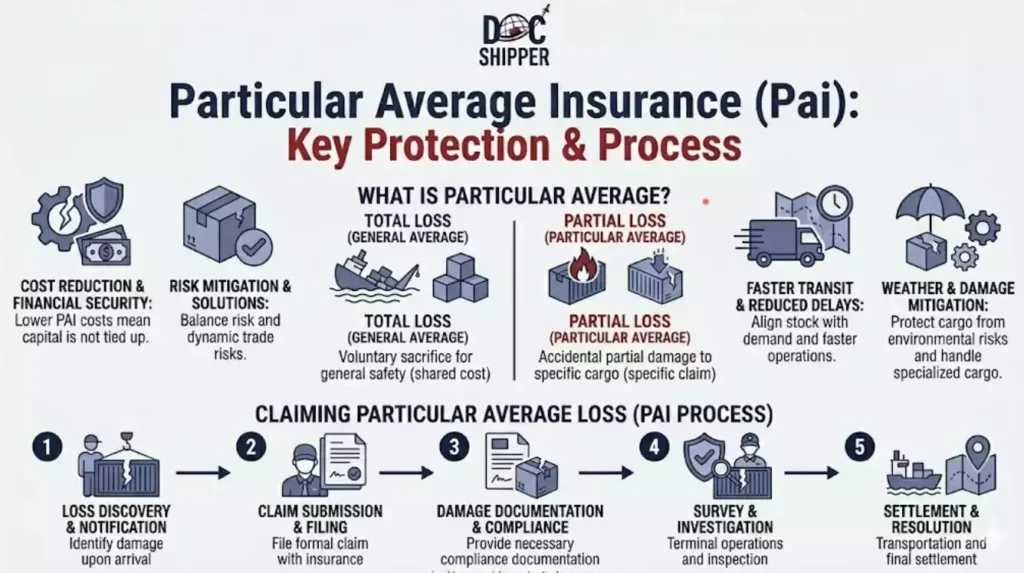
Particular Average (PA) is a partial loss or damage to cargo or vessel that is borne exclusively by the owner of the affected property, not shared among all parties with a financial interest in the voyage. Unlike General Average, which distributes losses proportionally, Particular Average applies when damage results from insured perils without creating a common sacrifice for the benefit of all.
Introduction
Many importers and exporters confuse Particular Average with General Average, leading to costly misunderstandings when cargo damage occurs. The distinction determines who bears financial responsibility and how insurance claims are processed.
In international trade, cargo faces numerous risks during transit: rough seas, improper handling, contamination, or container breaches. Understanding Particular Average is essential for accurately assessing insurance coverage needs and avoiding unexpected out-of-pocket expenses.
Key characteristics of Particular Average include:
- Individual loss: Affects only specific cargo or property owner
- No shared sacrifice: Unlike General Average, no proportional contribution required
- Insured perils: Covered only if damage results from policy-specified risks
- Franchise or deductible: Often subject to minimum thresholds before claims are paid
- Documentation requirements: Requires immediate surveyor reports and proof of damage
Understanding Mechanisms & Legal Framework
Particular Average operates within the marine insurance framework governed by legal precedents and international conventions. The most relevant legal foundation is found in the UK Marine Insurance Act 1906, which defines partial losses and establishes claims procedures still used globally.
The insured perils concept is central to Particular Average claims. Standard marine cargo policies cover risks like storms, vessel collision, fire, and jettison. However, damage from inherent vice (natural deterioration), poor packaging, or delay typically falls outside coverage. Understanding which perils your policy includes determines claim viability.
A critical element is the franchise clause, which establishes a minimum loss threshold. For example, a 3% franchise means losses below 3% of the cargo value are not recoverable. This prevents minor damage claims that would be administratively burdensome. Some policies use deductibles instead, where the insurer pays only amounts exceeding the deductible.
The survey and documentation process begins immediately upon discovering damage. Cargo surveyors assess extent, cause, and value of loss. Their reports form the claim foundation. Without proper documentation within specified timeframes (often 24-72 hours), insurers may deny claims regardless of damage legitimacy.
At DocShipper, we coordinate with approved surveyors worldwide to ensure our clients’ Particular Average claims are properly documented from the moment damage is discovered, maximizing recovery potential while minimizing administrative burden.
The valuation method also impacts settlements. Insurers typically pay based on the lesser of repair cost or diminution in market value. For total constructive losses (repair cost exceeds value), the claim transitions to total loss procedures with different calculation methods.
Concrete Examples & Data
Understanding Particular Average through real scenarios clarifies how coverage works in practice and reveals common pitfalls.
Case Study: Water Damage to Electronics Shipment
A US importer shipped $200,000 worth of consumer electronics from Shenzhen to Los Angeles. During transit, a container seal failed, allowing rainwater to damage 30% of the cargo during port handling.
| Element | Details |
|---|---|
| Total cargo value | $200,000 |
| Damaged portion | 30% ($60,000) |
| Policy franchise | 3% of total value ($6,000) |
| Deductible | $5,000 |
| Insurance payout | $55,000 ($60,000 – $5,000) |
The importer’s loss exceeded the franchise threshold, making the claim valid. After the deductible, the insurance covered $55,000 of the $60,000 loss. The remaining undamaged cargo proceeded to delivery without issue.
Comparative Scenarios: Particular Average vs General Average
| Scenario Aspect | Particular Average | General Average |
|---|---|---|
| Loss distribution | Owner of damaged cargo bears full loss | All cargo owners contribute proportionally |
| Cause example | Container breach, isolated fire, theft | Jettison to save vessel, firefighting water damage |
| Intent | Accidental, fortuitous event | Deliberate sacrifice for common benefit |
| Claim process | Direct claim to own insurer | Average adjuster calculates contributions |
| Timeline | Days to weeks | Months to years |
Industry Data Points
Recent insurance industry statistics reveal important patterns in Particular Average claims:
- Claim frequency: Approximately 2-3% of all containerized shipments experience some form of damage warranting Particular Average claims
- Average claim value: Ranges from $8,000 to $45,000 depending on cargo type and trade route
- Settlement time: Well-documented claims settle in 14-45 days on average, while disputed claims can extend 6+ months
- Denial rate: Approximately 18-22% of Particular Average claims are denied, primarily due to inadequate documentation or excluded perils
- Cargo categories most affected: Electronics (32%), machinery (24%), textiles (18%), foodstuffs (15%), other (11%)
Conclusion
Particular Average represents a fundamental aspect of marine cargo insurance that every international trader must understand. Unlike shared-loss scenarios, PA claims place financial responsibility directly on the affected cargo owner, making proper insurance coverage and immediate documentation absolutely critical.
Need expert guidance on marine insurance coverage or assistance with cargo damage claims? Contact DocShipper for comprehensive logistics support and insurance coordination.
📚 Quiz
Test Your Knowledge: Particular Average
Question 1: What distinguishes Particular Average from General Average in marine insurance?
Question 2: Your shipment valued at $100,000 sustains $2,500 in damage. Your policy has a 3% franchise clause. What happens?
Question 3: Your electronics shipment arrives water-damaged due to inadequate packaging. Can you file a Particular Average claim?
🎯 Your Result
📞 Free Personalized QuoteFAQ | Insurance, Particular Average: Definition, Calculation & Concrete Examples
Particular Average is a partial loss borne solely by the owner of damaged cargo, while General Average involves deliberate sacrifice where all parties with cargo on the voyage contribute proportionally. PA results from accidental damage; GA from intentional actions to save the voyage (like jettisoning cargo during storms).
Most marine cargo policies include Particular Average coverage, but with important limitations. Coverage typically applies only to specified perils (storms, collision, fire), excludes inherent vice or poor packaging, and often includes franchise clauses or deductibles. Always review your specific policy terms to understand exact coverage.
A franchise clause sets a minimum damage threshold below which no insurance payment is made. For example, with a 3% franchise on $100,000 cargo, losses under $3,000 aren't compensated. If loss exceeds 3%, the full amount (not just the excess) becomes payable. This differs from deductibles, which reduce all claim payments.
Most policies require notification within 24-72 hours of discovering damage. Immediate action is critical: document damage photographically, request surveyor inspection, preserve damaged goods, and formally notify your insurer and DocShipper representative. Delays can jeopardize claim validity regardless of damage legitimacy.
Essential documents include: surveyor's report detailing damage extent and cause, original insurance certificate or policy, commercial invoice showing cargo value, bill of lading, packing list, photographs of damage, repair estimates or salvage values, and correspondence with carriers. Comprehensive documentation significantly improves settlement speed and amount.
Typically no. Marine cargo policies exclude losses from inherent vice, insufficient packaging, or inherent characteristics of the goods. If cargo was inadequately protected and this caused damage, insurers will likely deny claims. Proper packaging that meets industry standards is essential for coverage eligibility.
If damage falls below the franchise percentage, you receive no insurance compensation and must absorb the entire loss. This makes understanding your franchise terms critical when evaluating insurance adequacy. Higher-value shipments may justify lower franchise percentages to ensure minor damages remain covered.
Valuation typically uses CIF (Cost, Insurance, Freight) value plus 10%, representing landed cost plus anticipated profit margin. This ensures you're compensated not just for replacement cost but also lost profit opportunity. Some policies allow agreed value declarations, eliminating valuation disputes during claims.
Cargo surveyors are independent experts who inspect damaged goods, determine cause and extent of damage, assess whether damage resulted from insured perils, and provide detailed reports that form the claim foundation. Their findings carry significant weight with insurers and can make or break claim approval.
Standard marine policies typically cover cargo from warehouse to warehouse under "warehouse to warehouse" clauses. This means PA coverage can apply during land transit to/from ports, during loading/unloading, and sometimes during short-term storage. However, extended warehousing usually requires separate insurance coverage.
You have two recovery options: claim under your insurance (Particular Average) or pursue carrier liability. Insurance usually provides faster settlement. Your insurer may then subrogate (pursue recovery) against the carrier. Many businesses prefer insurance claims for speed, letting insurers handle carrier disputes.
Yes. Fragile or perishable goods (electronics, glassware, fresh produce) often face higher franchises (3-5%) due to elevated damage risk. Bulk commodities or robust goods may have lower franchises (1-2%). Franchise percentages reflect statistical damage likelihood and help insurers manage high-frequency small claims.
Need Help with
Logistics or Sourcing ?
First, we secure the right products from the right suppliers at the right price by managing the sourcing process from start to finish. Then, we simplify your shipping experience - from pickup to final delivery - ensuring any product, anywhere, is delivered at highly competitive prices.


Fill the Form
Prefer email? Send us your inquiry, and we’ll get back to you as soon as possible.
Contact us




