


In short ⚡
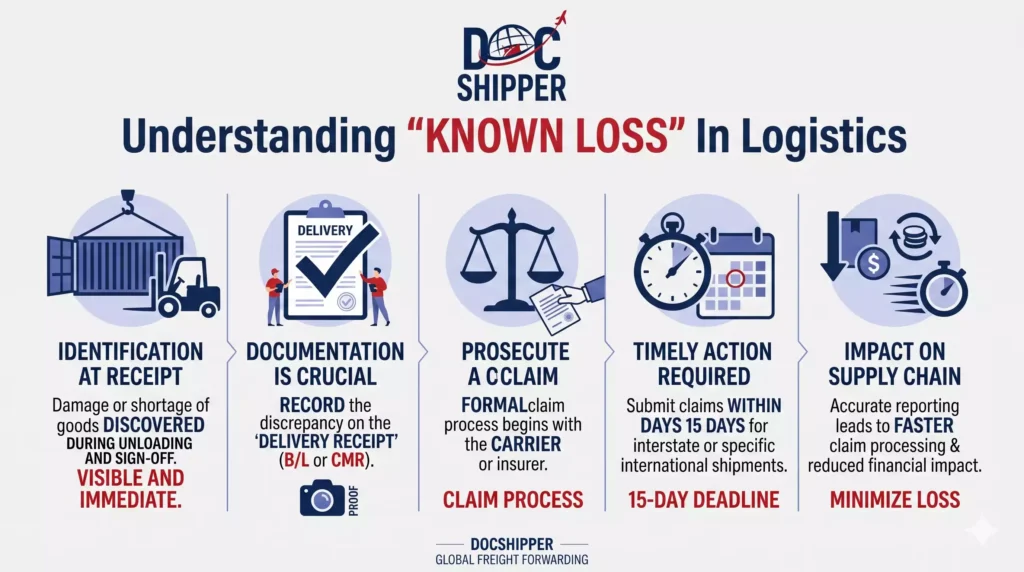
Known Loss refers to anticipated inventory shrinkage or damage documented before goods enter a supply chain stage. In international logistics, it represents quantified product deterioration, breakage, or contamination identified during inspection, enabling accurate valuation adjustments and insurance claims preparation.
Introduction
Importers frequently discover damaged goods upon container arrival, yet struggle to distinguish between preventable losses and documented shrinkage. This confusion leads to disputes with carriers, insurers, and suppliers. Known Loss provides the framework for transparent accountability in cross-border trade.
In international freight operations, this concept becomes critical during customs clearance and financial reconciliation. Proper documentation transforms potential disputes into manageable claims processes. At DocShipper, we systematically verify Known Loss declarations to protect our clients from unexpected liabilities.
Key characteristics of Known Loss management:
- Pre-documentation: Damage recorded before transfer of custody between logistics stages
- Valuation adjustment: Customs duties calculated on net usable goods, not total shipment
- Insurance correlation: Direct linkage between inspection reports and claims processing
- Contractual clarity: Defines liability boundaries in Incoterms execution
- Audit compliance: Satisfies regulatory requirements for import documentation
Expertise & Mechanisms
Known Loss operates through a three-phase verification system. First, initial inspection occurs at the origin warehouse or factory, where quality control teams identify defective units before loading. This creates the baseline documentation for all subsequent handling.
Second, in-transit monitoring captures additional deterioration through sealed container protocols. Temperature-sensitive shipments employ data loggers, while fragile goods use shock indicators. When thresholds breach, carriers generate timestamped reports forming the Known Loss record.
The third phase involves destination verification, where customs authorities or third-party surveyors validate pre-declared losses. This triangulation prevents fraudulent claims while ensuring accurate duty assessments. The World Customs Organization provides standardized protocols for these validations across 183 member countries.
Legal implications center on burden of proof. Without proper Known Loss documentation, importers face full duty liability on damaged goods. Conversely, carriers cannot invoke force majeure protections if losses weren’t declared upon delivery. This creates mutual accountability throughout the supply chain.
The financial mechanism operates through provisional value declarations. Customs authorities accept lower dutiable values when Known Loss certificates accompany entry paperwork. For example, a shipment invoiced at $100,000 with 15% documented loss receives duty calculation on $85,000, yielding immediate cash flow benefits.
At DocShipper, we implement automated Known Loss tracking through our digital platform, ensuring every inspection report integrates with customs filings and insurance dossiers. This eliminates manual errors that typically delay claim settlements by 45-60 days.
Concrete Examples & Data
Consider three scenarios demonstrating Known Loss application across different commodity types and transportation modes:
Scenario 1: Perishable Goods (Refrigerated Container)
A Belgian importer receives 20,000 kg of Ecuadorian bananas. Pre-shipment inspection identifies 8% ripeness exceeding target grade. The exporter issues a Commercial Invoice Adjustment Certificate documenting 1,600 kg as Known Loss. Upon arrival, actual spoilage reaches 12% (2,400 kg), but customs duties apply only to the 17,600 kg meeting import standards. The additional 4% becomes an insurance claim against the carrier for refrigeration failure.
Scenario 2: Electronics (Air Freight)
A shipment of 5,000 smartphones valued at $750,000 undergoes factory testing. Quality control flags 2.3% defect rate (115 units). The manufacturer provides a Defective Goods Certificate before air freight departure. Customs in Germany accepts the Known Loss declaration, calculating VAT on $667,500 instead of the full invoice amount, saving €15,525 in immediate tax payments.
Scenario 3: Bulk Commodities (Ocean Freight)
| Stage | Weight (MT) | Loss Type | Documentation |
|---|---|---|---|
| Loading Port (Brazil) | 10,000 | Moisture contamination: 150 MT | Surveyor’s Report #BR-2024-0891 |
| Transit (30 days) | 9,850 | Natural evaporation: 98 MT | Bill of Lading Clause 17(b) |
| Discharge Port (Rotterdam) | 9,752 | Total Known Loss: 248 MT | Customs Entry Adjustment |
Industry data reveals Known Loss declarations reduce claim processing time by 67% compared to undocumented disputes. The International Chamber of Commerce reports that proper pre-documentation increases claim approval rates from 43% to 89% across maritime cargo insurance portfolios.
Cost implications vary by commodity. High-value electronics generate Known Loss declarations averaging 1.8% of shipment value, while agricultural products reach 6.2%. Chemical bulk shipments maintain the lowest rates at 0.4%, reflecting stringent quality controls in hazardous materials handling.
Conclusion
Known Loss transforms unmanaged supply chain shrinkage into documented, accountable financial adjustments. Proper implementation protects importers from excessive duties while providing carriers and insurers with transparent claims frameworks. This systematic approach reduces disputes, accelerates customs clearance, and optimizes working capital allocation.
Need expert assistance with Known Loss documentation or claims management? Contact DocShipper’s logistics specialists for tailored support across 150+ countries.
📚 Quiz
Test Your Knowledge: Known Loss
When is Known Loss documented in the supply chain?
What is a common misconception about Known Loss declarations?
A Belgian electronics importer receives a shipment valued at €500,000 with 3% pre-documented defects. How should customs calculate VAT?
🎯 Your Result
📞 Free Quote in 24hFAQ | Known Loss: Definition, Calculation & Concrete Examples
Acceptable documentation includes pre-shipment inspection certificates from SGS, Bureau Veritas, or equivalent surveyors; manufacturer's quality control reports with serial numbers; carrier-issued exception reports; and photographic evidence timestamped before custody transfer. All documents must correlate with Bill of Lading notations or air waybill remarks.
Most jurisdictions prohibit retroactive declarations. Customs laws require Known Loss notification during initial entry filing. Post-clearance adjustments necessitate formal amendment procedures involving duty drawback claims, which typically take 90-180 days and require additional evidence of procedural error rather than simple omission.
Known Loss identifies damage before risk transfer between parties, establishing liability boundaries. Concealed damage emerges only after delivery acceptance, creating disputes over causation timing. Insurance policies treat these distinctly: Known Loss reduces coverage amounts proportionally, while concealed damage triggers investigation protocols to determine compensability.
Properly documented Known Loss typically doesn't increase premiums, as it demonstrates proactive risk management. Insurers view systematic pre-documentation favorably compared to frequent undocumented claims. However, chronic Known Loss patterns above industry norms (>5% for general cargo) may trigger underwriting reviews and premium adjustments.
No universal threshold exists. Best practice suggests documenting any loss exceeding 1% of shipment value or quantity. Regulatory requirements vary: EU customs mandate declaration for losses affecting duty calculations above €500, while US CBP requires notation for any "appreciable" damage potentially impacting classification or valuation.
Contractual terms define responsibility. Under FOB Incoterms, sellers conduct pre-shipment inspections; buyers verify at destination. CIF terms place greater burden on sellers to document all pre-transit losses. Independent surveyors provide neutral assessments when parties dispute findings, with costs typically split 50/50 unless contracts specify otherwise.
Customs may request corroborating evidence if declarations appear inconsistent with commodity norms or historical patterns. Challenges arise when loss percentages exceed industry standards without clear explanation. Authorities cross-reference surveyor credentials, inspect container seals, and verify timestamps against transport documents to validate authenticity.
Modern logistics systems integrate IoT sensors, blockchain verification, and API connections between inspection agencies, carriers, and customs platforms. Each custody transfer generates immutable records linking container IDs to inspection reports. Real-time alerts notify stakeholders when sensor thresholds breach, automatically generating preliminary Known Loss certificates.
Excess losses become "unknown losses" subject to separate liability determination. If occurring during carrier custody, they trigger cargo claim procedures under the carrier's liability limits (Hague-Visby Rules for ocean, Montreal Convention for air). Importers must file claims within contractual timeframes, typically 3-9 days for visible damage, longer for concealed issues.
Yes. Documented Known Loss creates deductible business losses for income tax purposes, reducing taxable profit. It also prevents VAT/GST overpayment on unusable inventory. Some jurisdictions allow accelerated loss recognition when Known Loss certificates accompany financial statements, improving cash flow timing compared to standard inventory write-down schedules.
Banks require Clean On Board bills of lading for LC payment, creating conflict when Known Loss exists. Solutions include: issuing Letters of Indemnity to carriers for clean B/L issuance, obtaining bank pre-approval for notated documents, or structuring payment terms as Documentary Collection rather than LC to accommodate exception clauses.
Known Loss affects origin calculations when damaged components reduce qualifying content below FTA thresholds. Rules of origin require net qualifying value percentages; shrinkage may disqualify shipments from preferential rates. Importers must recalculate origin compliance for each shipment, potentially reverting to MFN duty rates if Known Loss drops qualifying content below required minimums.
Need Help with
Logistics or Sourcing ?
First, we secure the right products from the right suppliers at the right price by managing the sourcing process from start to finish. Then, we simplify your shipping experience - from pickup to final delivery - ensuring any product, anywhere, is delivered at highly competitive prices.


Fill the Form
Prefer email? Send us your inquiry, and we’ll get back to you as soon as possible.
Contact us




