


In short ⚡
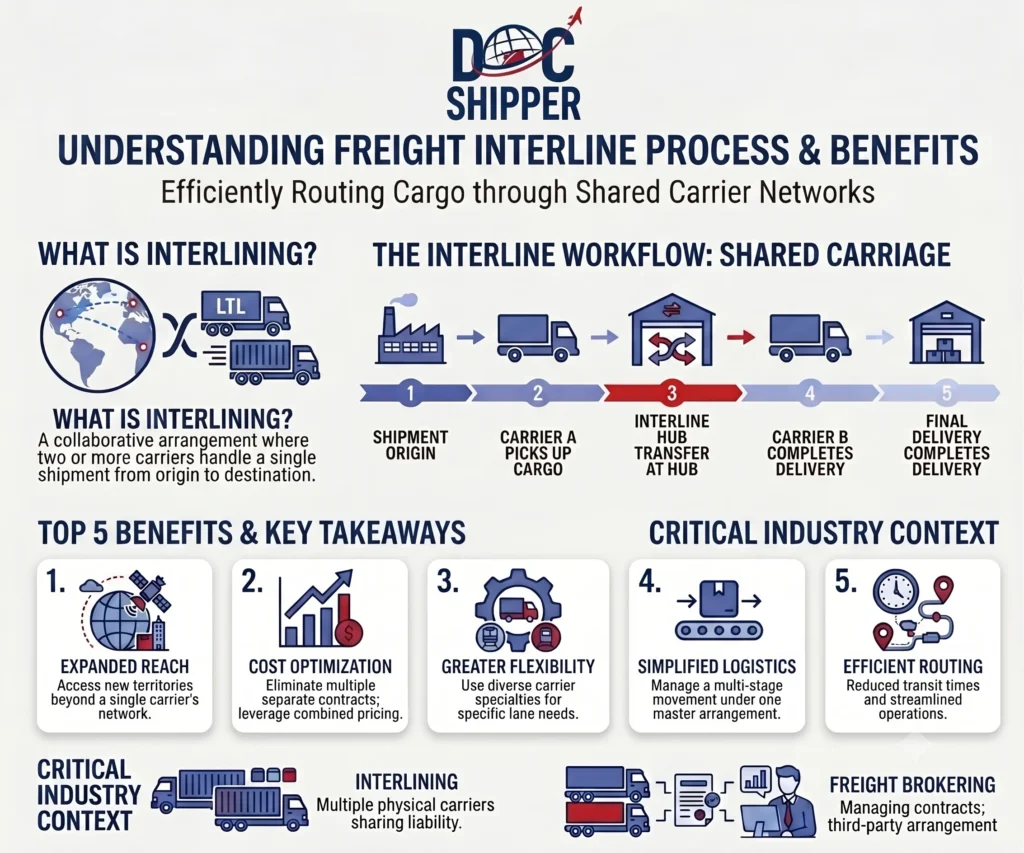
Interline refers to a cooperative agreement between multiple carriers or freight forwarders that allows a single shipment to be transported across different networks under one contract. This arrangement enables seamless multimodal transport without requiring separate agreements with each carrier, streamlining international logistics operations and ensuring continuous cargo movement across various routes and modes.Introduction
Many shippers face confusion when their cargo needs to transit through multiple carriers to reach its final destination. Who handles customs clearance at each leg? What happens if one carrier delays the entire shipment? How are liability and costs distributed across networks?
Interline agreements solve these operational complexities by creating contractual frameworks between transport providers. This system originated in aviation but now extends across maritime, rail, and trucking sectors. In international trade, where goods frequently cross multiple borders and transfer between transport modes, interline arrangements have become indispensable for maintaining supply chain continuity.
Key characteristics of interline operations include:
- Single contract coverage: One master agreement governs the entire journey despite multiple carriers involved
- Consolidated documentation: Unified bill of lading or air waybill covering all transport segments
- Shared liability framework: Predetermined protocols for damage claims and dispute resolution
- Through-routing capability: Direct booking from origin to final destination without separate arrangements
- Revenue sharing models: Established prorating systems dividing freight charges among participating carriers
Technical Mechanisms & Industry Standards
Interline operations function through bilateral or multilateral agreements where carriers mutually recognize each other’s booking systems, handling procedures, and commercial terms. These frameworks are regulated by international conventions including the Montreal Convention for air transport and the CMR Convention for road freight in Europe.
The master carrier typically assumes primary responsibility toward the shipper while maintaining recourse rights against subsequent carriers in the chain. This legal structure differs fundamentally from freight forwarding, where the forwarder acts as an intermediary rather than a carrier. Under interline arrangements, each transport provider retains carrier status and corresponding liability for their specific segment.
Documentation standards vary by transport mode. In maritime interline operations, carriers issue through bills of lading that reference connecting services without transferring the goods to another party’s custody at intermediate ports. For air freight, the IATA establishes electronic data interchange (EDI) protocols enabling seamless information flow between carriers using standardized messaging formats like Cargo-IMP.
Revenue proration mechanisms distribute freight charges based on distance, handling complexity, and market agreements. Industry bodies such as IATA’s Prorate Agency facilitate these settlements by maintaining databases of agreed rates and calculating carrier shares for interline shipments. These systems prevent revenue disputes and ensure transparent compensation across the transport chain.
From a practical perspective, DocShipper leverages interline partnerships strategically to provide clients with comprehensive door-to-door solutions. When routing cargo from Asia to European inland destinations, we coordinate with ocean carriers for the main haul and integrate rail or truck interline services for final delivery, maintaining single-point accountability throughout the entire journey.
The operational complexity increases with multimodal combinations. A shipment moving from Shanghai to Munich might involve ocean freight to Hamburg, rail transport to a distribution center, and final-mile trucking—all under one interline framework. Each handover point requires synchronized documentation, customs clearance coordination, and real-time tracking integration to prevent delays or cargo misrouting.
Practical Applications & Operational Data
Understanding interline operations becomes clearer through concrete scenarios that logistics professionals encounter regularly. The following data-driven examples illustrate how these agreements function in real commercial contexts.
Case Study: Electronics Manufacturer Shipment
A European electronics company needs to transport 5,000 units of laptops from Taipei, Taiwan to Warsaw, Poland. The shipment utilizes an interline arrangement involving three carriers:
| Transport Segment | Carrier | Distance | Transit Time | Revenue Share |
|---|---|---|---|---|
| Taipei to Hamburg (Sea) | Ocean Carrier A | 20,100 km | 28 days | 68% |
| Hamburg to Poznań (Rail) | Rail Operator B | 680 km | 2 days | 22% |
| Poznań to Warsaw (Truck) | Trucking Company C | 310 km | 6 hours | 10% |
Total freight cost: $8,400. Under the interline agreement, Ocean Carrier A issues the through bill of lading and collects the entire payment, subsequently settling with Rail Operator B and Trucking Company C according to the predetermined revenue shares. The shipper benefits from unified liability coverage and simplified documentation, avoiding the need to negotiate three separate contracts.
Comparative Analysis: Interline vs. Traditional Multi-Contract Approach
| Aspect | Interline Agreement | Separate Contracts |
|---|---|---|
| Documentation | 1 through bill of lading | 3 separate transport documents |
| Liability claims | Single point of contact | Must identify responsible carrier |
| Booking process | One reservation system | Three separate bookings |
| Payment | Single invoice | Three invoices to manage |
| Delay responsibility | Master carrier handles coordination | Shipper must coordinate between carriers |
Industry data shows that interline arrangements reduce administrative overhead by approximately 35-40% compared to managing multiple independent transport contracts. This efficiency becomes particularly valuable in e-commerce logistics where high shipment volumes require streamlined operational processes.
Operational Performance Metrics
Based on 2023 logistics industry benchmarks, interline shipments demonstrate the following characteristics:
- On-time performance: 82% of interline air-sea combinations meet delivery windows within ±1 day
- Damage rates: 0.8% for containerized interline cargo vs. 1.4% for separately contracted segments
- Claim resolution time: Average 21 days for interline vs. 47 days for multi-contract disputes
- Cost savings: 12-18% lower total logistics costs due to optimized routing and reduced handling
- Documentation errors: 3.2% error rate for through bills vs. 7.8% for multiple document sets
At DocShipper, we monitor these metrics continuously to optimize our interline carrier partnerships and ensure clients receive reliable, cost-effective multimodal transport solutions. Our quality control systems flag potential connection failures before they impact delivery schedules.
Conclusion
Interline agreements represent a fundamental infrastructure enabling global supply chain integration. By creating legal and operational frameworks for seamless multi-carrier transport, these arrangements reduce complexity, improve reliability, and lower costs for international shippers. As e-commerce and just-in-time manufacturing continue expanding, the strategic importance of interline capabilities will only increase.
Need expert guidance navigating interline transport options for your supply chain? Contact DocShipper for tailored logistics solutions.
📚 Quiz
Test Your Knowledge: Interline Agreements
What is the primary defining characteristic of an interline agreement in freight logistics?
Who assumes primary liability toward the shipper when cargo damage occurs during an interline shipment?
A European electronics company ships laptops from Taipei to Warsaw using ocean, rail, and trucking carriers under one interline agreement. What is the main operational advantage compared to booking three separate transport contracts?
🎯 Your Results
📞 Free Quote in 24hFAQ | Interline: Definition, Operations & Concrete Examples in Freight Logistics
While both involve carrier cooperation, interline agreements focus on through-transport under unified documentation with shared liability. Code-sharing primarily applies to aviation, allowing carriers to market flights operated by partners without necessarily handling the cargo directly. Interline encompasses broader operational integration including booking systems, revenue distribution, and end-to-end service responsibility across multiple transport modes.
The master carrier issuing the through bill of lading typically assumes primary liability toward the shipper for the entire journey. However, interline agreements establish recourse mechanisms allowing the master carrier to claim compensation from the segment carrier where damage actually occurred. This structure protects shippers from having to identify and pursue individual carriers while maintaining accountability within the carrier network.
Modern interline agreements increasingly incorporate integrated tracking systems using standardized EDI protocols. Major carriers provide unified tracking interfaces showing cargo status across all segments. However, visibility quality varies depending on technology adoption by participating carriers. Premium interline services typically offer superior tracking integration compared to basic arrangements.
Interline arrangements typically cost 8-15% less than separately contracted transport segments due to optimized routing, reduced handling, and negotiated carrier rates. While the master carrier adds a coordination margin, this is offset by administrative savings and improved operational efficiency. The total landed cost usually favors interline solutions for complex multimodal routes.
Interline agreements include contingency provisions requiring the master carrier to arrange alternative transport at no additional cost to the shipper. The master carrier absorbs the financial risk of partner failures. Reputable carriers maintain backup partnerships and insurance coverage to mitigate such scenarios. This protection represents a key advantage over self-managed multi-carrier arrangements.
Interline documentation facilitates customs processing by providing unified cargo declarations accepted across participating countries. The master carrier coordinates with customs brokers at each border crossing, though importers remain ultimately responsible for duties and compliance. Advanced interline services include integrated customs clearance management, streamlining the process significantly compared to separate contract arrangements.
Master carriers typically operate within established networks of interline partners based on service quality, reliability, and commercial agreements. While shippers can express carrier preferences, the master carrier retains discretion over segment assignments to optimize routing and ensure service commitments. Premium interline services may offer greater carrier selection flexibility at higher rates.
Standard carrier liability under interline agreements follows international conventions (Montreal, CMR, Hague-Visby) based on transport modes involved. These provide limited compensation—typically $20-30 per kilogram. Shippers requiring full value coverage should purchase cargo insurance independently. Some interline services offer integrated insurance products covering the entire journey under one policy.
Interline agreements establish service level protocols requiring carriers to coordinate recovery actions when delays occur. The master carrier must communicate revised delivery estimates and arrange expedited connections where feasible. Compensation for delays typically follows the applicable transport convention's force majeure provisions. Shippers should review specific interline terms regarding delay liability and remedies.
Hazardous materials require specialized interline arrangements with carriers certified for dangerous goods transport. Each segment carrier must hold appropriate certifications (IATA DGR for air, IMDG for sea, ADR for road). Documentation requirements increase substantially, including dangerous goods declarations validated across all transport modes. Not all interline partnerships accommodate hazmat shipments—advance verification is essential.
Yes, premium interline services specifically target time-sensitive cargo by pre-scheduling connections and prioritizing transfers. Air-to-truck interline combinations commonly serve express delivery requirements. However, standard interline arrangements may include longer connection windows compared to dedicated expedited services. Shippers should specify urgency requirements when booking to ensure appropriate service selection and guaranteed transit times.
Claims should be submitted to the master carrier that issued the through bill of lading, as they bear primary contractual responsibility. Provide comprehensive documentation including the transport document, commercial invoice, packing list, and evidence of damage or loss. The master carrier investigates across all segments and handles settlements. Claim deadlines follow the applicable transport convention—typically 14-21 days for notice of damage, 9-12 months for formal claims.
Need Help with
Logistics or Sourcing ?
First, we secure the right products from the right suppliers at the right price by managing the sourcing process from start to finish. Then, we simplify your shipping experience - from pickup to final delivery - ensuring any product, anywhere, is delivered at highly competitive prices.


Fill the Form
Prefer email? Send us your inquiry, and we’ll get back to you as soon as possible.
Contact us




