


In short ⚡
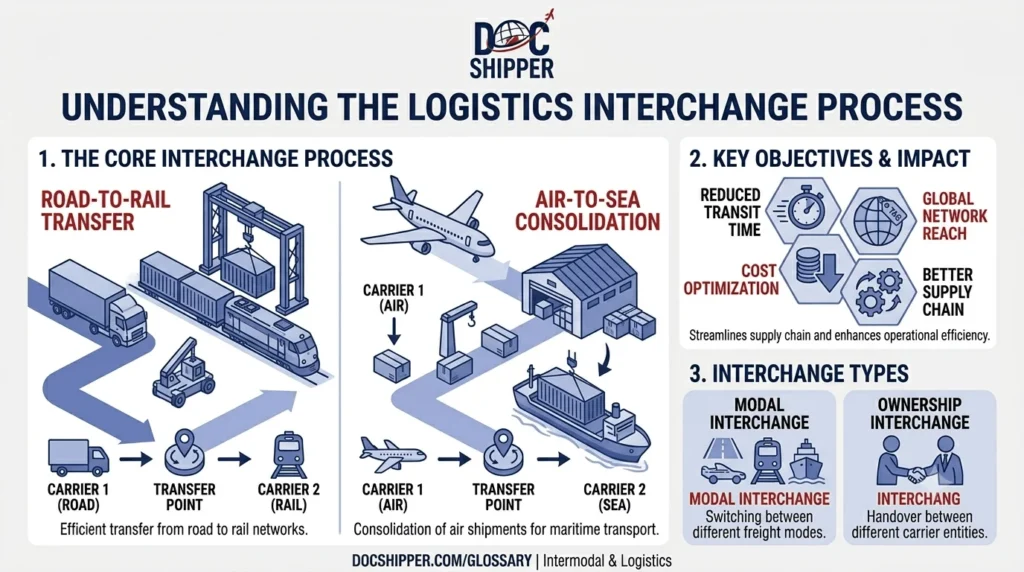
Interchange is a standardized location where freight containers are transferred between different transport modes (rail, truck, vessel) or between carriers. This critical node in the supply chain enables seamless multimodal logistics, reducing handling time and optimizing cargo flow across international trade routes.Introduction
Many importers underestimate the strategic importance of interchange points in their logistics chain. A delay at an interchange facility can cascade into missed vessel connections, demurrage charges, and disrupted production schedules. This infrastructure forms the backbone of intermodal transportation.
In modern supply chain management, interchange facilities serve as orchestration hubs. They coordinate container movements between ocean terminals, rail yards, and trucking operations. Understanding how these nodes function is essential for optimizing transit times and reducing costs.
- Multimodal connectivity: Enables seamless transfer between ocean, rail, and road transport
- Equipment standardization: Utilizes ISO container specifications for universal handling
- Documentation checkpoint: Verifies custody transfer and condition reports
- Time-sensitive operations: Operates 24/7 to maintain supply chain velocity
- Strategic positioning: Located near ports, rail terminals, and distribution centers
Understanding Interchange Operations & Infrastructure
The interchange process involves precise coordination between carriers, terminal operators, and customs authorities. When a container arrives at an interchange facility, operators perform a comprehensive Equipment Interchange Receipt (EIR) inspection. This document records the container’s condition, seal integrity, and custody transfer details.
Infrastructure requirements for interchange facilities include specialized handling equipment, secure storage yards, and integrated IT systems. Modern terminals deploy Terminal Operating Systems (TOS) that track every container movement in real-time. These systems communicate with carrier platforms to provide visibility across the entire logistics chain.
Legal frameworks governing interchange operations are defined by the Intermodal Association of North America (IANA), which establishes standardized procedures for equipment transfer. The Uniform Intermodal Interchange Agreement (UIIA) governs liability, maintenance responsibilities, and damage claim procedures between parties.
Operational efficiency at interchange points depends on dwell time management. Industry benchmarks target container dwell times under 48 hours to prevent congestion. Facilities utilize automated gate systems, chassis pools, and pre-arrival notifications to accelerate throughput.
At DocShipper, we coordinate with interchange facilities globally to ensure your containers move smoothly between transport modes. Our teams verify EIR documentation and monitor dwell times to prevent delays that could impact your delivery schedules.
The chassis provisioning system represents a critical component of interchange operations. North American facilities primarily use a “gray pool” model where chassis are owned by neutral providers rather than individual carriers. This eliminates equipment imbalances and reduces repositioning costs.
Real-World Scenarios & Performance Data
Consider a shipment moving from Shanghai to Chicago. The container arrives at the Port of Los Angeles, where it undergoes interchange at the terminal’s on-dock rail facility. Industry data shows on-dock rail interchanges reduce dwell time by 35% compared to off-dock transfers.
| Interchange Type | Average Dwell Time | Cost per Container | Optimal Use Case |
|---|---|---|---|
| On-Dock Rail | 24-36 hours | $150-$250 | High-volume corridors |
| Near-Dock Facility | 36-48 hours | $200-$300 | Secondary markets |
| Inland Port | 12-24 hours | $100-$180 | Regional distribution |
| Transload Facility | 48-72 hours | $300-$450 | Cross-docking operations |
A practical scenario involves a European automotive parts supplier shipping to a Detroit assembly plant. The containers arrive at the Port of New York/New Jersey and interchange at the ExpressRail facility. This routing reduces total transit time by 4-6 days compared to West Coast entry points, despite higher ocean freight costs.
Key performance metrics for interchange efficiency:
- Turn time: Industry leaders achieve under 45 minutes from gate-in to departure
- Equipment availability: Top facilities maintain 95%+ chassis availability ratios
- Damage rates: Best-in-class operations report less than 2% container damage incidents
- Documentation accuracy: Modern systems achieve 99.5%+ EIR accuracy through automation
- Operating hours: 24/7 facilities handle 30% more volume than single-shift operations
In the Asia-Europe trade lane, interchange operations at Rotterdam’s Maasvlakte terminal process over 15 million TEU annually. The facility’s automated interchange system reduces human error and enables dual transactions where containers simultaneously discharge from vessels while others load for departure.
DocShipper’s network includes partnerships with premium interchange facilities across major trade corridors. We leverage these relationships to secure priority handling slots, reducing your containers’ dwell time and ensuring on-time delivery to final destinations.
Conclusion
Interchange facilities represent critical infrastructure in global logistics networks, directly impacting transit times, costs, and supply chain reliability. Strategic selection of interchange points can reduce total logistics expenses by 15-20% while improving delivery consistency.
Need expert guidance on optimizing your intermodal logistics strategy? Contact DocShipper’s logistics specialists for customized solutions that streamline your container movements through the most efficient interchange networks.
📚 Quiz
Test Your Knowledge: Interchange
1. What is the primary function of an interchange facility in logistics?
2. Which document is essential for recording container condition and custody transfer during interchange?
3. Your container arrives at an interchange facility during peak congestion hours on Monday morning. What would be the most effective strategy to minimize delays?
🎯 Your Result
📞 Get Free Quote in 24hFAQ | Interchange: Definition, Calculation & Concrete Examples
An interchange involves transferring containers between different transport modes (rail to truck) or carriers at a single location, maintaining the same container throughout. Transshipment refers to unloading cargo from one vessel and reloading onto another vessel, typically at intermediate ports along the shipping route. Interchange focuses on modal transfer, while transshipment involves vessel-to-vessel movement.
Liability depends on when damage occurred relative to the interchange inspection. The Equipment Interchange Receipt (EIR) documents container condition at transfer. If damage is noted on the outbound EIR but not the inbound, the receiving party assumes responsibility. The UIIA agreement establishes specific claim procedures and liability limits, typically capping repair costs at predetermined amounts based on damage severity.
Efficient interchange operations complete within 45-90 minutes from gate arrival to departure. This includes documentation verification, physical inspection, and equipment coupling. Factors affecting duration include facility congestion, inspection complexity, and whether chassis are pre-positioned. Automated facilities using optical character recognition and digital EIR systems achieve faster processing times than manual operations.
Essential documents include the Equipment Interchange Receipt (EIR), Bill of Lading, customs clearance paperwork, and carrier instructions. The EIR is the primary document, recording container number, condition, seal verification, and custody transfer details. Digital platforms increasingly replace paper documentation, enabling real-time data exchange between parties and reducing processing errors.
Choice depends on your service agreement with carriers and forwarders. Ocean carriers typically designate specific interchange points based on their network infrastructure. However, shippers can sometimes negotiate routing through preferred facilities, especially when using merchant haulage. Your freight forwarder can advise on available options and potential cost implications of routing preferences.
Missed interchange windows can trigger additional charges including storage fees, equipment detention, and potential service rescheduling costs. Most facilities offer grace periods of 2-4 hours, but prolonged delays may require rebooking rail slots or truck appointments. Communication with your logistics provider immediately upon anticipated delays allows proactive rescheduling to minimize additional expenses.
Chassis pools are neutral equipment repositories where multiple carriers share access to a common fleet. When your container arrives, it's mounted on an available chassis from the pool rather than carrier-specific equipment. This system eliminates delays waiting for specific carrier chassis and reduces repositioning costs. The gray pool model, predominant in North America, charges standardized per-diem fees regardless of which pool member's chassis is used.
Congestion patterns vary by location, but common peak periods include Monday mornings (weekend backlog), mid-month (invoice cycle timing), and pre-holiday weeks. West Coast facilities experience surges following vessel arrivals from Asia, typically 2-3 days after ships dock. Scheduling your pickup/delivery during off-peak hours (overnight, weekends at 24/7 facilities) can reduce wait times by 40-60%.
Yes, each transport mode has specific weight limits. Trucks face highway weight restrictions (typically 80,000 lbs gross in the US), while rail has higher capacity but axle-load limitations. When interchanging from vessel to rail or truck, cargo may need redistribution if it exceeds land transport limits. Your logistics provider should verify weight compliance before booking to avoid delays and potential fines.
Severe weather can significantly disrupt interchange activities. Heavy snow requires equipment de-icing and slower handling speeds. Extreme heat affects machinery operations and worker safety protocols. Hurricane warnings may trigger facility closures 24-48 hours in advance. Facilities in temperate climates maintain 98%+ operational uptime, while those in extreme weather zones average 90-95%. Diversifying your routing options provides contingency alternatives during weather events.
Advanced facilities deploy automated gate systems using OCR and RFID for instant container identification, reducing entry processing to under 2 minutes. Artificial intelligence optimizes yard positioning to minimize internal movements. Blockchain platforms enable instant EIR verification across parties. Predictive analytics forecast congestion patterns, allowing dynamic appointment scheduling. These innovations collectively improve throughput capacity by 25-35% without physical expansion.
Most carriers and forwarders provide online tracking platforms showing real-time container status. GPS-enabled containers offer precise location data during interchange. Terminal Operating Systems generate milestone updates when containers enter/exit facilities. For enhanced visibility, third-party platforms aggregate data from multiple sources, providing consolidated tracking across all parties. DocShipper's tracking portal integrates these feeds, giving you comprehensive visibility throughout the interchange process.
Need Help with
Logistics or Sourcing ?
First, we secure the right products from the right suppliers at the right price by managing the sourcing process from start to finish. Then, we simplify your shipping experience - from pickup to final delivery - ensuring any product, anywhere, is delivered at highly competitive prices.


Fill the Form
Prefer email? Send us your inquiry, and we’ll get back to you as soon as possible.
Contact us




