


In short ⚡
An internal customer is any individual or department within an organization that relies on products, services, or information from another internal unit to perform their work. In logistics and supply chain operations, understanding internal customer relationships optimizes coordination, reduces bottlenecks, and enhances overall operational efficiency across departments.
Introduction
Many logistics professionals focus exclusively on external clients while overlooking a critical reality: most operational failures originate from internal miscommunication. When the warehouse team doesn’t coordinate with procurement, or when customs clearance operates in isolation from freight forwarding, delays cascade throughout the entire supply chain.
The internal customer concept revolutionizes how import/export operations function. It transforms isolated departments into interconnected service providers, where each unit’s output becomes another’s essential input. This paradigm shift directly impacts delivery times, cost control, and customer satisfaction.
Key characteristics of internal customers in logistics include:
- Interdependence: Operations depend on seamless information and material flow between departments
- Service-level expectations: Internal customers require defined standards for timeliness, accuracy, and quality
- Performance measurement: Internal service quality directly affects external customer satisfaction
- Continuous feedback loops: Regular communication prevents operational silos and redundancies
- Cost implications: Poor internal service generates hidden expenses through rework, delays, and errors
Deepening & Expertise
The internal customer framework operates on a fundamental principle: every process has both suppliers and customers within the organization. In international logistics, this creates complex dependency chains. The customs broker cannot file declarations without accurate commercial invoices from sales. The freight forwarder requires precise shipment instructions from operations. The warehouse needs advance shipping notices from procurement.
Understanding these relationships requires mapping value streams across organizational boundaries. For instance, when DocShipper manages a client’s import process, our documentation team serves as an internal customer to our freight department, which in turn depends on our customs clearance specialists. Each handoff represents a potential failure point or excellence opportunity.
From a regulatory perspective, internal customer relationships impact compliance. The European Union Customs Code requires Authorized Economic Operators to demonstrate robust internal control systems. This means documented processes for how internal departments exchange critical customs information.
The concept extends to service-level agreements (SLAs) between departments. Leading logistics operators establish internal SLAs defining response times, data accuracy standards, and escalation procedures. When the operations team commits to providing shipment details within 24 hours, they’re formalizing an internal customer promise.
Technology amplifies internal customer dynamics through integrated systems architecture. Modern TMS and WMS platforms create digital handshakes between departments. When a warehouse management system automatically notifies the transportation team of completed loading, it’s serving an internal customer need. At DocShipper, we integrate these systems to ensure seamless information flow, reducing manual touchpoints and error rates across our international operations.
Concrete Examples & Data
Research from the Supply Chain Management Review indicates that companies with formalized internal customer programs reduce operational errors by 34% and improve on-time delivery performance by 28%. These improvements stem from clearer accountability and stronger interdepartmental cooperation.
Practical Case: Import Documentation Flow
Consider a typical import shipment from Shanghai to Rotterdam:
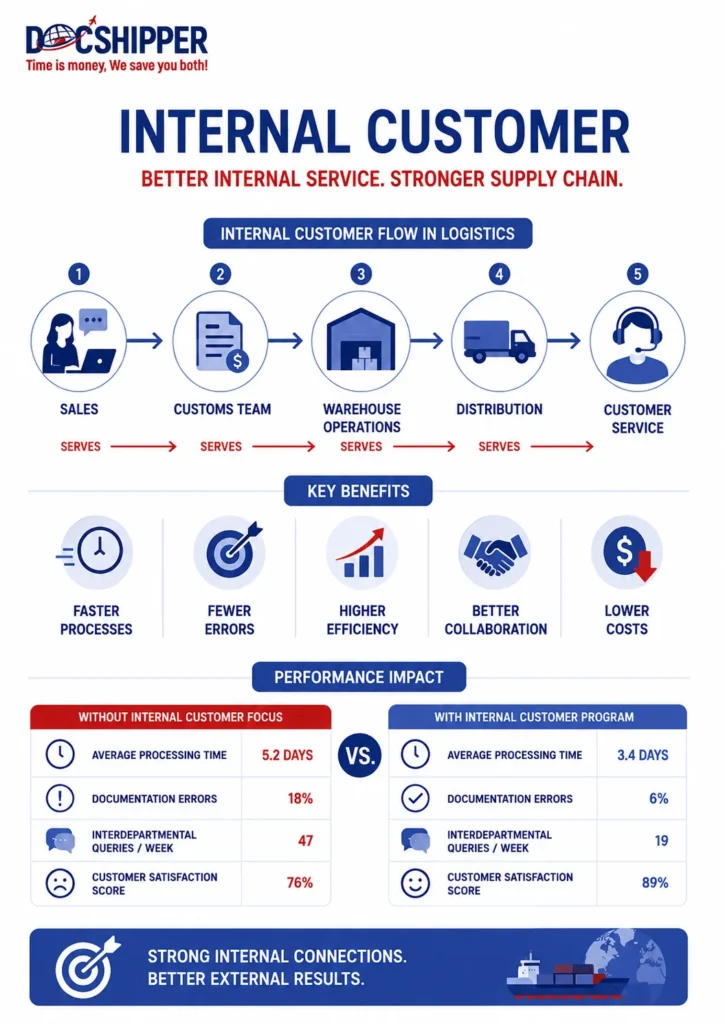
- Sales department (internal supplier) provides commercial invoice to customs team (internal customer)
- Customs team (now supplier) delivers import declaration to warehouse operations (new customer)
- Warehouse operations (supplier) coordinates with distribution (customer) for final delivery scheduling
- Distribution (supplier) communicates delivery windows to customer service (final internal customer)
Each transition point represents an internal customer relationship. When DocShipper manages this chain, we implement tracking protocols ensuring each handoff meets defined quality standards, preventing the 72-hour delays common when information gaps occur.
Comparative Performance Data
| Metric | Without Internal Customer Focus | With Internal Customer Program |
|---|---|---|
| Average Processing Time | 5.2 days | 3.4 days |
| Documentation Errors | 18% of shipments | 6% of shipments |
| Interdepartmental Queries | 47 per week | 19 per week |
| Customer Satisfaction Score | 76% | 89% |
Real-World Scenario: Customs Clearance Coordination
A mid-sized importer reduced customs clearance times from 96 hours to 38 hours by implementing internal customer protocols. The breakthrough came from treating the customs broker as an internal customer of the procurement team. Procurement began providing complete documentation packages 48 hours before vessel arrival rather than on-demand. This simple change eliminated 58 hours of average processing delays.
Industry data shows that 68% of logistics delays originate from internal coordination failures, not external factors. Addressing internal customer relationships therefore yields greater improvements than optimizing carrier selection or route planning alone.
Conclusion
The internal customer concept transforms logistics operations from fragmented silos into integrated service chains. Organizations that formalize these relationships through clear standards, communication protocols, and accountability measures consistently outperform competitors on speed, accuracy, and cost efficiency.
Need help optimizing your internal logistics coordination? Contact DocShipper for expert guidance on streamlining your supply chain operations.
📚 Quiz
Test Your Knowledge: Internal Customer
1. What is the primary characteristic of an internal customer in logistics operations?
2. According to the article, what percentage of logistics delays originate from internal coordination failures rather than external factors?
3. In a customs clearance scenario, the procurement team provides complete documentation to the customs broker 48 hours before vessel arrival. What role is the customs broker playing in this relationship?
🎯 Your Result
📞 Free Quote in 24hFAQ | Internal Customer: Definition, Role & Concrete Examples in Logistics
External customers purchase goods or services from your organization, while internal customers are colleagues or departments requiring your work output to complete their own tasks. In logistics, the warehouse team serves as an internal customer to procurement, while the end recipient represents an external customer. Both require service excellence, but internal relationships directly enable external satisfaction.
Customs clearance depends on accurate documentation from sales, procurement, and quality teams. When these departments understand customs as their internal customer, they prioritize providing complete certificates of origin, invoices, and product specifications. This prevents clearance delays caused by incomplete submissions, which account for approximately 42% of customs-related shipment holds according to World Customs Organization data.
Absolutely. When the freight booking team lacks timely information from sales about shipment readiness, vessels depart without cargo or rush fees accumulate from last-minute bookings. Similarly, when warehouse operations don't communicate container loading status to the transportation department, delivery schedules cascade into failure. Industry studies show internal coordination failures extend average transit times by 15-30%.
Key metrics include first-time information accuracy rates, average response time to internal requests, error correction turnaround, interdepartmental service level agreement compliance, and internal Net Promoter Scores. Leading organizations track these alongside external customer metrics. For example, measuring how often the customs team receives complete documentation on first submission from procurement directly indicates internal service quality.
DocShipper structures operations around defined handoff points where each team serves the next as an internal customer. Our documentation specialists ensure customs brokers receive complete files, our freight coordinators provide warehouses with accurate arrival notifications, and our customer service team receives real-time updates from operations. This systematic approach reduces processing times and eliminates redundant communications.
Initially, formalizing internal customer relationships requires investment in training, system integration, and process documentation. However, organizations typically recover these costs within 6-9 months through reduced errors, faster processing, and lower rework expenses. The elimination of redundant communications alone often justifies the investment, as employees spend 23% less time resolving interdepartmental issues according to Logistics Management research.
Supply chain visibility systems function as tools serving internal customers. When the sales team needs shipment status, when finance requires proof of delivery for invoicing, or when management wants performance analytics, they're acting as internal customers of the visibility system. Effective platforms anticipate these needs, providing self-service access rather than requiring manual information requests that burden operations teams.
Compliance depends on internal customer cooperation across multiple departments. Export control requires sales to identify restricted goods, shipping to apply proper labeling, and documentation to file accurate declarations. When these teams understand their mutual dependencies, compliance rates improve. Companies with formalized internal customer protocols experience 44% fewer regulatory violations according to Customs and Border Protection data.
Technology enhances but cannot fully replace internal customer relationships. Automated systems excel at routine information exchange—shipping notifications, status updates, document transfers. However, exception handling, priority decisions, and continuous improvement still require human collaboration. The most effective organizations combine robust technology with strong interpersonal internal customer practices.
Resolution mechanisms include escalation protocols, cross-functional review meetings, and defined service-level agreements with consequences. For example, if the operations team consistently provides incomplete booking information to freight forwarders, SLA tracking triggers management review. Leading logistics providers establish neutral arbitration processes where department heads jointly resolve recurring internal service failures affecting external delivery performance.
Effective training includes process mapping workshops where employees visualize how their work feeds other departments, role-rotation programs providing firsthand experience as internal customers, and service design exercises identifying pain points in current handoffs. Many logistics companies conduct annual internal customer surveys where departments rate each other's service quality, creating accountability and improvement focus.
In freight forwarding, internal customer relationships span booking agents, documentation specialists, customs brokers, and operations coordinators. When a booking agent secures ocean freight space, the documentation team becomes their internal customer requiring accurate shipment details. That documentation team then serves the customs broker, who in turn serves the final delivery coordinator. Each link must function reliably for successful end-to-end service.
Need Help with
Logistics or Sourcing ?
First, we secure the right products from the right suppliers at the right price by managing the sourcing process from start to finish. Then, we simplify your shipping experience - from pickup to final delivery - ensuring any product, anywhere, is delivered at highly competitive prices.


Fill the Form
Prefer email? Send us your inquiry, and we’ll get back to you as soon as possible.
Contact us




