


In short ⚡
The International Standards Organization (ISO) is a global federation of national standards bodies that develops and publishes voluntary international standards for products, services, and systems. In logistics and international trade, ISO standards ensure quality management, environmental compliance, and operational efficiency across global supply chains.
Introduction
Many companies struggle with inconsistent quality control, environmental compliance failures, and operational inefficiencies when shipping internationally. Without standardized processes, even experienced exporters face unexpected rejections at customs or costly product recalls.
ISO standards provide a universal framework that harmonizes business practices across 165 countries. These voluntary guidelines help logistics operators, manufacturers, and traders demonstrate compliance with international best practices.
Understanding ISO certifications is critical because:
- Regulatory Compliance: Many countries require ISO certification for specific product categories
- Market Access: Retailers and distributors increasingly demand ISO-certified suppliers
- Risk Mitigation: Standardized processes reduce operational errors and liability exposure
- Competitive Advantage: Certified companies win tenders and negotiate better contract terms
- Operational Efficiency: Documented procedures streamline workflows and reduce costs
ISO Framework in International Logistics
The ISO operates through technical committees composed of industry experts who draft consensus-based standards. Unlike government regulations, ISO standards remain voluntary unless adopted into national law or contractual requirements.
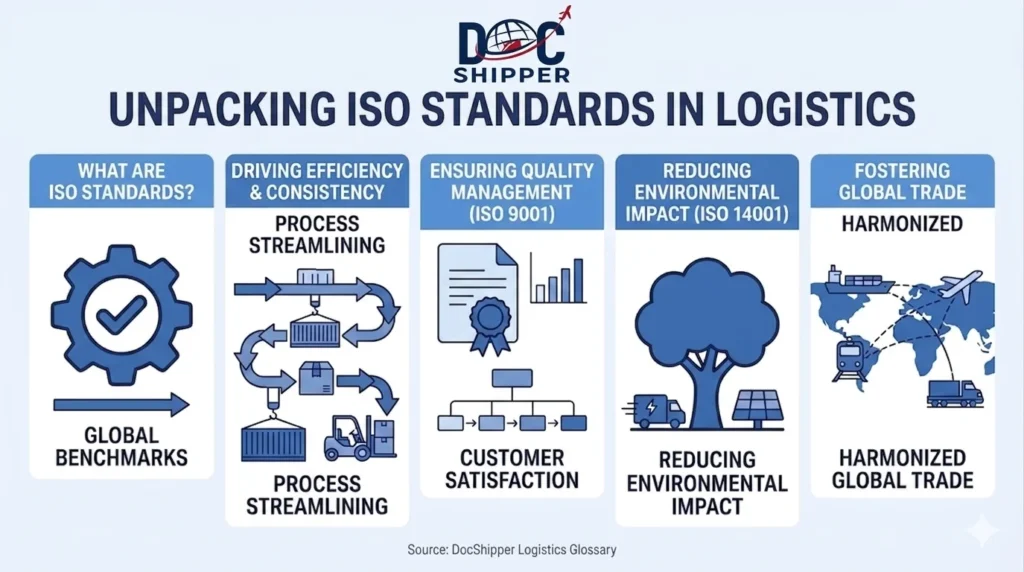
In logistics, three certification families dominate: ISO 9001 for quality management, ISO 14001 for environmental systems, and ISO 45001 for occupational health and safety. Each follows a Plan-Do-Check-Act cycle requiring continuous improvement.
The certification process involves independent auditors assessing documentation, interviewing staff, and observing operations. Companies must demonstrate conformity to standard requirements through objective evidence. Surveillance audits occur annually, with full recertification every three years.
Sector-specific standards like ISO 28000 (supply chain security) and ISO 22301 (business continuity) address specialized logistics challenges. These standards integrate with customs programs like the Authorized Economic Operator (AEO) status, providing fast-track clearance benefits.
According to the ISO official survey, over 1.3 million valid ISO certificates existed worldwide by 2022. The logistics and transportation sector accounted for approximately 8% of all ISO 9001 certifications.
At DocShipper, we verify supplier ISO certifications during our due diligence process to ensure partners meet international quality benchmarks before shipment authorization.
Key ISO Standards & Practical Applications
Different ISO standards address specific operational areas in international trade. Understanding which certifications apply to your business prevents compliance gaps and strengthens supplier relationships.
| ISO Standard | Focus Area | Logistics Application |
|---|---|---|
| ISO 9001 | Quality Management Systems | Ensures consistent product quality and traceability throughout the supply chain |
| ISO 14001 | Environmental Management | Compliance with international environmental regulations and waste reduction targets |
| ISO 28000 | Supply Chain Security | Risk assessment for cargo theft, terrorism, and tampering prevention |
| ISO 45001 | Occupational Health & Safety | Warehouse safety protocols and accident prevention in logistics operations |
| ISO 22000 | Food Safety Management | Temperature-controlled transport and contamination prevention for perishables |
Practical Case Study: A European electronics retailer required all Asian suppliers to hold valid ISO 9001 certification. One manufacturer lost a $2.8 million contract because their certificate had expired three months earlier. The replacement supplier with current certification delivered the first shipment within 45 days.
The investment in ISO certification typically ranges from $5,000 to $15,000 for small to medium enterprises. Annual maintenance costs average $2,000-$4,000 including surveillance audits. Companies report an average ROI of 280% within three years through reduced defects, improved customer retention, and access to premium markets.
Key implementation considerations include:
- Documentation Requirements: Prepare operational manuals, process flowcharts, and record-keeping systems
- Staff Training: All personnel must understand relevant standard requirements and their role in compliance
- Internal Audits: Conduct quarterly self-assessments to identify non-conformities before external audits
- Corrective Actions: Establish systematic procedures for addressing identified gaps within 30 days
- Continuous Improvement: Document efficiency gains and update procedures annually
DocShipper assists clients in selecting freight forwarders with appropriate ISO certifications, ensuring your cargo moves through compliant channels from origin to final destination. Our network includes over 300 ISO-certified logistics partners across Asia, Europe, and North America.
Conclusion
ISO standards provide the credibility and operational framework necessary for competing in international markets. Certification demonstrates commitment to quality, safety, and environmental responsibility while opening doors to regulated industries and premium buyers.
Need guidance on ISO requirements for your supply chain? Contact DocShipper for expert consultation on compliance strategies and certified logistics solutions.
📚 Quiz
Test Your Knowledge: ISO Standards in Logistics
What is the primary nature of ISO standards in international logistics?
A freight forwarder claims ISO 9001 certification guarantees they will never make operational errors. Is this interpretation correct?
Your European client requires temperature-controlled transport for perishable food exports. Which ISO standard is most directly applicable?
🎯 Your Result
📞 Free Quote in 24hFAQ | International Standards Organization (ISO): Definition, Application & Key Standards in Logistics
ISO is a non-governmental international body that creates voluntary consensus standards across all industries. Unlike regional organizations (CEN in Europe, ANSI in USA), ISO standards apply globally. Organizations like IEC focus specifically on electronics, while ISO covers broader management systems, products, and services applicable to logistics and trade.
Initial certification typically requires 6-12 months depending on company size and existing documentation. The process includes gap analysis (4-6 weeks), system implementation (3-6 months), internal audits (2-4 weeks), and certification audit (1-2 weeks). Companies with mature quality systems may achieve certification in 4-6 months.
Yes. While costs vary, small businesses can pursue certification through group schemes or simplified approaches. Consultant fees range from $50-$150 per hour, and some governments offer subsidies covering 30-70% of certification costs for SMEs. The competitive advantages often outweigh initial investment within 18-24 months.
Certificates remain valid for three years but require annual surveillance audits. Companies must maintain compliance throughout the certification cycle. Failure to pass surveillance audits results in certificate suspension. At the three-year mark, organizations undergo full recertification audits covering all standard requirements comprehensively.
ISO 9001 (Quality Management) remains the foundation for freight forwarders, demonstrating operational reliability. ISO 28000 (Supply Chain Security) increasingly matters for international shipments, especially for AEO status eligibility. Many forwarders pursue both certifications to meet diverse client requirements and regulatory expectations.
Customs agencies recognize ISO certification as evidence of reliable business practices. Many AEO programs incorporate ISO 9001 or ISO 28000 as preferred criteria. While not legally mandatory, certified companies experience fewer inspections, faster clearances, and priority processing during peak periods at major ports.
Loss of certification typically constitutes a material breach if the contract specified ISO compliance. Buyers may invoke quality assurance clauses, require corrective action within 30-60 days, or terminate agreements. Some contracts include penalty clauses ranging from 5-15% of order value for non-compliant shipments discovered post-delivery.
Yes. ISO 16106 covers dangerous goods packaging transport requirements. ISO 14001 environmental management applies to hazmat handlers. While UN Model Regulations and IMDG Code provide legal frameworks, ISO standards offer management system approaches ensuring consistent compliance with international dangerous goods transport laws.
Request the certificate directly and verify through the issuing certification body's website. Legitimate certificates include unique registration numbers, certification body accreditation marks, and validity dates. Accreditation bodies like IAF maintain registries of recognized certification bodies. Beware of fake certificates—always cross-reference with official databases.
ISO certifications receive global recognition, but acceptance varies by sector and regulatory framework. Countries with mutual recognition agreements honor certifications from accredited bodies. Some nations require additional local certifications for regulated products despite existing ISO certificates. Verification with destination country authorities prevents surprises.
ISO 9001 provides a structured framework implementing Total Quality Management (TQM) principles. While TQM represents a broader philosophy emphasizing continuous improvement and customer satisfaction, ISO 9001 offers specific requirements and audit criteria. Many organizations use ISO 9001 as the foundation for comprehensive TQM programs.
Indirectly, yes. ISO-certified companies maintain better documentation accuracy, reducing customs queries and inspection rates. Certification demonstrates reliability, making customs authorities more likely to approve simplified procedures. When combined with AEO status, clearance times can decrease by 40-60% compared to non-certified competitors at busy border crossings.
Need Help with
Logistics or Sourcing ?
First, we secure the right products from the right suppliers at the right price by managing the sourcing process from start to finish. Then, we simplify your shipping experience - from pickup to final delivery - ensuring any product, anywhere, is delivered at highly competitive prices.


Fill the Form
Prefer email? Send us your inquiry, and we’ll get back to you as soon as possible.
Contact us




:%20Definition,%20Application%20&%20Key%20Standards%20in%20Logistics)