


In short ⚡
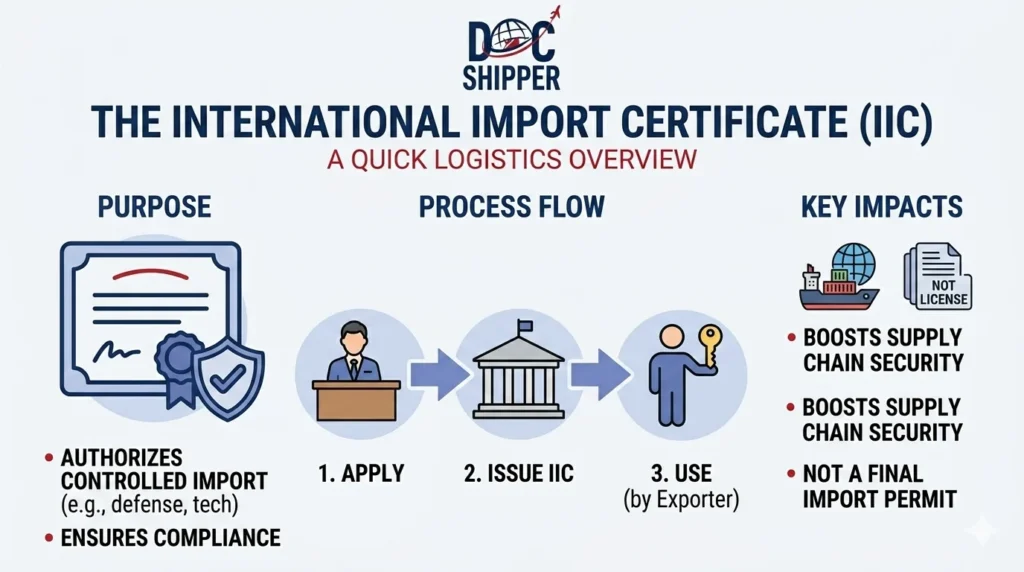
The International Import Certificate (IIC) is an official document issued by a government authority confirming that imported goods will remain in the destination country and not be re-exported without authorization. This certificate is primarily required for controlled substances, strategic materials, weapons, and dual-use technologies to ensure compliance with international arms control agreements and prevent illegal trafficking.
Introduction
Importers frequently encounter confusion when dealing with restricted or controlled goods, especially regarding documentation requirements beyond standard customs declarations. The International Import Certificate addresses this challenge by providing governmental assurance that sensitive materials will be used responsibly within the importing country.
This certificate plays a crucial role in international trade compliance, particularly for industries handling strategic commodities. Without proper IIC documentation, shipments may face indefinite detention, rejection at customs, or legal consequences for both importers and exporters.
The IIC system serves multiple stakeholders in the global supply chain:
- Exporting countries – verify destination and end-use of controlled materials
- Importing governments – maintain oversight of strategic goods entering their territory
- Manufacturers and traders – demonstrate compliance with international regulations
- International organizations – monitor adherence to non-proliferation treaties
- Customs authorities – validate legitimacy of controlled shipments
Regulatory Framework & Compliance Requirements
The International Import Certificate operates within a complex regulatory ecosystem governed by international treaties and national legislation. The certificate requirement stems primarily from the Arms Trade Treaty (ATT) and various dual-use goods control regimes including the Wassenaar Arrangement.
Obtaining an IIC typically requires the importer to submit a formal application to their national export control authority. This process involves detailed documentation about the intended end-use, final destination, and end-user identification. Processing times vary significantly by country, ranging from 2 weeks to 3 months depending on the sensitivity of the goods.
Key requirements for IIC issuance include:
- End-user verification – documented proof of the final recipient’s identity and legitimacy
- End-use declaration – detailed description of how the goods will be utilized
- Non-diversion commitment – guarantee that goods will not be re-exported or transferred without permission
- Company registration – the importer must be officially registered and authorized to handle controlled goods
- Security clearances – for highly sensitive materials, personnel security verification may be required
The certificate typically contains standardized information fields including HS codes, product descriptions, quantities, exporter details, and validity periods. Most IICs remain valid for 6 to 12 months from issuance, though this varies by jurisdiction and product category.
At DocShipper, we systematically verify IIC requirements during the pre-shipment phase for all controlled goods, ensuring our clients avoid costly delays. Our compliance team maintains updated databases of country-specific regulations and directly coordinates with national authorities when necessary.
A critical companion document is the Delivery Verification Certificate (DVC), which the importer must provide after receiving goods. This DVC confirms to the exporting country that materials arrived as declared, completing the verification loop. Some exporting nations require the DVC before issuing future export licenses to the same supplier.
Practical Applications & Case Studies
Understanding the IIC’s practical implications requires examining real-world scenarios across different industries and product categories. The certificate’s complexity and importance vary significantly based on the strategic sensitivity of the imported materials.
Comparative Analysis: IIC Requirements by Product Category
| Product Category | IIC Required | Average Processing Time | Validity Period |
|---|---|---|---|
| Military weapons and ammunition | Always required | 6-12 weeks | 6 months |
| Dual-use technologies (electronics, software) | Frequently required | 3-8 weeks | 12 months |
| Chemicals and precursors | Case-by-case | 2-6 weeks | 12 months |
| Nuclear materials and equipment | Always required | 8-16 weeks | 6 months |
| Cryptographic equipment | Often required | 4-10 weeks | 12 months |
Case Study: Electronics Manufacturing Import
A European electronics manufacturer needed to import specialized semiconductor testing equipment from the United States valued at $2.3 million. The equipment contained dual-use technologies subject to export controls under the Wassenaar Arrangement.
Documentation process breakdown:
- Week 1-2: Initial application submitted to national export control authority with technical specifications, end-use description, and facility security documentation
- Week 3-5: Authority conducted site verification visit and interviewed key technical personnel
- Week 6: IIC issued with 12-month validity and specific conditions regarding technology transfer restrictions
- Week 7: IIC transmitted to U.S. exporter, who then applied for export license
- Week 12: Complete shipment cleared for export after U.S. Department of Commerce approval
The total timeline from initial order to shipment authorization was approximately 12 weeks, with the IIC representing the critical first step. Without this certificate, the U.S. exporter could not legally initiate the export license application process.
Statistical Insights on IIC Processing
According to Wassenaar Arrangement compliance data from 2023:
- 73% of IIC applications are approved on first submission
- 19% require additional documentation or clarification before approval
- 8% are rejected due to end-use concerns or incomplete applications
- Average processing time has decreased by 22% since 2020 due to digitalization initiatives
- Dual-use goods represent 64% of all IIC requests, with military items accounting for 28%
Conclusion
The International Import Certificate represents a fundamental compliance requirement for controlled goods trade, serving as governmental assurance that strategic materials will be used responsibly. Proper understanding and timely acquisition of this certificate prevents costly shipment delays and legal complications.
Need assistance navigating IIC requirements for your imports? Contact DocShipper for expert guidance on controlled goods compliance and documentation management.
📚 Quiz
Test Your Knowledge: International Import Certificate
What is the primary purpose of an International Import Certificate?
Can an International Import Certificate be transferred to another company after issuance?
A European manufacturer needs to import dual-use semiconductor testing equipment valued at $2.3 million from the United States. What is the most appropriate first step?
🎯 Your Result
📞 Free Quote in 24hFAQ | International Import Certificate: Definition, Requirements & Practical Examples
An International Import Certificate specifically confirms that controlled goods will not be re-exported without authorization, primarily for strategic materials and weapons. A regular import license is broader, covering various restricted goods based on quotas, health standards, or economic policies. The IIC is issued to satisfy exporting country requirements, while import licenses fulfill domestic regulatory obligations. Some shipments may require both documents simultaneously.
The issuing authority varies by country but is typically the national export control agency or defense ministry. In the United States, it's the Directorate of Defense Trade Controls (DDTC) for military items. The UK's Export Control Joint Unit handles these certificates. France relies on the Service des Biens à Double Usage. Germany uses the Federal Office for Economic Affairs and Export Control (BAFA). Importers should identify their country's designated authority through the Ministry of Commerce or Foreign Affairs.
Processing times range from 2 to 16 weeks depending on product sensitivity and country procedures. Straightforward dual-use goods may receive approval in 3-4 weeks, while military equipment or nuclear materials require 8-12 weeks or longer. Complex cases involving new end-users or sensitive technologies may extend to 16 weeks. Expedited processing is rarely available. Importers should initiate the application process immediately after order confirmation to avoid shipment delays.
No, IICs are non-transferable and company-specific. The certificate is issued to a particular legal entity for specific goods and end-uses. If ownership changes or the goods are sold domestically before arrival, a new certificate application may be required. The original certificate holder remains legally responsible for compliance with stated conditions. Any deviation from the declared end-user or purpose constitutes a violation of export control regulations and may result in penalties.
Customs authorities will detain the shipment indefinitely until proper documentation is provided. The importer faces potential penalties, including fines up to three times the shipment value in some jurisdictions. The exporter may lose export privileges for future transactions. In severe cases involving weapons or nuclear materials, criminal prosecution may occur. Goods may be subject to re-export at the importer's expense or destroyed. Insurance typically does not cover losses resulting from documentation non-compliance.
No, IIC requirements are not universal. The exporting country's regulations determine whether an IIC is needed from the destination country. Major arms exporters like the United States, Russia, France, Germany, and the UK routinely require IICs for military and dual-use exports. Some developing nations lack formal IIC systems. The Wassenaar Arrangement member states (42 countries) generally expect IICs for controlled goods. Exporters should verify requirements through their national export control authority before shipping.
Applications must contain: detailed product descriptions with technical specifications, HS codes, quantities, exporter and manufacturer details, end-user identification with business registration documents, intended end-use description, facility location where goods will be used, and a non-diversion commitment. Supporting documents typically include company licenses, security clearances if required, procurement contracts, and technical justification for the import. Incomplete applications result in processing delays or rejection.
Extension policies vary by issuing authority. Some countries allow one-time extensions of 3-6 months if goods haven't yet shipped due to legitimate delays. Renewal typically requires a new application with updated documentation. If the original certificate expires before goods arrive, a new certificate is mandatory. Some authorities maintain faster processing for renewal applications from established importers with good compliance records. Importers should request extensions at least 30 days before expiration to avoid gaps in authorization.
Military weapons, ammunition, explosives, and combat vehicles universally require IICs. Nuclear materials, equipment, and technology always need certification. Chemical weapon precursors listed under the Chemical Weapons Convention mandate IICs. Ballistic missile technology and components are subject to strict certificate requirements. Man-portable air defense systems (MANPADS) always require governmental authorization. However, specific thresholds and technical parameters determine requirements for dual-use technologies, so case-by-case evaluation is necessary.
The Delivery Verification Certificate (DVC) is a document the importer provides to the exporting country after receiving goods covered by an IIC. It confirms that materials arrived as declared and are in the stated location for the approved purpose. The DVC closes the verification loop initiated by the IIC. Many exporting nations require the DVC before issuing subsequent export licenses to the same end-user. Failure to provide a DVC can blacklist the importer from future controlled goods transactions.
Most cargo insurance policies exclude coverage for losses resulting from regulatory non-compliance, including missing or invalid IICs. Liability typically remains with the party responsible for documentation—usually the importer. Freight forwarders may refuse to handle shipments lacking proper certificates to avoid legal exposure. Specialized brokers experienced with controlled goods should verify certificate validity before accepting cargo. Insurance premiums for strategic materials are significantly higher and require proof of complete documentation compliance including valid IICs.
Digital IIC systems are emerging but not yet universal. The European Union has implemented electronic licensing for dual-use goods in member states. The United States accepts electronic submissions but issues paper certificates. Many developing countries still require original stamped documents. Customs authorities at ports may not have systems to verify electronic certificates. Best practice involves carrying both digital copies and certified paper originals for international shipments. Cross-border recognition of digital certificates remains limited, requiring case-by-case verification with destination country customs.
Need Help with
Logistics or Sourcing ?
First, we secure the right products from the right suppliers at the right price by managing the sourcing process from start to finish. Then, we simplify your shipping experience - from pickup to final delivery - ensuring any product, anywhere, is delivered at highly competitive prices.


Fill the Form
Prefer email? Send us your inquiry, and we’ll get back to you as soon as possible.
Contact us




