


In short ⚡
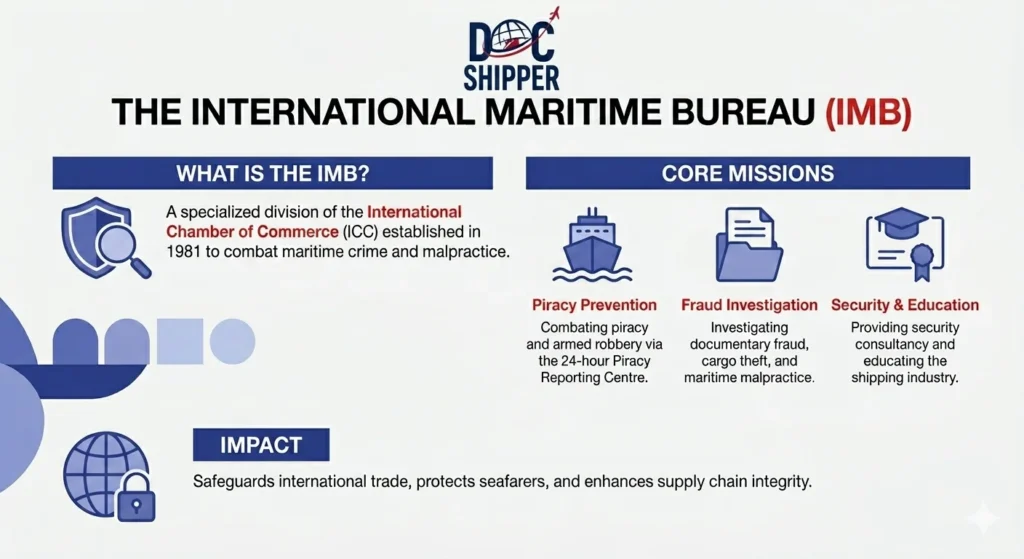
The International Maritime Bureau (IMB) is a specialized division of the International Chamber of Commerce (ICC) that combats maritime crime and fraud worldwide. Established in 1981, the IMB monitors piracy, cargo theft, fraud, and other maritime crimes, providing real-time intelligence to shipping companies, insurers, and law enforcement agencies to enhance maritime security and protect global trade.
Introduction
Many businesses engaged in international shipping face confusion about which organization to contact when maritime security incidents occur. Cargo theft, piracy attacks, and fraudulent documentation plague global trade, causing billions in losses annually. The International Maritime Bureau stands as the authoritative body addressing these challenges.
In the complex landscape of international logistics, understanding the IMB’s role becomes essential for protecting shipments and ensuring supply chain continuity. This organization serves as the central intelligence hub for maritime crime, bridging the gap between private industry and law enforcement.
- Real-time piracy reporting: 24/7 Piracy Reporting Centre monitoring global incidents
- Fraud prevention: Investigation of fraudulent shipping documentation and charter party scams
- Global intelligence network: Collaboration with over 150 countries and maritime organizations
- Free alert system: Distribution of security warnings to shipping industry stakeholders
- Training and consultation: Advisory services for shipping companies on security best practices
IMB Structure & Expertise
The International Maritime Bureau operates through three primary divisions, each addressing distinct maritime security challenges. The IMB Piracy Reporting Centre (PRC) in Kuala Lumpur serves as the organization’s flagship operation, receiving distress calls from vessels under attack and coordinating responses with naval forces and coastal authorities.
The Commercial Crime Services division investigates sophisticated fraud schemes targeting the shipping industry. These include fake charter agreements, phantom ships, and documentary fraud where criminals impersonate legitimate shipping companies. This unit works directly with INTERPOL and national law enforcement to prosecute offenders.
A third critical function involves the Financial Investigation Bureau, which traces money laundering operations connected to maritime crime. Criminal networks often use complex financial structures to hide proceeds from piracy ransoms, cargo theft, and insurance fraud. The IMB’s forensic accountants track these financial flows across jurisdictions.
The organization maintains a comprehensive database of maritime incidents dating back decades. This historical data enables pattern analysis, identifying high-risk shipping routes and emerging criminal tactics. Shipping companies access this intelligence through confidential briefings and published reports.
Legal frameworks supporting IMB operations include the United Nations Convention on the Law of the Sea (UNCLOS) and SOLAS regulations. The bureau does not possess enforcement powers but facilitates cooperation between flag states, port authorities, and military forces. At DocShipper, we regularly consult IMB advisories when planning shipments through high-risk corridors, adjusting routes and security measures accordingly to protect our clients’ cargo.
The IMB’s reporting methodology follows strict verification protocols. When a piracy incident occurs, the PRC immediately contacts the vessel, confirms details, and alerts nearby ships and authorities. This rapid response capability has proven crucial in preventing hijackings and rescuing crews. The bureau publishes quarterly and annual reports detailing global maritime crime trends, which insurance companies use to calculate premiums and shippers reference for risk assessment.
Concrete Examples & Data
IMB statistics reveal the tangible impact of maritime crime on global commerce. In 2023, the organization documented 120 actual and attempted piracy incidents worldwide, representing a significant decline from the 2011 peak of 439 attacks. This reduction directly correlates with increased naval patrols and IMB intelligence-sharing initiatives.
The Gulf of Guinea region demonstrates the IMB’s critical role. Between 2019 and 2021, this area accounted for over 40% of global kidnappings at sea. Following intensified IMB coordination with regional navies and the establishment of reporting protocols, incidents dropped by 70% in 2022-2023. Shipping companies now rely on IMB’s weekly advisories to navigate these waters safely.
A concrete case involved a phantom ship fraud in Southeast Asia where criminals impersonated a legitimate bulk carrier. The IMB’s investigation team identified discrepancies in the vessel’s documentation, traced the fraudulent company to a shell corporation, and alerted authorities before the scheme could defraud buyers of $4.2 million in cargo payments.
| Region | 2023 Incidents | Primary Crime Type | IMB Response |
|---|---|---|---|
| Southeast Asia (Singapore Strait) | 50 | Opportunistic theft | Enhanced patrol coordination |
| West Africa (Gulf of Guinea) | 17 | Crew kidnapping | Real-time naval alerts |
| South America (Peru/Ecuador) | 22 | Armed robbery | Port security advisories |
| Indian Ocean (Somalia) | 3 | Attempted hijacking | Military escort guidance |
The IMB’s documentary fraud database prevents an estimated $500 million in annual losses. Shipping companies verify counterparties through the IMB hotline before executing transactions. In one quarter alone, the bureau received 187 verification requests, identifying 23 fraudulent entities.
Insurance implications demonstrate financial stakes. Vessels transiting high-risk areas without following IMB routing recommendations face premium increases of 15-40%. Conversely, companies implementing IMB security protocols qualify for reduced war risk insurance rates. This economic incentive reinforces the bureau’s influence on industry practices.
Conclusion
The International Maritime Bureau remains indispensable for securing global trade against maritime crime. Its intelligence network, rapid reporting systems, and investigative expertise directly protect billions in cargo value annually. Understanding IMB resources and following its advisories constitutes essential risk management for any international shipping operation.
Need expert guidance navigating high-risk shipping routes or implementing maritime security protocols? Contact DocShipper for comprehensive logistics solutions tailored to your security requirements.
📚 Quiz
Test Your Knowledge: International Maritime Bureau (IMB)
What is the primary function of the International Maritime Bureau (IMB)?
When a shipping company discovers suspicious documentation from a potential charter party, what role does the IMB play?
A vessel transiting the Gulf of Guinea receives a piracy alert from the IMB Piracy Reporting Centre. What should the captain understand about this warning?
🎯 Your Result
📞 Free Quote in 24hFAQ | International Maritime Bureau (IMB): Definition, Role & Concrete Examples
Contact the IMB Piracy Reporting Centre immediately at their 24/7 hotline: +60 3 2078 5763 or via email at piracy@icc-ccs.org. Provide vessel name, position, incident details, and crew status. The centre will coordinate response with naval authorities and alert nearby vessels.
While not legally mandatory, reporting to the IMB is strongly recommended and considered industry best practice. Many insurance policies require incident reporting to the IMB for claims processing. Additionally, unreported incidents leave other vessels vulnerable to similar attacks in the same area.
The IMB Piracy Reporting Centre services are free for all mariners and shipping companies. However, the organization is funded by the International Chamber of Commerce and industry contributions. Specialized investigative services for fraud cases may involve consultation fees depending on complexity.
The International Maritime Bureau (IMB) is a specialized division of the ICC focused on combating maritime crime and fraud. The International Maritime Organization (IMO) is a United Nations agency that regulates shipping standards, safety, and environmental practices. The IMB operates as an intelligence and investigation body, while the IMO creates binding international maritime law.
IMB data represents the most comprehensive publicly available piracy statistics, verified through direct vessel contact and cross-referenced with naval reports. However, underreporting exists as some incidents go unreported due to concerns about delays, insurance implications, or lack of awareness. Actual incident numbers may be 20-30% higher than published figures.
The IMB publishes quarterly and annual piracy reports freely available on the ICC Commercial Crime Services website. Detailed intelligence briefings and real-time alerts are typically reserved for ICC members, shipping companies, and maritime security professionals. Law enforcement agencies have direct access to the complete database.
The IMB immediately broadcasts an alert to vessels in the vicinity via maritime communication channels. They contact relevant naval forces and coastal authorities to coordinate response. Your incident details are added to the global database, and investigators may follow up for additional information if patterns emerge or prosecution opportunities exist.
Yes, the IMB investigates cargo theft and fraud occurring in ports and during inland transport. They work with port authorities and local law enforcement to track criminal networks. However, their primary focus remains maritime incidents. For landlocked cargo theft, they coordinate with INTERPOL and national agencies rather than leading investigations directly.
The IMB maintains strict confidentiality protocols. Incident reports are anonymized in public statistics, with vessel names and commercial details protected. Detailed information is shared only with law enforcement under formal investigation agreements. Companies reporting fraud can request confidential handling to protect business relationships and ongoing transactions.
The IMB offers security awareness training covering fraud recognition, piracy response procedures, and crime prevention best practices. Training formats include webinars, on-site workshops, and consultation services. They also provide guidance on implementing the Best Management Practices for Protection against Somalia Based Piracy (BMP) and similar frameworks for other regions.
The IMB Piracy Reporting Centre operates 24/7 with staff trained to respond within minutes of receiving distress calls. Initial response includes immediate alert broadcasts and naval contact. Follow-up coordination continues throughout the incident until the vessel reaches safety. Response speed depends on communication quality and incident location, but average initial response time is under 5 minutes.
The IMB assists law enforcement in tracing stolen cargo and tracking ransom payments through their Financial Investigation Bureau. However, they do not negotiate ransoms or conduct recovery operations directly. They provide intelligence to authorities and work with insurers to document losses. Actual recovery depends on law enforcement capabilities and jurisdiction where assets are located.
Need Help with
Logistics or Sourcing ?
First, we secure the right products from the right suppliers at the right price by managing the sourcing process from start to finish. Then, we simplify your shipping experience - from pickup to final delivery - ensuring any product, anywhere, is delivered at highly competitive prices.


Fill the Form
Prefer email? Send us your inquiry, and we’ll get back to you as soon as possible.
Contact us




:%20Definition,%20Role%20&%20Concrete%20Examples)