



In short ⚡
Inventory Accuracy is the measure of how closely recorded inventory levels match actual physical stock. It reflects the reliability of warehouse management systems and directly impacts customer satisfaction, operational costs, and supply chain efficiency in international logistics operations.
Introduction
Many importers discover discrepancies between their recorded stock and physical inventory only during audits or when fulfilling urgent orders. These gaps create cascading problems: delayed shipments, customer complaints, and inflated carrying costs.
In international trade, inventory accuracy becomes critical when managing goods across multiple warehouses, customs zones, and distribution channels. A single miscounted SKU can trigger compliance issues, stockouts, or excess inventory write-offs.
Key characteristics of inventory accuracy include:
- Quantitative precision between system records and physical counts
- Direct correlation with order fulfillment rates and customer trust
- Foundation for demand forecasting and procurement decisions
- Regulatory compliance requirement for customs-bonded warehouses
- Impact on financial reporting and tax obligations
Understanding Inventory Accuracy Mechanisms
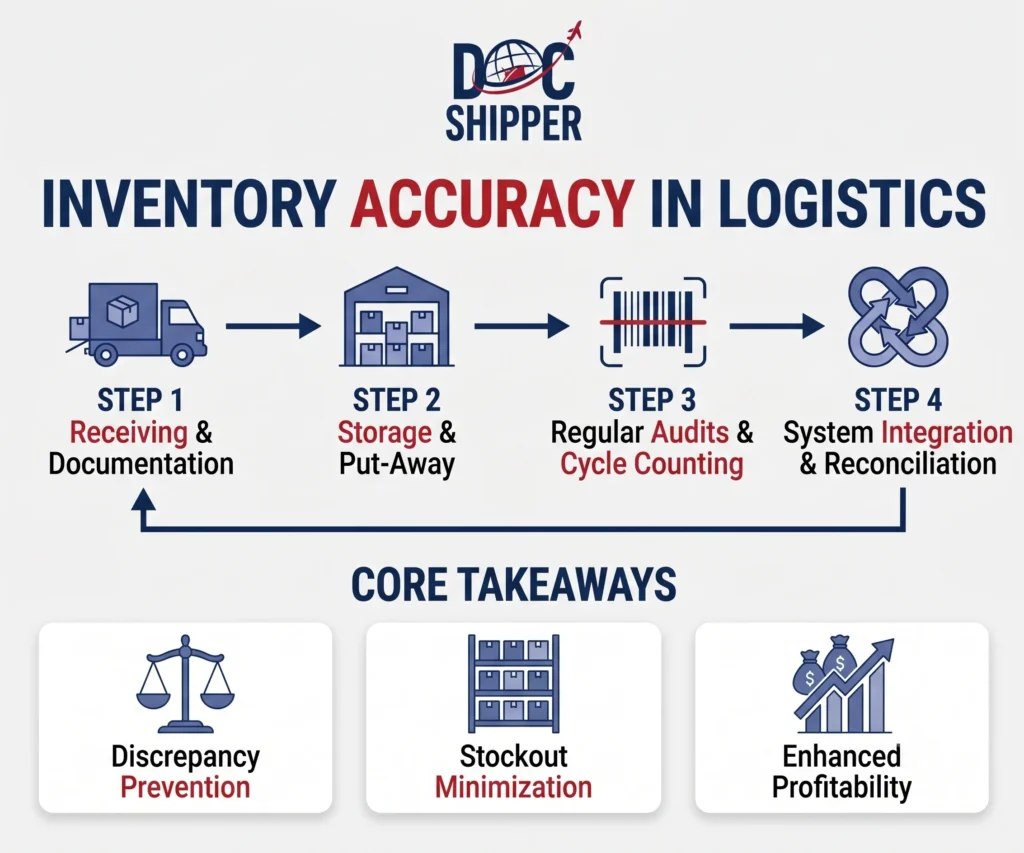
Inventory accuracy operates through continuous reconciliation between perpetual inventory systems and physical reality. Modern warehouse management systems (WMS) track every transaction—receipts, picks, adjustments—creating a digital twin of actual stock.
Three primary methodologies measure this accuracy. Cycle counting audits subsets of inventory regularly rather than annual full counts. ABC analysis prioritizes high-value items for frequent verification while lower-value goods receive less attention. RFID and barcode scanning automate data capture to reduce human error at receiving and shipping points.
Legal implications vary by jurisdiction. The U.S. Customs and Border Protection requires bonded warehouse operators to maintain inventory records with 99%+ accuracy for compliance audits. European Union regulations demand detailed stock records for VAT reporting and customs declarations under Union Customs Code Article 178.
Common accuracy killers include receiving errors when shipment quantities aren’t verified, location misplacement where goods are stored in undocumented bins, and shrinkage from theft or damage that goes unreported. At DocShipper, we implement multi-point verification protocols during receiving and cross-docking operations to eliminate these vulnerabilities before they impact your supply chain.
The financial impact extends beyond immediate operational costs. Inaccurate inventory inflates safety stock requirements, ties up working capital, and creates obsolescence risk. Companies typically hold 15-25% excess inventory as buffer against uncertainty caused by poor data quality.
Calculation Methods & Real-World Scenarios
Calculating inventory accuracy follows a straightforward formula: (Accurate Item Count ÷ Total Item Count) × 100. However, practitioners measure this at three levels—location accuracy, SKU accuracy, and total inventory value accuracy—each revealing different operational insights.
| Accuracy Level | Measurement Method | Industry Benchmark | Impact Area |
|---|---|---|---|
| Location Accuracy | Physical location matches system record | 95-98% | Picking efficiency, labor costs |
| SKU Accuracy | Quantity matches for each product code | 97-99% | Order fulfillment, stockouts |
| Value Accuracy | Total inventory value variance | 98-99.5% | Financial reporting, taxes |
Use Case: Electronics Importer
A consumer electronics distributor imports 50,000 units monthly across 200 SKUs. Their WMS showed 1,247 units of a popular smartphone model, but physical count revealed only 1,189 units—a 58-unit discrepancy.
Calculation breakdown:
- SKU accuracy for this item: (1 incorrect SKU ÷ 200 total SKUs) × 100 = 99.5% accuracy
- Unit accuracy: (49,942 correct units ÷ 50,000 total) × 100 = 99.88% accuracy
- Financial impact: 58 units × $450 unit cost = $26,100 variance requiring investigation
Root cause analysis traced the error to a miscounted receiving shipment three weeks prior. The importer had already sold 45 units based on inflated system data, creating backorder situations and customer complaints.
DocShipper’s quality control process includes mandatory recount verification when receiving shipment quantities exceed 100 units or $10,000 value, preventing such discrepancies from entering client inventory systems.
Conclusion
Inventory accuracy stands as the invisible backbone of successful international logistics operations. Without reliable data, even the most sophisticated supply chain strategies crumble under the weight of preventable errors and inflated costs.
Need support improving your inventory accuracy rates? Contact DocShipper for warehouse management solutions tailored to international trade requirements.
📚 Quiz
Test Your Knowledge: Inventory Accuracy
What does inventory accuracy fundamentally measure?
A company discovers their system shows 1,000 units but physical count reveals 950 units. What is the most accurate statement about this situation?
An electronics importer handles 200 SKUs with one product showing incorrect quantities. What is their SKU accuracy rate?
🎯 Your Result
📞 Free Quote in 24hFAQ | Inventory Accuracy: Definition, Calculation & Concrete Examples
Industry standards target 95-99% accuracy depending on inventory value and industry. High-value pharmaceutical or aerospace components require 99%+ accuracy, while low-value bulk commodities may operate effectively at 95-97%. Bonded warehouses and customs facilities typically mandate 98%+ accuracy for regulatory compliance.
High-velocity A-items should be counted monthly or weekly, B-items quarterly, and C-items annually. This ABC approach balances accuracy maintenance with labor costs. Facilities handling perishable goods or high-theft items may implement daily spot checks on vulnerable SKUs.
Primary causes include receiving errors during inbound processing, mispicks during order fulfillment, location errors when restocking, system transaction mistakes, shrinkage from theft or damage, and poor barcode label quality. Each transaction without verification compounds cumulative error rates.
RFID dramatically improves accuracy by automating data capture, but cannot guarantee perfection. Physical tag failures, metal interference, liquid absorption, and reader positioning issues create 0.5-2% error rates. Combining RFID with periodic physical verification achieves optimal results.
Customs authorities require precise documentation matching physical shipments. Discrepancies between commercial invoices, packing lists, and actual goods trigger inspections, delays, and potential penalties. Bonded warehouses face license suspension if accuracy falls below regulatory thresholds.
Accuracy measures how closely recorded quantities match physical reality. Precision reflects the granularity of measurement units. A warehouse might have 99% accuracy (correct quantities) but low precision if counting cases rather than individual units, obscuring partial case discrepancies.
Peak seasons increase transaction volumes and temporary labor, both degrading accuracy. Facilities experience 3-8% accuracy drops during holidays due to rushed receiving, inexperienced pickers, and deferred cycle counting. Pre-season training and enhanced supervision mitigate these effects.
Logical bin locations, clear aisle marking, and standardized putaway processes reduce placement errors. Fixed location strategies where SKUs always occupy the same bins improve accuracy versus random slotting. Vertical space utilization must balance density with picking accuracy—higher shelves increase mispick rates.
Immediate investigation determines root causes before adjusting system records. Document findings, implement corrective actions, and adjust inventory values per accounting standards. Material discrepancies require management notification and may trigger expanded audits. Recurring errors signal systemic process failures needing redesign.
Directly impacts order fulfillment rates, shipping speed, and customer satisfaction scores. Inaccurate inventory causes overselling, leading to cancellations and refunds. Marketplace platforms penalize sellers with poor accuracy through reduced search visibility and account restrictions. Maintaining 98%+ accuracy protects seller ratings.
Track inventory turnover rates, carrying costs, stockout frequency, shrinkage percentages, and order fill rates alongside accuracy. These interconnected metrics reveal whether accuracy improvements translate to operational gains. Monitor accuracy by SKU category and storage zone to identify localized problems.
Reputable 3PLs implement multi-point verification, regular cycle counting programs, and technology integration with client systems. Service level agreements specify accuracy guarantees with financial penalties for failures. At DocShipper, we provide real-time inventory visibility and monthly accuracy reports backed by our quality guarantee.
Need Help with
Logistics or Sourcing ?
First, we secure the right products from the right suppliers at the right price by managing the sourcing process from start to finish. Then, we simplify your shipping experience - from pickup to final delivery - ensuring any product, anywhere, is delivered at highly competitive prices.


Fill the Form
Prefer email? Send us your inquiry, and we’ll get back to you as soon as possible.
Contact us




