


In short ⚡
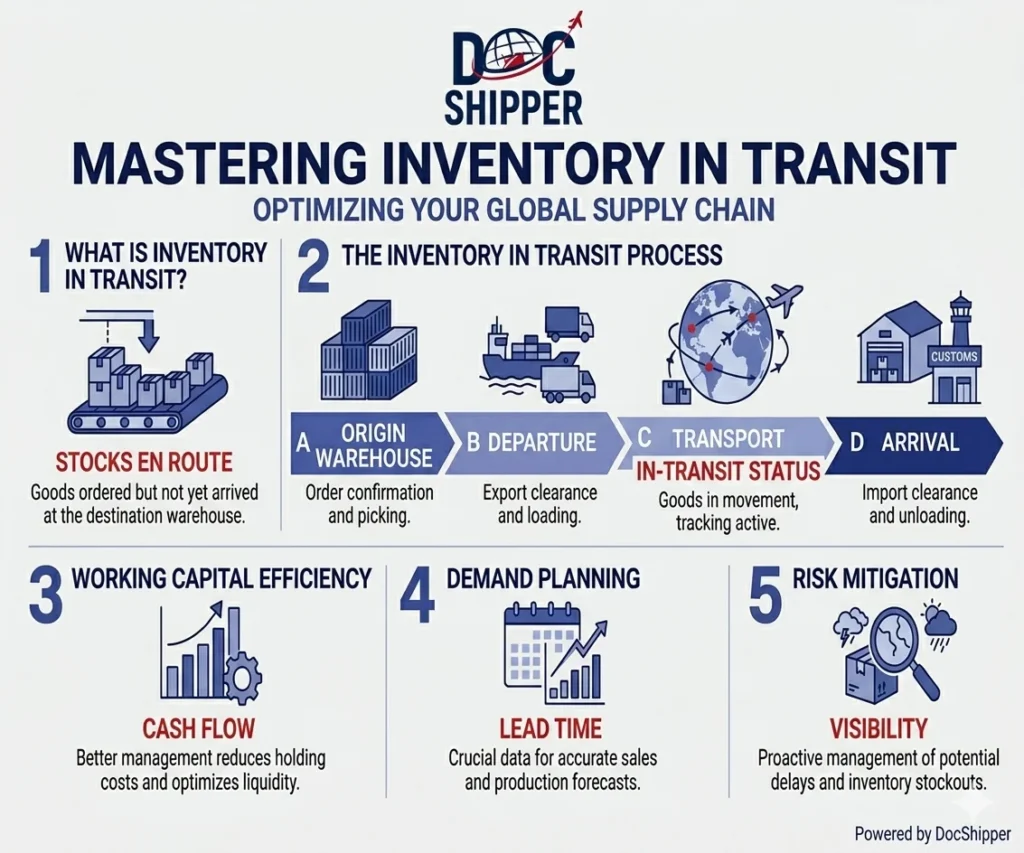
Inventory In Transit refers to goods that have been shipped from the supplier but have not yet arrived at their destination warehouse or facility. This inventory is physically moving between locations and represents a critical asset on the company's balance sheet, requiring precise tracking and visibility throughout the supply chain journey.Introduction
One of the most common challenges in international logistics is the lack of visibility over goods during transit. Between the moment cargo leaves the supplier’s dock and arrives at your warehouse, inventory exists in a financial and operational limbo. This gap creates uncertainty in planning, increases carrying costs, and complicates financial reporting.
Inventory in transit becomes especially critical for companies operating global supply chains with extended lead times. Understanding how to account for, track, and optimize this floating inventory directly impacts cash flow, customer satisfaction, and operational efficiency.
Key characteristics of inventory in transit include:
- Ownership ambiguity: Depending on Incoterms, ownership may transfer at various points during shipment
- Visibility challenges: Real-time tracking requires integration of carrier data and customs information
- Financial implications: Must be accurately recorded as an asset despite not being physically accessible
- Risk exposure: Goods are vulnerable to delays, damage, theft, or customs issues
- Lead time variability: Transit duration affects inventory planning and safety stock calculations
In-Transit Inventory Management & Expertise
Managing inventory in transit requires a sophisticated understanding of logistics operations, accounting principles, and technology integration. The complexity increases exponentially when dealing with international shipments crossing multiple jurisdictions.
Accounting treatment varies based on the agreed Incoterms between buyer and seller. Under FOB (Free On Board) shipping point terms, the buyer records inventory in transit once goods leave the supplier’s facility. Conversely, under FOB destination terms, ownership only transfers upon arrival. This distinction significantly impacts balance sheet reporting and inventory valuation timing.
Tracking technology has evolved from basic bill of lading numbers to sophisticated GPS-enabled IoT devices. Modern supply chain visibility platforms integrate data from ocean carriers, air freight forwarders, customs brokers, and final-mile delivery services. At DocShipper, we provide clients with real-time tracking dashboards that consolidate shipment data across all transportation modes, eliminating blind spots in the supply chain.
Risk mitigation strategies include comprehensive cargo insurance, supplier performance metrics, and contingency routing plans. Companies must also factor in potential delays from customs inspections, port congestion, or weather disruptions. Building buffer time into production schedules helps absorb transit variability without disrupting operations.
The financial carrying cost of inventory in transit includes not only the product value but also freight charges, insurance premiums, and the opportunity cost of tied-up capital. For high-value electronics or pharmaceuticals, these costs can represent 15-25% annually of the inventory value, making transit time optimization a critical financial imperative.
Regulatory compliance requires maintaining accurate documentation throughout the journey. Export declarations, certificates of origin, commercial invoices, and packing lists must all be accessible for customs clearance at destination. Discrepancies in this documentation can result in shipment holds, fines, or even seizure of goods. According to World Customs Organization data, documentation errors account for nearly 40% of customs delays globally.
Practical Examples & Data
Consider a U.S. electronics retailer importing smartphones from Shenzhen, China. Under typical FOB Shenzhen terms, the retailer assumes ownership when containers are loaded onto the vessel. For a shipment valued at $500,000 with a 28-day ocean transit time, the company must account for this inventory on its balance sheet despite having zero physical access to the goods.
The financial impact becomes immediately apparent when calculating working capital requirements. Using a weighted average cost of capital of 8%, the carrying cost for those 28 days alone amounts to approximately $3,068 — and that’s before considering insurance, demurrage risk, or potential currency fluctuations.
| Shipment Scenario | Transit Duration | Inventory Value | Daily Carrying Cost (8% WACC) | Total Transit Cost |
|---|---|---|---|---|
| Air Freight (China-US) | 5 days | $100,000 | $21.92 | $109.60 |
| Ocean Freight (China-US) | 28 days | $500,000 | $109.59 | $3,068.52 |
| Rail Freight (Germany-Poland) | 3 days | $75,000 | $16.44 | $49.32 |
| Truck Freight (Domestic US) | 2 days | $50,000 | $10.96 | $21.92 |
Another practical scenario involves pharmaceutical companies shipping temperature-sensitive products. A biotech firm transporting vaccines from Belgium to Brazil faces strict cold-chain requirements. Any deviation from the 2-8°C range during the 14-day transit can render the entire shipment worthless. Real-time temperature monitoring via IoT sensors becomes not just a tracking tool but a critical quality assurance measure.
Inventory optimization strategies for in-transit goods include:
- Modal selection analysis: Balancing speed versus cost based on inventory carrying charges
- Consignment inventory arrangements: Transferring ownership only at destination to reduce balance sheet exposure
- Cross-docking operations: Minimizing warehouse dwell time by synchronizing inbound and outbound shipments
- Advanced shipping notices (ASN): Enabling warehouse preparation before physical arrival
- Expedited customs clearance programs: Reducing border crossing delays through pre-clearance initiatives
At DocShipper, we’ve observed that companies implementing comprehensive in-transit visibility solutions reduce their overall inventory carrying costs by 12-18% while simultaneously improving order fulfillment accuracy by over 20%. The key lies in transforming passive tracking into actionable intelligence that drives proactive decision-making.
Conclusion
Inventory in transit represents a significant yet often underestimated component of supply chain management. Proper tracking, accounting, and optimization of goods in motion directly impacts financial performance and operational efficiency. As global supply chains become increasingly complex, mastering in-transit inventory management transitions from competitive advantage to business necessity.
Need expert guidance on optimizing your in-transit inventory management? Contact DocShipper for comprehensive logistics solutions tailored to your supply chain needs.
📚 Quiz
Test Your Knowledge: Inventory In Transit
What does "Inventory In Transit" fundamentally represent in logistics operations?
Under FOB (Free On Board) shipping point terms, when does the buyer record inventory in transit on their balance sheet?
A company ships $500,000 worth of electronics via ocean freight with a 28-day transit time and 8% weighted average cost of capital. What is the primary financial concern during this period?
🎯 Your Result
📞 Free Quote in 24hFAQ | Inventory In Transit: Definition, Management & Practical Examples
Inventory in transit is recorded as a current asset on the balance sheet under the inventory account. The timing of recognition depends on the agreed Incoterms—under FOB shipping point, it's recorded when goods leave the supplier; under FOB destination, only upon arrival. The value includes the purchase price plus any freight, insurance, and handling charges incurred to bring the goods to their destination. Proper documentation like bills of lading and commercial invoices supports this accounting treatment during audits.
Inventory in transit refers to goods physically moving between locations and not yet available for use or sale. Safety stock, conversely, is extra inventory held at a fixed location to buffer against demand variability or supply disruptions. While in-transit inventory is a temporary state during transportation, safety stock is a deliberate inventory policy decision. Both impact working capital, but serve fundamentally different purposes in supply chain management.
Incoterms define the precise point at which risk and ownership transfer from seller to buyer. Under EXW (Ex Works), the buyer assumes responsibility immediately at the supplier's facility. FOB terms transfer ownership at the port of shipment. CIF and DDP terms keep ownership with the seller until goods reach destination. This contractual distinction determines which party records the inventory in transit on their books, bears insurance responsibility, and handles customs clearance obligations at each stage of the journey.
Modern supply chain visibility relies on GPS tracking devices, RFID tags, IoT sensors, and blockchain-based documentation platforms. Transportation Management Systems (TMS) integrate data from multiple carriers, while Electronic Data Interchange (EDI) automates communication between trading partners. Cloud-based control towers aggregate shipment information in real-time, providing predictive analytics on arrival times. Advanced solutions include temperature monitors for cold chain shipments and shock sensors for fragile goods, all accessible through unified dashboards.
Valuation includes the invoice price of goods plus all costs necessary to bring inventory to its intended location and condition. This encompasses international freight charges, insurance premiums, customs duties, tariffs, and handling fees. Companies typically use either FIFO (First-In-First-Out) or weighted average cost methods. For international shipments, currency exchange rates at the transaction date apply. Proper valuation requires maintaining detailed documentation of all incidental costs throughout the transportation process.
Primary risks include physical damage or loss during handling, theft or pilferage, customs delays due to documentation errors, port congestion causing demurrage charges, and currency fluctuations affecting landed costs. Natural disasters, political instability, and carrier bankruptcy also pose threats. Temperature excursions damage sensitive products, while extended transit times increase obsolescence risk for fashion or technology goods. Comprehensive cargo insurance, reliable carrier selection, and real-time monitoring mitigate these exposures.
Inventory in transit ties up working capital without generating revenue until goods arrive and are sold. Payment to suppliers typically occurs before or upon shipment, while customer payment only follows delivery and sale. This timing gap strains cash flow, especially for high-value or slow-moving products. Extended ocean transit times amplify the effect—a 30-day shipment requires financing inventory for an entire month before potential sales. Optimizing payment terms, reducing transit times, and implementing consignment arrangements improve cash conversion cycles.
Critical documents include the commercial invoice detailing goods and values, bill of lading serving as a receipt and title document, packing list specifying contents and dimensions, certificate of origin proving manufacturing location, and insurance certificate covering transit risks. Customs declarations, inspection certificates for regulated goods, and advance shipping notices also play vital roles. Digital copies stored in cloud systems enable access by all supply chain partners, facilitating seamless customs clearance and delivery coordination.
The formula is: (Inventory Value × Annual Carrying Cost Rate × Transit Days) ÷ 365. The carrying cost rate typically ranges from 15-25% annually, encompassing cost of capital, insurance, risk of obsolescence, and handling charges. For a $100,000 shipment with a 20% carrying rate and 30-day transit, the cost equals ($100,000 × 0.20 × 30) ÷ 365 = $1,644. This calculation helps justify faster transportation modes when carrying costs exceed the incremental freight premium.
Yes, through specialized inventory financing arrangements. Lenders accept bills of lading as collateral since they represent title to goods. However, the loan-to-value ratio is typically lower than for warehoused inventory due to increased risk and verification challenges. Trust receipt financing and warehouse receipt programs facilitate such arrangements. Marine cargo insurance becomes mandatory, and lenders may require tracking systems for real-time visibility. This financing option helps bridge the cash flow gap during extended transit periods, particularly for seasonal importers.
Customs clearance represents a critical transition point where inventory in transit may temporarily halt while authorities verify documentation and assess duties. Under DDP terms, the seller handles clearance and duties, maintaining ownership longer. Under DDU terms, the buyer clears customs, potentially recording inventory before physical receipt. Customs holds due to incomplete documentation, valuation disputes, or inspection requirements extend the in-transit period, increasing carrying costs and delaying revenue recognition. Pre-clearance programs and experienced customs brokers minimize these disruptions.
Accurate forecasting must account for pipeline inventory to avoid stockouts or overordering. The effective lead time includes manufacturing, transit, and customs clearance durations. Longer in-transit periods require higher safety stock levels to buffer against demand variability during replenishment. Advanced planning systems incorporate real-time shipment tracking data to adjust reorder points dynamically. Seasonal products with long ocean transit times require placing orders months in advance, increasing forecast uncertainty and potential markdown risk if demand predictions prove inaccurate.
Need Help with
Logistics or Sourcing ?
First, we secure the right products from the right suppliers at the right price by managing the sourcing process from start to finish. Then, we simplify your shipping experience - from pickup to final delivery - ensuring any product, anywhere, is delivered at highly competitive prices.


Fill the Form
Prefer email? Send us your inquiry, and we’ll get back to you as soon as possible.
Contact us




