


In short ⚡
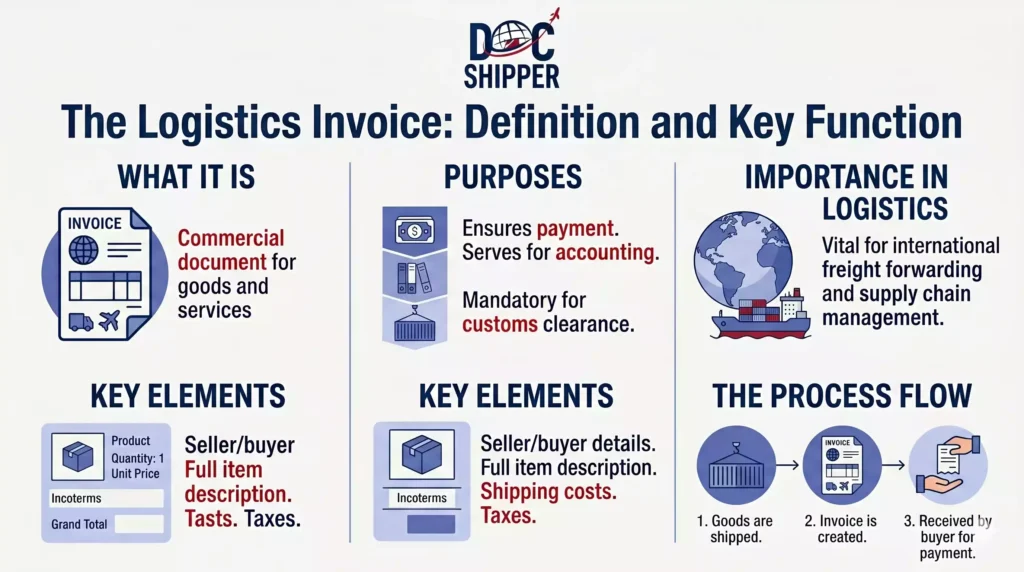
An invoice is a commercial document issued by a seller to a buyer, detailing goods or services provided, quantities, agreed prices, and payment terms. In international logistics, it serves as proof of transaction, customs declaration basis, and legal contract between parties.
Introduction
Many importers face delays or penalties because of incomplete or incorrect invoices. A simple omission—missing HS codes, wrong Incoterms, or vague product descriptions—can trigger customs audits or shipment holds.
The invoice is not just an accounting tool. It determines duty calculations, validates origin claims, and ensures smooth customs clearance. In cross-border operations, it becomes a multi-functional document bridging finance, logistics, and regulatory compliance.
Key characteristics of a compliant trade invoice:
- Complete party information: Full legal names, addresses, and tax IDs of buyer and seller.
- Accurate product descriptions: Detailed enough for customs classification (HS codes mandatory).
- Pricing transparency: Unit prices, total amounts, currency, and Incoterms clearly stated.
- Payment terms: Due dates, methods, and any advance payment details.
- Regulatory mentions: Export licenses, certificates of origin, or FTA references when applicable.
Invoice Types & Compliance Requirements
International trade uses several invoice formats, each serving distinct purposes. Understanding which type applies to your shipment prevents customs rejections and accelerates clearance.
The commercial invoice is the standard document for all paid transactions. It contains full transaction details and serves as the primary customs declaration. Customs authorities calculate duties and taxes directly from this document.
A proforma invoice acts as a quotation or preliminary agreement. Issued before shipment, it outlines expected costs but holds no payment obligation. Buyers use it to arrange financing or import permits. Once the deal is confirmed, it converts to a commercial invoice.
The customs invoice is a specialized format required by certain countries (notably Canada). It includes additional fields like country of origin, export reasons, and vendor-purchaser relationship. This format ensures compliance with specific import regulations.
For goods moving between subsidiaries or for non-commercial purposes, a no-commercial-value (NCV) invoice is used. It declares zero transaction value but must still detail goods for customs inspection. This applies to samples, repairs, or returns.
Consular invoices are pre-approved by the importing country’s consulate and bear an official stamp. Though less common today, some Middle Eastern and Latin American countries still require them for high-value shipments.
At DocShipper, we systematically verify invoice accuracy before shipment, cross-checking Incoterms, HS codes, and declared values against customs databases. This proactive control reduces clearance time by an average of 30%.
Legal compliance extends beyond format. The World Customs Organization (WCO) sets global standards for invoice content through the Revised Kyoto Convention, mandating minimum data elements for all international shipments.
Practical Examples & Key Data
Real-world scenarios illustrate how invoice details directly impact logistics costs and timelines. Small errors can trigger penalties up to 40% of shipment value in some jurisdictions.
Case Study: Electronics Shipment EU to USA
A French exporter ships 500 tablets valued at €50,000 to a US buyer. The commercial invoice states:
- Incoterm: DDP New York (seller pays all duties)
- HS Code: 8471.30.01 (portable digital computers)
- Unit Price: €100/tablet
- Payment Terms: Net 30 days
- Origin: France (EU manufacturing certificate attached)
Result: US Customs applies standard 0% duty rate for laptops/tablets under HTSUS. Clearance occurs in 24 hours. Had the HS code been wrong or missing, a 5.3% general duty would apply, adding $2,650 in unexpected costs.
Comparative Invoice Accuracy Impact:
| Invoice Element | If Missing/Incorrect | Average Delay | Potential Cost |
|---|---|---|---|
| HS Code | Manual classification required | 3-5 days | Storage fees + possible reclassification duty |
| Incoterm | Unclear liability for duties/freight | 1-2 days | Dispute resolution costs |
| Origin Certificate | FTA benefits denied | 2-7 days | Full duty rate instead of 0% |
| Product Description | Physical inspection triggered | 5-10 days | Inspection fees + demurrage |
| Buyer Tax ID | Unable to release shipment | 1-3 days | Daily storage charges |
Critical Invoice Data Points (Top 5):
- Harmonized System Code (6-10 digits): Determines duty rates, import restrictions, and statistical tracking. Must match product exactly.
- Declared Value Accuracy: Under/over-valuation triggers audits. Must reflect transaction price, adjusting for Incoterm-specific costs (freight, insurance).
- Country of Origin: Activates preferential trade agreements. Requires supporting documentation (EUR.1, Form A, USMCA certificate).
- Complete Entity Details: Legal names, full addresses, and tax IDs for both parties. PO boxes are often rejected by customs systems.
- Currency and Exchange Rate: State transaction currency clearly. For customs valuation, specify the exchange rate date if different from shipment date.
DocShipper’s compliance team cross-references every invoice against destination country regulations before dispatch, ensuring all mandatory fields are completed and formatted correctly. This reduces amendment requests by 85% compared to self-prepared documents.
Conclusion
The invoice is the foundation of compliant international trade, directly impacting clearance speed, cost accuracy, and legal compliance. Precision in every field—from HS codes to Incoterms—protects your supply chain from costly disruptions.
Need expert review of your trade documents before shipping? Contact DocShipper for a complimentary invoice audit and customs risk assessment.
📚 Quiz
Test Your Knowledge: Invoice in International Trade
What is the primary function of a commercial invoice in international logistics?
A common misconception is that samples or gifts don't require invoices. Which statement is correct?
An electronics shipment from France to the USA has an incorrect HS code on the invoice. What is the most likely consequence?
🎯 Your Result
📞 Free Quote in 24hFAQ | Invoice: Definition, Types & Best Practices in International Trade
A commercial invoice is a legal demand for payment issued after goods ship, used for customs clearance and accounting. A proforma invoice is a preliminary quotation issued before shipment, outlining estimated costs without creating a payment obligation. It's often used to secure financing or import permits.
No. While most countries accept standard commercial invoices, some require specific formats. Canada mandates customs invoices with additional fields. Several Middle Eastern countries require consular invoices. Always verify destination-specific requirements before shipping to avoid rejections.
Use the transaction value—the actual price paid or payable. For customs purposes, adjust this based on your Incoterm: add freight/insurance for CIF terms, exclude them for FOB. Include royalties, assists, or packing costs if they're part of the sale condition. Under-declaration risks penalties; over-declaration increases duty costs.
Customs will reclassify the goods, potentially applying higher duty rates. This triggers delays of 3-7 days for verification, storage fees, and possible penalties for misclassification. In severe cases, it can lead to audits of past shipments. Always verify codes against official tariff schedules.
Yes. Even zero-value shipments require an invoice marked "No Commercial Value" or "For Samples Only." This document declares contents for customs inspection and safety screening. Without it, shipments may be held or returned regardless of actual value.
Absolutely. Incoterms define who pays freight, insurance, and duties—critical for customs valuation. Without them, disputes arise over cost responsibility. Always state the specific term (e.g., "FOB Shanghai") and the ICC version (usually Incoterms 2020) to avoid ambiguity.
You can, but it complicates customs valuation. It's best practice to invoice in the same currency as the contract. If different, clearly state both currencies and the exchange rate used. Some customs authorities require conversion to local currency using official rates from the shipment date.
Your invoice must reference the trade agreement (e.g., "USMCA Origin") and include or attach the required certificate of origin. State the origin country clearly. Some FTAs require specific invoice declarations or certification numbers directly on the commercial invoice itself.
Customs regulations typically require 5-10 years retention. The EU mandates 5 years, the US requires 5 years from entry date, and some countries demand up to 10 years for audit purposes. Keep digital and physical copies, as customs can request documentation years after clearance.
Yes, but it's complex. For minor errors (typos, unit descriptions), submit a corrected invoice to customs before clearance. For value changes, you may need to file a post-clearance amendment with justification. Significant discrepancies can trigger investigations, so accuracy before shipment is critical.
Most countries now accept electronic invoices via customs portals or EDI systems, provided they contain all required data fields and a verifiable digital signature. However, some jurisdictions still require original paper invoices with wet signatures for high-value shipments. Check local e-customs acceptance policies before going paperless.
Consequences vary by country but typically include seizure of goods, fines of 2-10 times the evaded duties, criminal charges for intentional fraud, and blacklisting from import privileges. Even unintentional errors can result in penalties. Always ensure invoice accuracy and seek professional review for complex shipments.
Need Help with
Logistics or Sourcing ?
First, we secure the right products from the right suppliers at the right price by managing the sourcing process from start to finish. Then, we simplify your shipping experience - from pickup to final delivery - ensuring any product, anywhere, is delivered at highly competitive prices.


Fill the Form
Prefer email? Send us your inquiry, and we’ll get back to you as soon as possible.
Contact us




