


In short ⚡
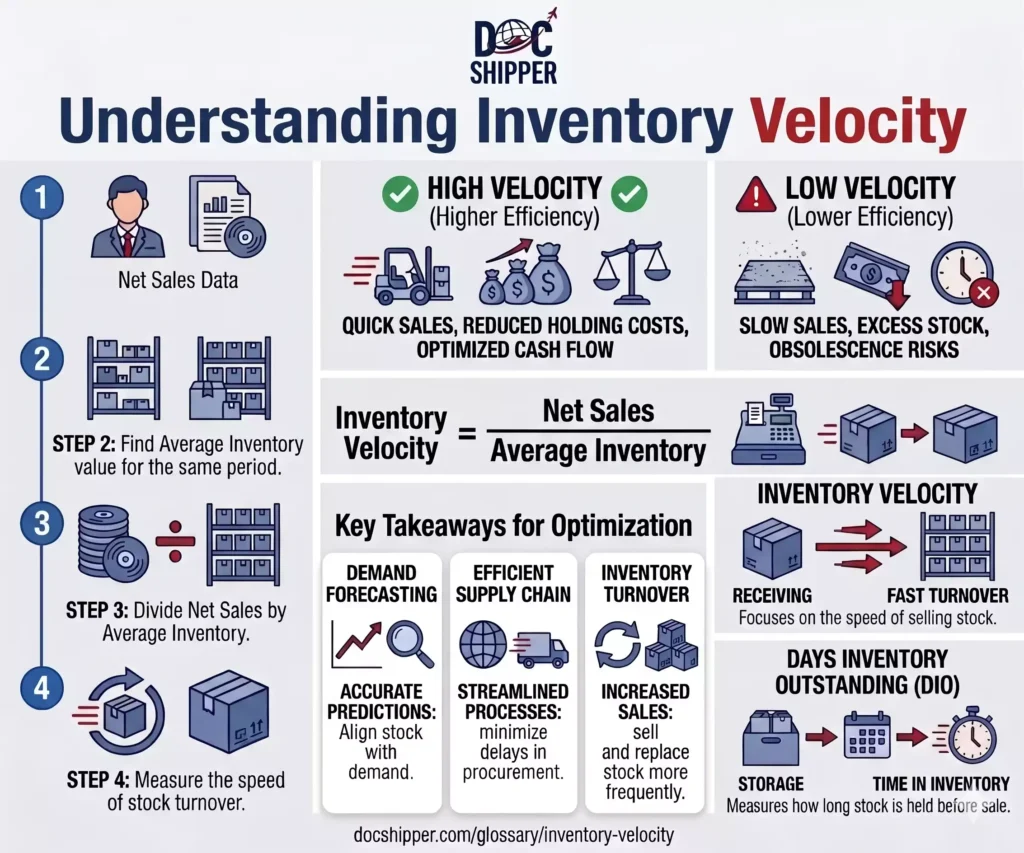
Inventory Velocity measures how quickly goods move through the supply chain from receipt to sale or shipment. This metric indicates the efficiency of inventory management by calculating the rate at which stock is sold, consumed, or replaced within a specific period. Higher velocity typically reflects better demand forecasting, optimized storage costs, and reduced capital tied up in unsold products.
Introduction
Many businesses struggle with the balance between overstocking and stockouts. Too much inventory drains cash flow and increases warehousing costs, while insufficient stock leads to lost sales and dissatisfied customers. Understanding inventory velocity solves this dilemma by providing clear visibility into how efficiently products move through your operations.
In international trade and logistics, this metric becomes even more critical. Long lead times, customs clearance delays, and fluctuating demand patterns make inventory management complex. Companies that master inventory velocity gain competitive advantages through reduced holding costs, improved cash flow, and enhanced customer satisfaction.
Key characteristics of inventory velocity include:
- Turnover Rate: Frequency at which entire inventory is sold and replaced during a period
- Days Sales of Inventory: Average number of days inventory remains in stock before sale
- Stock-to-Sales Ratio: Relationship between available inventory and actual sales volume
- SKU Performance: Velocity variations across different product categories and units
- Seasonal Fluctuations: Cyclical changes in velocity based on market demand patterns
In-Depth Analysis & Expertise
Inventory velocity directly impacts working capital efficiency. When goods move faster through your warehouse, less capital remains locked in inventory. This freed capital can be reinvested in growth initiatives, new product lines, or used to negotiate better payment terms with suppliers. The relationship is mathematical: if you double your inventory velocity, you theoretically halve the capital required to maintain the same sales volume.
The calculation methodology varies by industry but follows a core formula. The most common approach divides the cost of goods sold (COGS) by average inventory value. For example, $1,200,000 COGS divided by $200,000 average inventory equals a velocity of 6, meaning inventory turns over six times annually. Alternatively, companies calculate days sales of inventory by dividing 365 by the turnover rate, yielding approximately 61 days in this example.
International logistics introduces complexity to velocity calculations. Transit times, customs processing, and compliance documentation extend the inventory cycle. At DocShipper, we factor these delays into velocity projections, helping clients establish realistic reorder points that account for both domestic warehouse time and international shipping duration. This prevents both stockouts during long lead times and excessive safety stock accumulation.
The optimal velocity target depends on product characteristics and market positioning. Perishable goods and fashion items require high velocity to minimize obsolescence risk. Technical equipment or specialized industrial components may justify lower velocity due to sporadic demand patterns and higher unit values. According to U.S. Department of Commerce guidelines, manufacturers should benchmark against industry standards while considering their unique operational constraints.
Technology integration dramatically improves velocity management. Warehouse management systems (WMS) track real-time stock movements, while demand forecasting algorithms predict future velocity trends. RFID technology and barcode scanning eliminate manual counting errors that distort velocity calculations. Modern enterprise resource planning (ERP) systems integrate sales data, procurement cycles, and inventory positions to provide comprehensive velocity dashboards across multiple locations and product lines.
Concrete Examples & Data
Consider a consumer electronics importer shipping smartphones from Asia to European markets. With an average inventory value of €500,000 and annual COGS of €3,000,000, the company achieves an inventory velocity of 6 turns per year. However, analysis reveals significant SKU variations: flagship models turn 12 times annually, while accessories turn only 3 times. This insight prompts the company to reduce accessory inventory by 40% and increase flagship allocation, improving overall velocity to 7.2 turns and freeing €83,000 in working capital.
A pharmaceutical distributor demonstrates the impact of velocity on profitability. Comparing two scenarios with identical annual sales of $5,000,000:
| Metric | Scenario A (Low Velocity) | Scenario B (High Velocity) |
|---|---|---|
| Inventory Turns | 4 times/year | 8 times/year |
| Average Inventory | $1,250,000 | $625,000 |
| Holding Cost (20%) | $250,000 | $125,000 |
| Annual Savings | Baseline | $125,000 |
The high-velocity scenario reduces holding costs by $125,000 annually, demonstrating why velocity optimization represents a significant profit lever. These savings stem from reduced warehousing space, lower insurance premiums, decreased obsolescence risk, and improved cash flow for early payment discounts.
An automotive parts distributor improved velocity through strategic inventory positioning. Originally centralized in a single warehouse, inventory turned 5.2 times annually. By establishing three regional distribution centers closer to end customers, transit times decreased from 7 days to 2 days. This proximity enabled the company to reduce safety stock by 35% while maintaining service levels. Velocity increased to 8.1 turns, and order fulfillment accuracy improved from 94% to 98.5%.
Key velocity benchmarks by industry:
- Grocery/Food: 12-20 turns annually due to perishability
- Apparel/Fashion: 4-6 turns with seasonal variations
- Electronics: 6-8 turns balancing demand and obsolescence
- Industrial Equipment: 2-4 turns reflecting specialized demand
- Pharmaceuticals: 8-12 turns considering expiration dates
DocShipper assists clients in achieving target velocities through optimized shipping schedules, consolidated freight options, and customs pre-clearance services. Our data analytics identify slow-moving SKUs before they become obsolete, enabling proactive inventory adjustments that maintain healthy turnover rates across international supply chains.
Conclusion
Inventory velocity remains one of the most actionable metrics for supply chain optimization. By measuring and improving how quickly products move through your operations, you simultaneously reduce costs, improve cash flow, and enhance customer satisfaction. In international logistics, where complexity multiplies, velocity management becomes the difference between profitable operations and capital-draining inefficiencies.
Need assistance optimizing your inventory velocity across international supply chains? Contact DocShipper for expert guidance on reducing lead times, improving turnover rates, and maximizing working capital efficiency.
📚 Quiz
Test Your Knowledge: Inventory Velocity
What does inventory velocity primarily measure?
A company has $1,200,000 COGS and $200,000 average inventory. If they double their inventory velocity, what happens to capital requirements?
Your pharmaceutical distributor achieves 15 inventory turns annually. Should you always aim to increase this velocity further?
🎯 Your Result
📞 Free Quote in 24hFAQ | Inventory Velocity: Definition, Calculation & Concrete Examples
These terms are often used interchangeably, though velocity sometimes emphasizes the speed aspect while turnover focuses on the frequency. Both measure how many times inventory is sold and replaced during a period. The calculation remains identical: COGS divided by average inventory value. The distinction is primarily semantic rather than mathematical.
Higher velocity means goods convert to cash faster, reducing the capital tied up in inventory. When products sell quickly, you receive payment sooner and can reinvest in new inventory or other business needs. Conversely, slow velocity locks cash in unsold goods, creating liquidity constraints that limit growth opportunities and negotiating power with suppliers.
Good velocity depends entirely on your industry and product characteristics. Grocery stores target 15-20 turns annually due to perishability, while jewelry retailers may achieve only 1-2 turns for high-value items. Compare your velocity against industry benchmarks and your own historical performance. Focus on improving trend direction rather than achieving arbitrary numbers.
Yes, excessively high velocity may indicate insufficient inventory levels, leading to stockouts and lost sales. If velocity increases because you're chronically understocked, customers face backorders and may switch to competitors. The optimal balance maintains high velocity while preserving service level agreements and customer satisfaction metrics.
Calculate velocity individually for each SKU, then compute weighted averages based on their contribution to total inventory value. This reveals which products perform well and which drag down overall velocity. Many companies segment SKUs into A, B, and C categories, applying different velocity targets to each group based on strategic importance and demand patterns.
Common velocity inhibitors include inaccurate demand forecasting, overstocking low-demand items, seasonal fluctuations, quality issues causing returns, inefficient warehouse layouts increasing pick times, and inadequate sales and marketing efforts. In international trade, customs delays, documentation errors, and extended shipping times also reduce velocity significantly.
Seasonal businesses should calculate velocity using peak and off-peak periods separately rather than annual averages. A toy retailer might achieve 12 turns in Q4 but only 2 turns in Q2. Rolling 12-month calculations smooth these fluctuations. Alternatively, compare current period velocity against the same period last year to account for seasonal patterns.
Modern warehouse management systems provide real-time visibility into stock levels, movement patterns, and aging inventory. Predictive analytics forecast demand more accurately, reducing safety stock requirements. Automated reordering systems trigger purchases when velocity patterns indicate upcoming shortages. Integration between sales channels, warehouses, and suppliers creates synchronized supply chains that maximize velocity while minimizing risk.
Implement demand forecasting algorithms that analyze historical sales patterns, seasonal trends, and market indicators. Establish safety stock levels based on lead time variability and demand uncertainty. Develop relationships with flexible suppliers who can fulfill rush orders. Use drop-shipping for low-velocity items. Create cross-docking operations that bypass storage entirely for fast-moving products.
Use COGS for consistency with accounting standards and comparability across companies. COGS represents the actual cost of inventory sold, matching the cost-based valuation of inventory on your balance sheet. Using sales revenue inflates the ratio because it includes markup. However, some industries use revenue-based calculations, so specify your methodology when comparing velocities externally.
Retailers focus on finished goods velocity, measuring how quickly products move from receiving to sale. Manufacturers track raw materials, work-in-progress, and finished goods separately, each with different velocity characteristics. Manufacturing velocity calculations must account for production cycle time, while retail calculations emphasize shelf time. Both ultimately measure capital efficiency but at different supply chain stages.
Carrying costs typically range from 15% to 35% of inventory value annually, including warehousing, insurance, taxes, obsolescence, and opportunity cost. Higher velocity reduces these costs proportionally. If you double velocity from 4 to 8 turns, you halve average inventory levels and therefore halve absolute carrying costs. This direct relationship makes velocity improvement one of the fastest paths to cost reduction.
Need Help with
Logistics or Sourcing ?
First, we secure the right products from the right suppliers at the right price by managing the sourcing process from start to finish. Then, we simplify your shipping experience - from pickup to final delivery - ensuring any product, anywhere, is delivered at highly competitive prices.


Fill the Form
Prefer email? Send us your inquiry, and we’ll get back to you as soon as possible.
Contact us




