


In short ⚡
In Gate refers to the formal process of receiving and registering a container into a terminal, depot, or warehouse facility. This critical checkpoint involves documentation verification, physical inspection, and system recording to establish custody and condition of the container upon arrival.
Introduction
Container delays at terminal gates cost shippers an average of $200-500 per container per day in demurrage and detention fees. Yet many logistics professionals underestimate the importance of the In Gate process—the moment when container custody officially transfers to the facility operator.
In international trade, the In Gate represents more than just a physical entry point. It’s a legal and operational checkpoint that determines liability, tracks equipment condition, and initiates the storage or handling cycle. Errors or delays at this stage cascade through the entire supply chain.
Key characteristics of the In Gate process include:
- Documentation validation: EDI messages, booking confirmations, and delivery orders are verified against physical arrivals
- Container inspection: Physical examination for damages, seal integrity, and cargo condition before acceptance
- System registration: Entry into the Terminal Operating System (TOS) with timestamp, location, and status updates
- Interchange receipt: Generation of the Equipment Interchange Receipt (EIR) documenting container condition
- Billing trigger: Activation of storage charges and tracking of free time periods
This process applies to container terminals, empty depots, container freight stations (CFS), and inland ports. Understanding its mechanics prevents costly disputes and operational inefficiencies.
Process & Technical Framework
The In Gate procedure follows a standardized sequence mandated by ISO 28219 standards for container handling. This ensures consistency across international facilities and protects all parties in the logistics chain.
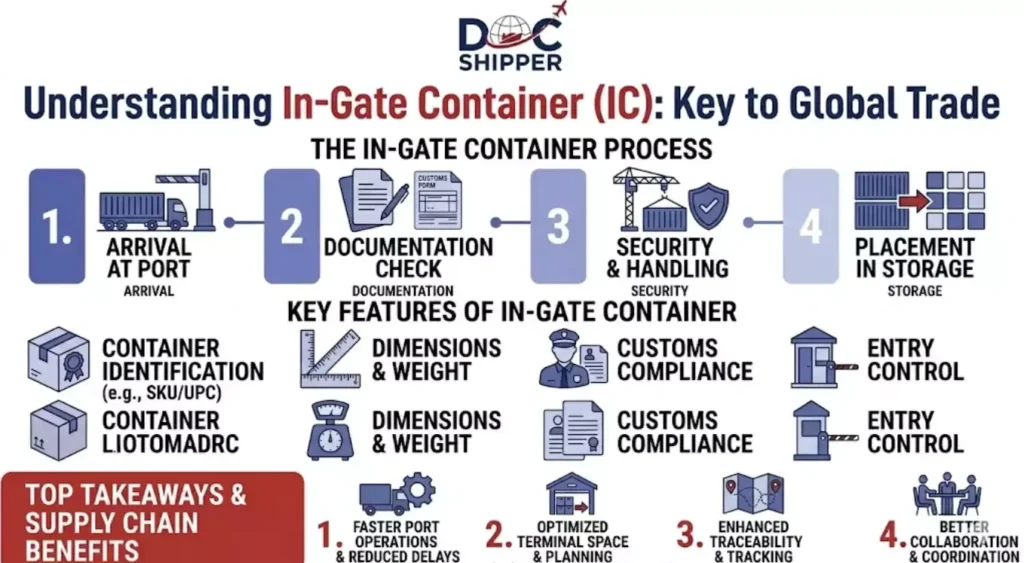
The process typically unfolds in five distinct stages:
Pre-arrival notification: Trucking companies or shipping lines transmit advance data through EDI messages (typically COPARN or CODECO formats). This allows terminals to prepare yard space and allocate resources. Without this digital handshake, containers risk rejection at the gate.
Physical arrival and queuing: Upon reaching the facility, trucks enter designated lanes where optical character recognition (OCR) systems scan container numbers, seal codes, and chassis details. Modern terminals process this in under 90 seconds. Outdated facilities still rely on manual entry, creating bottlenecks.
Documentation verification: Gate clerks validate the delivery order, customs clearance documents, and dangerous goods declarations if applicable. Any discrepancy—such as mismatched container numbers or expired free time—halts the process. At DocShipper, we pre-verify all documentation 48 hours before In Gate appointments to eliminate these delays for our clients.
Physical inspection: Inspectors conduct a four-point examination: external structural integrity, door seal verification, undercarriage condition, and refrigeration unit functionality for reefer containers. Damages discovered at this stage are photographed and recorded on the EIR. This protects the facility from liability for pre-existing damage.
System entry and placement: Once accepted, the Terminal Operating System assigns the container a yard location based on algorithms considering weight, size, destination, and dwell time predictions. The container’s status changes from “on wheels” to “grounded,” triggering storage billing cycles according to the EU’s detention and demurrage regulations.
Legal implications extend beyond simple receipt. The In Gate timestamp establishes the start of storage contracts, determines free time calculations, and serves as evidence in cargo claims. The Equipment Interchange Receipt generated at this point is a legally binding document that courts recognize in liability disputes.
Practical Examples & Data
Real-world scenarios demonstrate why In Gate precision matters. Consider these comparative cases from major trade routes:
| Scenario | Issue | Financial Impact | Resolution Time |
|---|---|---|---|
| Documentation mismatch | Container number on delivery order doesn’t match physical unit | $350/day detention fees | 2-3 business days |
| Undisclosed damage | Structural damage not reported at In Gate | $1,200-3,500 repair cost dispute | 14-30 days (claim investigation) |
| Customs hold oversight | In Gate processed before customs release obtained | $500-1,000 re-handling + storage | 1-5 days |
| Optimized process | Pre-cleared documentation, advance notification, daytime arrival | $0 extra charges | 15-20 minutes total |
Use Case – Asia-Europe Import: A French importer receives 40 containers monthly from Shanghai. Previously, they experienced In Gate rejections on 12% of containers due to documentation errors, costing €14,000 monthly in detention fees. After implementing systematic pre-gate audits and EDI pre-notifications, rejection rates dropped to 1.5%, saving €11,900 monthly.
Industry data reveals that 68% of In Gate delays stem from preventable documentation issues. The remaining 32% involve customs holds, physical damage discoveries, or system outages. Peak hour arrivals (8-10 AM) increase processing time by 40% compared to mid-afternoon slots.
Key operational metrics for efficient In Gate management:
- Target processing time: Under 20 minutes from gate entry to yard placement for dry containers
- Reefer containers: Additional 10-15 minutes for genset functionality verification and temperature data recording
- Documentation accuracy: Aim for 98%+ pre-arrival data match rates to avoid rejections
- Appointment compliance: Arriving within 30-minute window of scheduled slot reduces wait time by 60%
- Off-peak advantages: Mid-week afternoon slots (Tuesday-Thursday, 2-4 PM) show 35% faster throughput
At DocShipper, we coordinate In Gate appointments across 300+ terminals globally, leveraging our relationships with facility operators to secure priority time slots and resolve discrepancies before physical arrival.
Conclusion
The In Gate process represents a critical control point where documentation, physical condition, and system coordination converge. Mastering this procedure prevents costly delays, protects against liability disputes, and ensures smooth cargo flow throughout the supply chain.
Need expert assistance managing In Gate procedures across multiple terminals? Contact DocShipper for comprehensive container logistics support.
📚 Quiz
Test Your Knowledge: In Gate Process
What is the primary purpose of the In Gate process?
A container arrives at In Gate with a documentation mismatch between the delivery order and physical unit. What happens?
According to the article, what percentage of In Gate delays stem from preventable documentation issues?
🎯 Your Result
📞 Free Quote in 24hFAQ | In Gate: Definition, Process & Practical Examples in Container Logistics
Rejection triggers immediate detention charges as the container remains "on wheels" under carrier responsibility. You must resolve the documentation issue, damage dispute, or customs clearance problem before resubmitting. Terminals typically allow 24-48 hours for correction before imposing additional penalties. The truck may need to return the container to the original location or wait in a holding area.
In Gate records a container entering a facility, establishing the facility's custody and starting storage charges. Out Gate marks the container's departure, ending the facility's liability and stopping storage billing. Both generate Equipment Interchange Receipts, but In Gate focuses on acceptance criteria while Out Gate emphasizes release authorization and final condition verification.
Many modern terminals operate 24/7 gate operations, but after-hours processing often incurs surcharges of $50-150 per container. Smaller inland facilities typically limit In Gate to business hours (7 AM-6 PM weekdays). Always verify operating hours and book appointments in advance. Weekend and holiday In Gate operations generally cost 20-40% more.
Essential documents include: delivery order or equipment release, valid booking confirmation, customs clearance proof (for imports), dangerous goods declaration (if applicable), and carrier interchange agreement. Electronic submissions via EDI are increasingly mandatory. Missing any required document results in immediate rejection. DocShipper ensures all documentation is complete 48 hours before your scheduled In Gate.
Liability depends on when and where damage occurred. If documented on the EIR at In Gate, the previous custodian (typically the trucking company or shipping line) bears responsibility. If damage appears after In Gate but wasn't noted, the terminal may face claims. This is why thorough inspection and accurate EIR completion are critical. Disputes often require photographic evidence and third-party surveys.
Efficient terminals process standard dry containers in 15-20 minutes from gate arrival to yard placement. Reefer containers require 25-35 minutes due to additional genset checks. Peak hours, manual systems, or documentation issues can extend this to 60-90 minutes. Appointment-based systems reduce wait times by 40-50% compared to first-come-first-served operations.
The EIR is a legal document generated at In Gate that records container number, condition, seal integrity, and timestamp of acceptance. Both parties (facility and delivering carrier) sign or electronically acknowledge it. This receipt serves as prima facie evidence in damage claims, billing disputes, and liability determinations. Always retain copies for your records.
Empty containers undergo simplified inspection focused on structural integrity and cleanliness. Full containers require additional seal verification, weight confirmation (for VGM compliance), and dangerous goods documentation if applicable. Empty containers typically process 30% faster. However, both trigger storage charges from the In Gate timestamp according to terminal tariffs.
Most terminals allow appointment modifications up to 4-6 hours before the scheduled time through their online portals or EDI systems. Last-minute changes may incur fees or result in longer wait times as you're assigned to available slots. No-shows without cancellation often result in penalties of $75-200 and may affect your priority status for future bookings.
Demurrage (storage charges) begins at the In Gate timestamp for import containers once free time expires—typically 3-7 days depending on the carrier and destination. Detention (equipment usage charges) applies to carrier-owned containers and also starts accruing based on In Gate time. Calculating these charges requires understanding both the In Gate date and the last free day allowed under your shipping agreement.
Automated systems using OCR, RFID, and AI-powered damage detection reduce processing time by 50-60% while improving accuracy. They eliminate manual data entry errors, provide instant documentation validation, and integrate directly with Terminal Operating Systems and customs platforms. However, they require compatible truck equipment and standardized container markings. Facilities with full automation achieve 95%+ first-time acceptance rates.
The container remains in the terminal yard under customs control, but storage charges continue accruing from the original In Gate time. You cannot retrieve the cargo until customs releases it, which may require additional documentation, inspections, or duty payments. These holds typically last 1-7 days for routine exams, longer for suspected violations. Terminal storage fees during customs holds are non-negotiable and can reach several thousand dollars for extended holds.
Need Help with
Logistics or Sourcing ?
First, we secure the right products from the right suppliers at the right price by managing the sourcing process from start to finish. Then, we simplify your shipping experience - from pickup to final delivery - ensuring any product, anywhere, is delivered at highly competitive prices.


Fill the Form
Prefer email? Send us your inquiry, and we’ll get back to you as soon as possible.
Contact us




