


In short ⚡
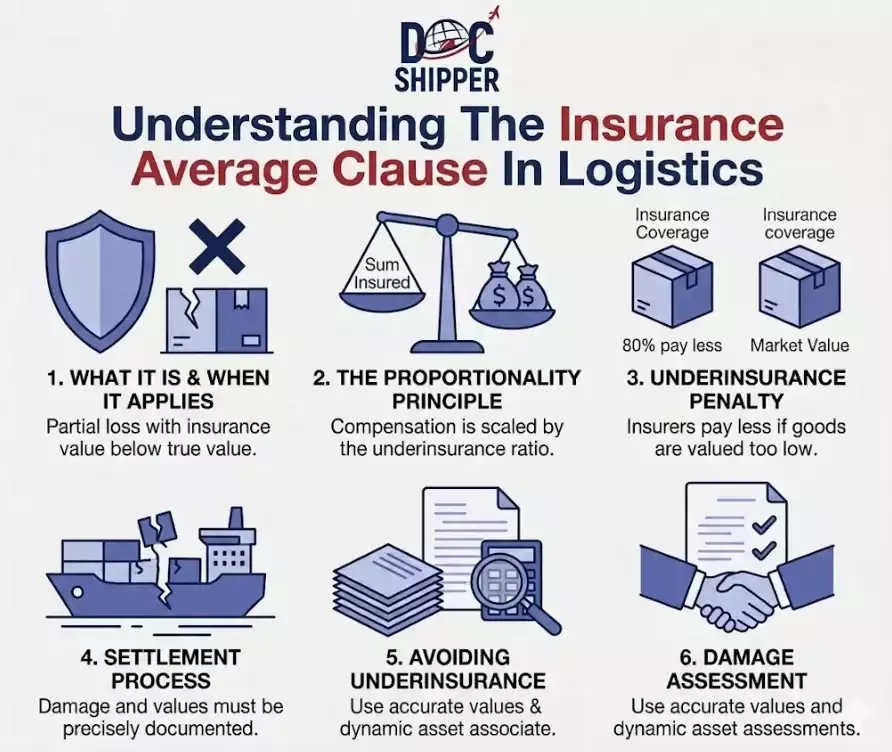
Insurance with Average Clause is a proportional indemnity mechanism applied when goods are underinsured. If the declared value is lower than the actual value, the insurer compensates the claim proportionally to the insured-to-real value ratio. This clause prevents moral hazard and encourages accurate cargo valuation in international trade.Introduction
Many shippers undervalue cargo to reduce insurance premiums, believing full compensation remains guaranteed. This misconception costs businesses millions annually when partial losses occur. The Average Clause corrects this imbalance by proportionally reducing payouts when declared values fall short of actual replacement costs.
In international logistics, cargo insurance protects against transit risks—damage, theft, natural disasters. However, inaccurate valuations create disputes during claims. The Average Clause enforces accountability, ensuring premiums match exposure levels while maintaining equitable risk distribution across policyholders.
Key characteristics of this mechanism include:
- Proportional Compensation: Payout equals (Insured Value / Actual Value) × Loss Amount
- Universal Application: Standard in marine cargo policies worldwide under ICC clauses
- Encourages Accuracy: Penalizes underinsurance while rewarding proper valuation
- Legal Foundation: Recognized in international maritime law and national insurance regulations
- Applies to Partial Losses: Total losses typically receive full insured amount regardless of clause
Mechanisms & Legal Implications
The Average Clause operates through a mathematical formula that proportions liability. When a claim occurs, insurers compare the insured sum to the true cargo value at departure. The compensation ratio directly reflects this comparison, creating financial consequences for undervaluation.
Legal frameworks governing this clause vary by jurisdiction but share core principles. The UK Insurance Act 2015 codifies proportional remedies for non-disclosure. EU regulations align with international maritime conventions, while US policies follow state-specific insurance codes alongside federal shipping laws.
Application triggers include three conditions: declared value below market replacement cost, partial damage to cargo, and policy explicitly containing the Average Clause. Total losses circumvent this mechanism—full insured amounts are paid since nothing remains to calculate proportionally.
The clause introduces duty of disclosure responsibilities. Shippers must provide accurate invoices, appraisals, and market valuations at policy inception. Fraudulent undervaluation may void coverage entirely, exposing businesses to complete financial loss beyond proportional penalties.
Premium calculations directly tie to declared values. Lower valuations reduce upfront costs but increase post-loss exposure. Actuaries price policies assuming honest declarations—systematic underinsurance across the market would destabilize premium models and reduce insurer solvency.
At DocShipper, we systematically audit cargo valuations during insurance placement to ensure compliance with Average Clause requirements. Our pre-shipment assessments prevent costly claim disputes by aligning declared values with replacement costs, certificates of origin, and current market rates.
Concrete Examples & Data
Understanding the Average Clause requires examining real-world scenarios where underinsurance triggers proportional compensation. The following case demonstrates financial impacts across varying valuation levels.
Use Case: Electronics Shipment Damage
A manufacturer ships €100,000 worth of laptops from Shenzhen to Rotterdam. To reduce premiums, they declare €60,000 as insured value. During transit, container damage destroys €40,000 worth of goods. The Average Clause calculation determines actual compensation:
Standard Formula:
Compensation = (Insured Value / Actual Value) × Loss Amount
€60,000 / €100,000 × €40,000 = €24,000 paid
The €16,000 shortfall represents the underinsurance penalty. Had full value been declared, the manufacturer would receive €40,000. The premium savings (approximately €200–300) cost €16,000 in unrecovered losses.
| Scenario | Insured Value | Actual Loss | Compensation | Shortfall |
|---|---|---|---|---|
| Full Coverage | €100,000 | €40,000 | €40,000 | €0 |
| 75% Underinsured | €75,000 | €40,000 | €30,000 | €10,000 |
| 60% Underinsured | €60,000 | €40,000 | €24,000 | €16,000 |
| 50% Underinsured | €50,000 | €40,000 | €20,000 | €20,000 |
Industry data reveals significant trends: approximately 38% of cargo claims involve Average Clause disputes annually. Swiss Re reports that underinsured shipments average 25–40% below true values, with textile and electronics sectors showing highest discrepancy rates.
The clause’s deterrent effect appears in premium-to-loss ratios. Properly insured shipments maintain 1:15 ratios (€1 premium per €15 coverage), while underinsured cargo effectively pays 1:9 due to claim shortfalls. Over 100 shipments annually, this difference compounds to substantial financial exposure.
Regional variations exist: Asian exporters historically undervalue by 32% on average, while European shippers maintain 8–12% gaps primarily due to stricter regulatory oversight and claims history awareness. North American policies increasingly mandate third-party appraisals for high-value cargo to prevent Average Clause activations.
Conclusion
The Average Clause protects insurance market integrity by proportionally penalizing underinsurance while encouraging accurate cargo valuation. For international shippers, understanding this mechanism prevents unexpected financial shortfalls during claims and ensures premium expenditures align with actual risk exposure.
Need expert guidance on cargo insurance valuation and Average Clause compliance? Contact DocShipper for comprehensive insurance advisory services tailored to your logistics operations.
📚 Quiz
Test Your Knowledge: Insurance with Average Clause
What is the primary purpose of the Average Clause in cargo insurance?
A shipper insures €50,000 worth of cargo for €30,000. After a partial loss of €20,000, what compensation will they receive under the Average Clause?
When does the Average Clause typically NOT apply?
🎯 Your Result
📞 Free Quote in 24hFAQ | Insurance with Average Clause: Definition, Calculation & Concrete Examples
No. The clause must be explicitly stated in policy terms. Many modern policies exclude it or apply "agreed value" coverage where insurers waive proportional penalties. Always verify policy wording during procurement—ICC Institute Cargo Clauses (A), (B), and (C) typically include Average provisions unless specifically removed by endorsement.
Actual value reflects replacement cost at shipment origin, including invoice price, freight charges to destination, and expected profit margin (typically 10%). Insurers reference purchase orders, commercial invoices, and market valuations. Disputes often require independent surveyor assessments commissioned jointly by insured and insurer.
No. Insurance valuation locks at policy inception—the moment coverage binds. Post-shipment amendments to increase insured values are prohibited for cargo already in transit. This prevents moral hazard where shippers learn of damage before adjusting coverage. Pre-shipment valuation accuracy is mandatory.
Yes. Total losses—where cargo is completely destroyed or irretrievable—generally receive full insured amounts regardless of undervaluation. The Average Clause only activates for partial losses since proportional calculation requires comparing damaged portions to insured values. However, policy terms vary, so verification is essential.
Policies base valuation on departure value, not arrival market conditions. If cargo worth €100,000 at shipment appreciates to €120,000 by arrival, the €100,000 remains the "actual value" for Average Clause calculations. Conversely, depreciation doesn't reduce insured amounts—original declared values stand throughout transit.
Some policies include "franchise clauses" creating minimum thresholds (e.g., 3% of insured value). Losses below thresholds may be fully compensated without proportional reduction. Additionally, certain goods categories—livestock, perishables, or high-volatility commodities—may have modified Average Clause applications due to inherent valuation difficulties.
Calculations use exchange rates at policy inception or shipment date, depending on terms. If goods are valued in CNY but insured in EUR, the conversion rate locks at coverage start. Subsequent currency movements don't alter the proportional ratio—only the original declared versus actual values in the policy currency matter.
Yes. Disputes typically proceed through surveyor reviews, mediation, or arbitration. You must provide evidence supporting your declared valuation—invoices, appraisals, market analyses. Insurers bear burden of proving underinsurance. Many policies require independent loss adjusters whose findings bind both parties, reducing litigation needs.
Enforcement varies. Common law jurisdictions (UK, US, Australia) strictly apply it. Civil law systems (France, Germany) may allow judicial discretion in proportionality. Developing markets sometimes lack standardized application, creating claim uncertainties. International shipments should reference governing law clauses specifying which jurisdiction's interpretation applies.
Maintain comprehensive records: commercial invoices matching declared values, independent pre-shipment appraisals, freight quotes including all charges, packing lists with item-level pricing, and certificates of origin. Photographic evidence of cargo condition at loading also supports valuations. These documents streamline claims and minimize insurer challenges to declared amounts.
Deductibles apply after Average Clause calculations. If a €40,000 loss reduces to €24,000 via the clause, a €5,000 deductible then subtracts from that amount, leaving €19,000 compensation. This compounds underinsurance penalties—both proportional reduction and deductible erosion decrease final payouts significantly.
Yes. "Agreed Value" or "Valued Policy" coverage eliminates proportional penalties by establishing fixed compensation at policy inception. Insurers charge higher premiums but guarantee full claimed amounts for agreed valuations. These suit high-value, difficult-to-appraise cargo where valuation disputes would be costly or complex.
Need Help with
Logistics or Sourcing ?
First, we secure the right products from the right suppliers at the right price by managing the sourcing process from start to finish. Then, we simplify your shipping experience - from pickup to final delivery - ensuring any product, anywhere, is delivered at highly competitive prices.


Fill the Form
Prefer email? Send us your inquiry, and we’ll get back to you as soon as possible.
Contact us




