


In short ⚡
All-risk insurance is a comprehensive cargo insurance policy that covers goods against all physical loss or damage from external causes during international transportation, except explicitly excluded perils. Unlike named-perils policies that list covered risks, all-risk insurance operates on a reverse principle: everything is covered unless specifically excluded in the policy terms.
Introduction
Many importers mistakenly believe their freight forwarder’s basic insurance covers all potential damages during shipping. This misunderstanding costs businesses thousands in uncompensated losses annually. When your container falls overboard, goods suffer water damage, or cargo gets contaminated during transit, standard coverage often falls short.
All-risk insurance provides the broadest protection available for international cargo shipments. This policy type eliminates guesswork about whether specific incidents are covered, offering peace of mind for high-value or sensitive shipments moving across multiple transportation modes.
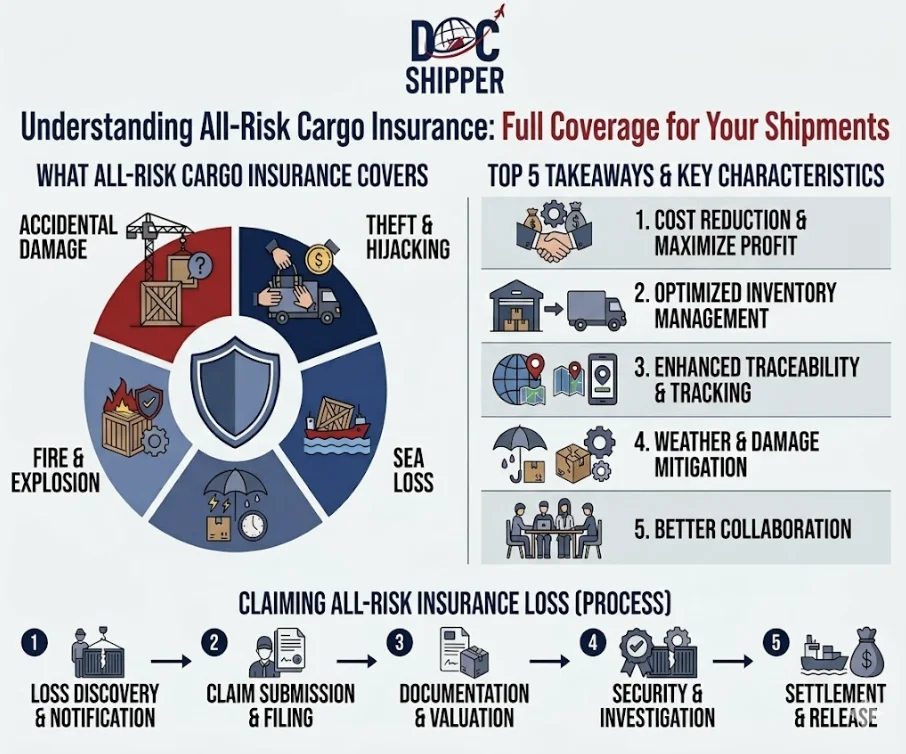
Key characteristics of all-risk insurance include:
- Comprehensive protection from warehouse to final destination
- Reverse coverage principle where all perils are covered unless excluded
- Protection against physical loss from external causes during transit
- Multi-modal coverage across ocean, air, road, and rail transportation
- Extended protection including loading, unloading, and temporary storage
Understanding All-Risk Coverage & Policy Mechanisms
All-risk insurance functions on the principle of maximum coverage with defined exclusions. Rather than listing what is covered, the policy covers everything except explicitly stated exceptions. This approach significantly reduces claim disputes and provides superior protection for international shipments.
The policy typically covers loss or damage from external physical causes including weather events, accidents, handling errors, container collapse, vessel sinking, and contamination from other cargo. Coverage extends from the moment goods leave the seller’s warehouse until delivery at the buyer’s designated location.
Standard exclusions apply to circumstances beyond physical damage. Inherent vice—deterioration from the goods’ own nature—remains excluded. A shipment of fresh flowers wilting naturally during transit wouldn’t be covered, but flowers damaged by refrigeration unit failure would qualify. Similarly, ordinary leakage, weight loss, or wear and tear fall outside coverage parameters.
Willful misconduct and inadequate packaging also void coverage. If the shipper uses insufficient packaging materials or fails to follow proper export procedures, the insurer may deny claims. Documentation proving proper packaging standards and handling instructions becomes crucial for claim validation.
According to International Chamber of Commerce (ICC) classifications, all-risk insurance aligns with Institute Cargo Clauses (A), providing the most extensive coverage tier. This classification requires insurers to prove an exclusion applies rather than claimants proving coverage exists.
At DocShipper, we systematically recommend all-risk coverage for shipments exceeding $10,000 value or containing fragile, perishable, or high-tech goods. Our team verifies policy terms match your specific cargo requirements and transportation routes before shipment departure.
Practical Examples & Coverage Scenarios
Understanding how all-risk insurance applies in real-world situations helps businesses make informed coverage decisions. The following scenarios demonstrate the policy’s practical application across common shipping challenges.
Comparative Coverage Analysis
| Incident Type | All-Risk Coverage | Named-Perils Coverage |
|---|---|---|
| Container falls overboard during storm | ✓ Covered | ✓ Covered |
| Forklift punctures packaging during loading | ✓ Covered | ✗ Not Covered |
| Refrigeration unit failure ruins perishables | ✓ Covered | ✗ Not Covered |
| Condensation damage from temperature changes | ✓ Covered | ✗ Not Covered |
| Theft from warehouse during transit delay | ✓ Covered | ✓ Covered (usually) |
Real-World Use Case: Electronics Shipment
A European electronics manufacturer shipped €250,000 worth of sensitive components from Germany to Singapore via ocean freight. During transshipment in Rotterdam, rough handling caused container damage, exposing goods to rain. Additionally, port congestion delayed delivery by 12 days.
Coverage breakdown:
- Water damage from rain: €78,000 in damaged circuit boards—fully covered under all-risk policy
- Additional storage costs: €3,200 for extended warehouse fees—covered as consequential expense
- Inspection and repackaging: €1,800—covered under damage mitigation clause
- Total claim paid: €83,000 within 21 days of documentation submission
Had the manufacturer chosen named-perils coverage, only the direct water damage would have qualified for compensation, excluding storage and handling costs. The comprehensive nature of all-risk insurance saved the company €5,000 in additional expenses.
Key Coverage Considerations
Premium differences: All-risk policies typically cost 0.3-0.8% of cargo value, compared to 0.2-0.4% for named-perils coverage. For a $100,000 shipment, expect to pay $300-$800 versus $200-$400. This modest increase provides substantially broader protection.
Claim success rates: Industry data shows all-risk policies have 87% claim approval rates compared to 62% for named-perils policies. The broader coverage parameters reduce disputes over whether specific incidents qualify for compensation.
Geographic considerations: All-risk coverage becomes essential when shipping through high-risk regions, multiple transshipment ports, or countries with variable handling standards. Routes involving African, South American, or Southeast Asian ports particularly benefit from comprehensive protection.
Commodity-specific applications: Certain goods inherently require all-risk coverage. Pharmaceuticals, precision machinery, electronics, fashion goods, and perishables face numerous potential damage scenarios that named-perils policies inadequately address. Temperature-sensitive shipments especially benefit from the policy’s comprehensive approach.
At DocShipper, we evaluate your cargo characteristics, route complexity, and value threshold to recommend appropriate coverage levels. Our insurance specialists work directly with leading underwriters to secure competitive rates while ensuring policy terms match your specific requirements. For shipments requiring all-risk coverage, we handle documentation, premium payment, and certificate issuance as part of our comprehensive logistics service.
Conclusion
All-risk insurance represents the gold standard in cargo protection, offering comprehensive coverage that eliminates uncertainty about claim eligibility. For businesses shipping valuable or sensitive goods internationally, this policy type provides essential financial protection against the unpredictable nature of global logistics.
Need expert guidance on cargo insurance for your international shipments? Contact DocShipper’s insurance team for customized coverage recommendations and competitive premium quotes.
📚 Quiz
Test Your Knowledge: All-Risk Insurance
What is the fundamental coverage principle of all-risk insurance?
Your electronics shipment suffers condensation damage from temperature fluctuations during ocean transit. Is this covered under all-risk insurance?
When shipping high-value pharmaceuticals worth $150,000 through multiple transshipment ports in Southeast Asia, which insurance approach is most appropriate?
🎯 Your Result
📞 Free Quote in 24hFAQ | All-Risk Insurance: Definition, Coverage & Practical Examples
Named-perils policies list specific covered risks (fire, sinking, collision), covering only those events. All-risk insurance covers everything except explicitly excluded perils, providing broader protection. The burden of proof reverses: named-perils require you to prove the incident matches a listed risk, while all-risk requires insurers to prove an exclusion applies. For international shipments facing multiple potential damage scenarios, all-risk eliminates coverage gaps.
No, despite the name, all-risk policies contain standard exclusions. Inherent vice (natural deterioration), ordinary leakage, weight loss, delay-related losses, insolvency of carriers, willful misconduct, war (unless extended), and inadequate packaging are typically excluded. However, all-risk covers significantly more scenarios than named-perils policies, including handling damage, contamination, and equipment failure that cause physical loss or damage to goods.
All-risk premiums range from 0.3% to 0.8% of cargo value, depending on commodity type, route, packaging quality, and claims history. A $50,000 electronics shipment might cost $150-$400 to insure. High-risk commodities (glassware, art) or challenging routes (developing countries, multiple transshipments) command higher premiums. Named-perils coverage costs 0.2-0.4% less but provides substantially reduced protection.
Choose all-risk for shipments exceeding $10,000, fragile goods, electronics, perishables, pharmaceuticals, or any cargo where damage scenarios are difficult to predict. All-risk is essential when using multiple transportation modes, shipping through high-risk regions, or when cargo requires special handling. For bulk commodities with low damage risk traveling direct routes, named-perils coverage may suffice.
Standard all-risk policies exclude pure delay and indirect losses like lost profits or market value changes. However, if delay causes physical damage (perishables spoiling because equipment failed), that damage is covered. Some policies offer delay extensions for specific situations. Consequential loss endorsements are available separately but significantly increase premiums. Always verify delay terms with your insurer before shipment.
Essential documents include the insurance certificate, commercial invoice, packing list, bill of lading, survey report documenting damage, photographs of damaged goods, correspondence with carriers, and any relevant inspection certificates. For total loss claims, add vessel casualty reports or police reports for theft. Complete documentation within the policy's notification period (typically 72 hours of discovery) ensures smooth claim processing.
No, cargo insurance must be arranged before shipment departure or at the moment goods are loaded. Retroactive coverage is impossible in marine insurance. Some policies offer "floating" or "open cover" arrangements for regular shippers, automatically covering all shipments within defined parameters. Always arrange insurance before goods leave the seller's premises to ensure uninterrupted coverage throughout transit.
All-risk policies provide continuous coverage across all transportation modes and carriers from origin to destination, including transshipment periods. Coverage remains active during temporary storage at intermediate ports (typically up to 60 days). If goods transfer between ocean, truck, and rail carriers, protection continues seamlessly. This multi-modal coverage eliminates gaps that might occur when relying on individual carrier liability limits.
Yes, all-risk policies require proper packaging appropriate for the cargo type and journey. Inadequate packaging voids coverage, as insurers expect shippers to take reasonable precautions. Use export-grade materials, proper cushioning, moisture barriers for sensitive goods, and clearly marked handling instructions. Insurers may request packaging specifications before issuing policies. Proper packaging not only protects your goods but ensures claim validity.
If underinsured, insurers apply the "average clause," paying claims proportionally. If you declare $50,000 value but actual value is $100,000, the insurer pays only 50% of any claim. Always insure for full replacement value including freight and import costs (CIF value plus 10% is standard). Overinsuring doesn't increase claim payments, as insurers only compensate actual proven losses.
No, all-risk policies exclude losses from customs rejection, regulatory seizures, import prohibitions, or documentation errors. These are considered commercial risks rather than physical damage. If customs authorities confiscate goods due to non-compliance, or if documentation delays cause storage fees, standard cargo insurance provides no coverage. Separate trade credit insurance or customs bond arrangements address these risks.
Straightforward claims with complete documentation typically settle within 21-45 days. Complex claims requiring extensive surveys, liability disputes with carriers, or multiple party involvement may take 60-90 days. Prompt notification, comprehensive documentation, and professional survey reports accelerate processing. Working with experienced freight forwarders like DocShipper who understand claim procedures can significantly reduce settlement timeframes and improve approval rates.
Need Help with
Logistics or Sourcing ?
First, we secure the right products from the right suppliers at the right price by managing the sourcing process from start to finish. Then, we simplify your shipping experience - from pickup to final delivery - ensuring any product, anywhere, is delivered at highly competitive prices.


Fill the Form
Prefer email? Send us your inquiry, and we’ll get back to you as soon as possible.
Contact us




