


In short ⚡
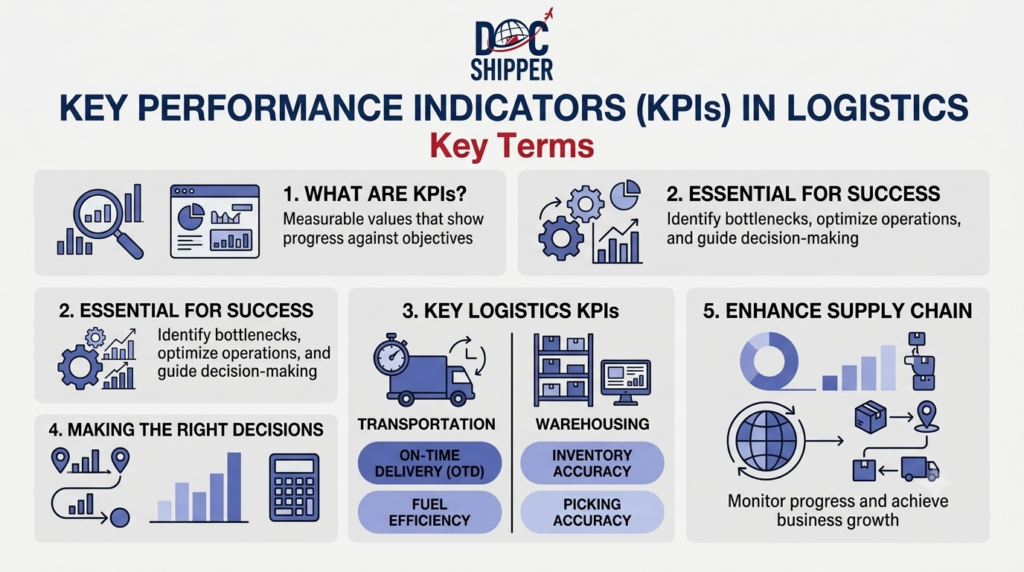
KPI (Key Performance Indicator) is a quantifiable metric used to evaluate the effectiveness and efficiency of logistics operations. In international trade, KPIs measure performance across supply chain activities—from warehouse operations to delivery times—enabling companies to identify bottlenecks, optimize processes, and reduce costs while maintaining service quality standards.
Introduction
Many logistics managers struggle with the same challenge: how to objectively measure performance across complex supply chains involving multiple carriers, warehouses, and customs checkpoints. Without clear metrics, operational inefficiencies remain invisible until they cause costly delays or customer complaints.
KPIs transform abstract logistics activities into actionable, measurable data. They provide the visibility needed to make informed decisions in import/export operations, where delays of even 24 hours can cascade into significant financial losses.
Key characteristics of effective logistics KPIs:
- Quantifiable – expressed in numbers, percentages, or time units
- Relevant – directly tied to business objectives and supply chain performance
- Actionable – provide insights that enable operational improvements
- Time-bound – measured over consistent periods for meaningful comparison
- Benchmarkable – comparable against industry standards or historical performance
Understanding KPIs: Strategic Framework & Implementation
Logistics KPIs function across three operational levels: strategic (long-term supply chain design), tactical (medium-term resource allocation), and operational (daily execution). Each level requires different metrics with varying measurement frequencies.
Strategic KPIs measure overall supply chain health. These include total logistics cost as percentage of sales, typically ranging from 5-15% depending on industry. Companies in international trade often track perfect order rate—the percentage of orders delivered complete, on time, damage-free, with correct documentation. According to the APICS Supply Chain Council, world-class performance exceeds 95%.
Tactical KPIs focus on resource optimization. Warehouse capacity utilization measures space efficiency, with optimal ranges between 85-90%. Below 80% indicates underutilization; above 95% creates operational congestion. Transportation cost per unit tracks shipping efficiency, calculated by dividing total freight costs by units shipped.
Operational KPIs monitor daily execution. Order cycle time measures the duration from order placement to delivery. Dock-to-stock time evaluates warehouse receiving efficiency. At DocShipper, we monitor customs clearance duration as a critical KPI, ensuring shipments don’t encounter preventable delays at borders.
Implementation requires establishing baseline measurements before setting targets. Many companies make the mistake of adopting industry benchmarks without understanding their current performance. Start by measuring existing processes for 30-90 days, then set realistic improvement targets—typically 5-15% improvement quarterly for operational KPIs.
Data collection systems must be reliable and consistent. Manual tracking introduces errors and delays. Modern Transportation Management Systems (TMS) and Warehouse Management Systems (WMS) automate KPI calculation, providing real-time dashboards. Integration with customs platforms enables tracking of documentation compliance rates and border crossing times.
Essential Logistics KPIs: Metrics & Benchmarks
Different supply chain functions require specific KPIs. The following table presents critical metrics for international logistics with calculation methods and industry benchmarks:
| KPI | Calculation | Target Benchmark |
|---|---|---|
| On-Time Delivery Rate | (Orders delivered on time / Total orders) × 100 | ≥95% |
| Order Accuracy Rate | (Perfect orders / Total orders) × 100 | ≥98% |
| Freight Cost per Unit | Total freight costs / Units shipped | Industry-dependent |
| Inventory Turnover | Cost of goods sold / Average inventory value | 6-12 times/year |
| Customs Clearance Time | Average hours from arrival to release | <24 hours |
Use Case: Optimizing Ocean Freight Performance
A European importer ships 500 containers annually from China. Initial KPI measurement revealed:
- Average transit time: 42 days (industry standard: 35-38 days)
- On-time delivery rate: 78% (target: 90%)
- Documentation error rate: 12% (causing customs delays)
- Cost per container: €2,800
By implementing weekly KPI tracking and working with DocShipper to streamline customs documentation, the company achieved within six months: transit time reduced to 38 days, on-time delivery improved to 91%, documentation errors dropped to 3%, and per-container costs decreased to €2,650—generating €75,000 annual savings.
The improvement came from identifying specific bottlenecks through KPI analysis: container dwell time at origin port averaged 8 days due to incomplete export documentation. By standardizing documentation procedures and implementing pre-clearance protocols, this was reduced to 3 days.
Critical success factors for KPI implementation:
- Stakeholder alignment – ensure all parties understand metrics and targets
- Regular review cycles – weekly for operational KPIs, monthly for tactical, quarterly for strategic
- Root cause analysis – when KPIs deteriorate, investigate underlying causes rather than symptoms
- Continuous adjustment – refine KPIs as business conditions and priorities evolve
- Balanced scorecard approach – track multiple KPIs to avoid optimizing one metric at the expense of others
Conclusion
KPIs transform logistics from reactive problem-solving to proactive optimization. By measuring what matters and establishing clear benchmarks, companies gain the visibility needed to reduce costs, improve service, and maintain competitive advantage in international trade.
Need help implementing KPI tracking systems for your supply chain? Contact DocShipper for customized logistics performance solutions.
📚 Quiz
Test Your Knowledge: KPI in Logistics
What defines a KPI in logistics operations?
A company tracks 25 different logistics metrics but struggles with actionable insights. What is the most likely issue?
Your freight forwarder reports an 82% on-time delivery rate for ocean shipments. How should you interpret this?
🎯 Your Results
📞 Free Personalized QuoteFAQ | KPI in Logistics: Definition, Calculation & Practical Examples
All KPIs are metrics, but not all metrics are KPIs. A metric is any measurable data point (e.g., number of shipments). A KPI is a metric specifically chosen because it directly reflects performance against strategic objectives. KPIs are actionable and tied to business outcomes, while general metrics may simply provide informational context.
Best practice recommends 5-7 primary KPIs per operational area to maintain focus. Too few KPIs provide insufficient visibility; too many create analysis paralysis. Start with critical KPIs addressing your biggest challenges—typically on-time delivery, cost efficiency, and order accuracy—then expand as measurement capabilities mature.
Review frequency depends on KPI type. Operational KPIs (order fulfillment, transit times) require daily or weekly monitoring. Tactical KPIs (inventory turnover, capacity utilization) are reviewed monthly. Strategic KPIs (total supply chain cost, customer satisfaction) are assessed quarterly. Establish dashboards that automatically update to enable continuous monitoring.
Industry benchmarks for international logistics target 90-95% on-time delivery, though this varies by transport mode. Ocean freight typically achieves 85-90% due to greater variables, while air freight often exceeds 95%. Define "on-time" clearly in contracts—arrival within delivery window (e.g., +/- 1 day) versus exact date performance.
Perfect order rate = (Number of orders delivered complete, on time, damage-free, with correct documentation / Total orders) × 100. This is a composite KPI reflecting multiple performance dimensions. World-class logistics operations achieve 95%+ perfect order rates. Calculate each component separately first to identify which factors most impact overall performance.
Key warehouse KPIs include receiving cycle time (hours from truck arrival to inventory availability), order picking accuracy (99%+ target), warehouse capacity utilization (85-90% optimal), inventory accuracy (99%+ target), and cost per order fulfilled. These metrics collectively indicate warehouse productivity and operational quality.
KPIs identify cost drivers and inefficiencies that would otherwise remain hidden. By tracking freight cost per unit, companies negotiate better carrier rates. Monitoring inventory turnover reduces holding costs. Measuring damage rates highlights packaging improvements. Regular KPI review creates a continuous improvement culture, typically yielding 5-15% cost reductions within the first year.
Inventory turnover = Cost of goods sold / Average inventory value. It measures how many times inventory is sold and replaced over a period. Higher turnover indicates efficient inventory management and reduced holding costs. Target rates vary by industry: perishables may turn 20+ times annually, while industrial equipment might turn 4-6 times. Low turnover ties up working capital.
Benchmark against three sources: your historical performance (year-over-year trends), direct competitors (when data is available), and industry standards published by organizations like CSCMP or APICS. Internal benchmarking is often most actionable—focus on continuous improvement rather than matching external benchmarks that may not reflect your specific business model or customer requirements.
Basic KPI tracking can start with spreadsheets, but scalability requires integrated systems. Transportation Management Systems (TMS) track freight KPIs, Warehouse Management Systems (WMS) measure fulfillment metrics, and Enterprise Resource Planning (ERP) systems consolidate data. Modern solutions offer real-time dashboards with automated alerts when KPIs deviate from targets, enabling proactive intervention.
Dock-to-stock time measures the duration from when goods arrive at a receiving dock until they're available as warehouse inventory. It includes unloading, inspection, documentation, and system updates. Efficient operations achieve dock-to-stock times under 4 hours for standard shipments. Extended times indicate receiving bottlenecks that delay inventory availability and slow order fulfillment.
Customs KPIs—clearance time, documentation error rate, duty payment accuracy—directly impact supply chain velocity and cost. Tracking these metrics reveals patterns in delays, enabling proactive solutions like advanced electronic filing or pre-classification programs. Companies monitoring customs KPIs typically reduce border crossing times by 30-50%, significantly improving overall supply chain performance.
Need Help with
Logistics or Sourcing ?
First, we secure the right products from the right suppliers at the right price by managing the sourcing process from start to finish. Then, we simplify your shipping experience - from pickup to final delivery - ensuring any product, anywhere, is delivered at highly competitive prices.


Fill the Form
Prefer email? Send us your inquiry, and we’ll get back to you as soon as possible.
Contact us




