


In short ⚡
The laid-down cost represents the total landed expense of goods delivered to a specific destination, encompassing purchase price, freight, insurance, duties, taxes, and handling fees. It provides the true comprehensive cost per unit once merchandise reaches its final location, enabling accurate pricing decisions and profitability analysis in international trade operations.
Introduction
Many importers focus solely on the factory price when evaluating supplier quotes, only to discover that hidden logistics expenses drastically inflate their actual product costs. This miscalculation leads to pricing errors, margin erosion, and competitive disadvantages in the marketplace.
Understanding the laid-down cost is crucial for any business engaged in import/export activities. It represents the financial reality of international procurement by aggregating every expense incurred from the manufacturer’s door to your warehouse shelf. This metric serves as the foundation for accurate costing, strategic sourcing decisions, and realistic margin projections.
Key characteristics of laid-down cost include:
- Comprehensive scope: Includes all direct and indirect costs associated with goods delivery
- Location-specific: Varies based on destination warehouse or distribution center
- Multi-component structure: Aggregates purchase price, international freight, customs duties, taxes, and local delivery
- Decision-making tool: Enables accurate comparison between suppliers across different countries
- Profitability indicator: Reveals true cost basis for pricing and margin calculations
In-Depth Analysis & Expert Insights
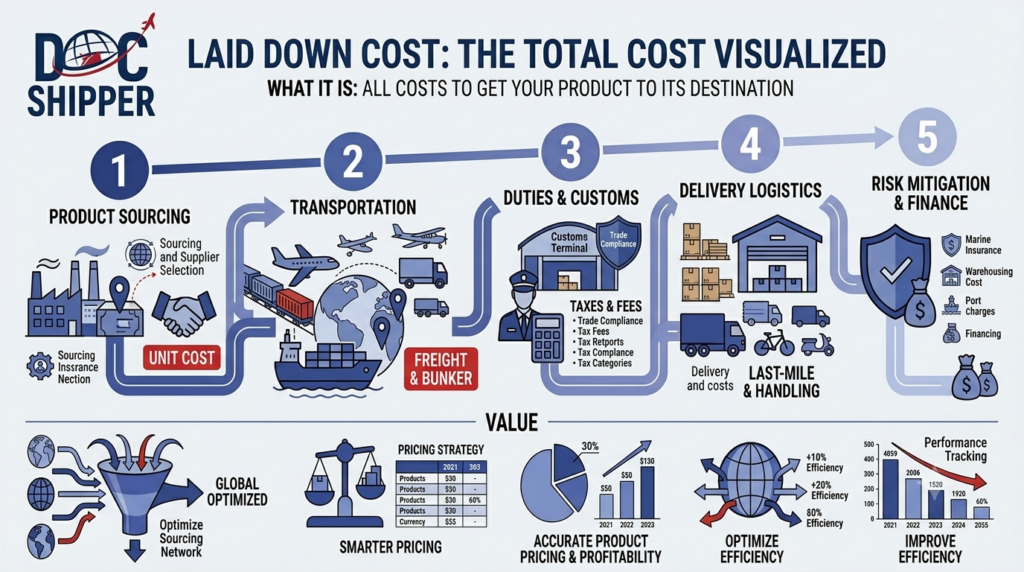
The laid-down cost calculation requires systematic aggregation of multiple expense categories. Understanding each component enables businesses to identify cost optimization opportunities and negotiate more effectively with suppliers and logistics providers.
The base purchase price represents the FOB (Free On Board) or EXW (Ex Works) cost from the manufacturer. This foundational element excludes international transportation but may include domestic handling within the origin country. Negotiating volume discounts or payment terms directly impacts this component.
International freight costs constitute a significant variable depending on mode (ocean, air, rail, or road), route, seasonal demand, and cargo specifications. Ocean freight for containerized goods typically ranges from $1,500 to $4,000 per 20-foot container for major trade lanes, while air freight averages $3-8 per kilogram for urgent shipments.
The customs duties and taxes component requires precise tariff classification under the Harmonized System (HS) code. Import duties vary significantly by product category and country of origin, ranging from 0% for certain raw materials to over 25% for protected industries. Value-added tax or goods and services tax further increases this burden. Importers can consult official resources such as the U.S. International Trade Administration for current duty rates and trade agreements.
Insurance coverage protects cargo value during international transit, typically costing 0.3-1.5% of goods value depending on route risk profile and coverage extent. While optional under certain Incoterms, prudent importers secure comprehensive marine cargo insurance to mitigate loss or damage exposure.
Finally, destination handling and delivery includes port charges, customs brokerage fees, warehouse receiving, and last-mile transportation to the final location. At DocShipper, we systematically calculate these terminal expenses to provide clients with transparent, comprehensive laid-down cost projections before shipment initiation, eliminating budget surprises and enabling accurate financial planning.
Practical Examples & Data-Driven Scenarios
Understanding laid-down cost through concrete examples illustrates its practical application in sourcing decisions and profitability analysis. The following scenarios demonstrate how different variables impact the final delivered cost structure.
Comparative Analysis: China vs. Vietnam Manufacturing
| Cost Component | China Origin | Vietnam Origin |
|---|---|---|
| FOB Unit Price | $12.50 | $13.20 |
| Ocean Freight (per unit) | $0.85 | $0.95 |
| Import Duty (8% vs 0%) | $1.07 | $0.00 |
| Insurance (0.5%) | $0.07 | $0.07 |
| Customs Brokerage | $0.15 | $0.15 |
| Inland Transportation | $0.32 | $0.32 |
| Total Laid-Down Cost | $14.96 | $14.69 |
This comparison reveals that despite Vietnam’s higher FOB price, the elimination of import duties under preferential trade agreements results in a lower laid-down cost. This $0.27 per-unit advantage translates to $2,700 in savings per 10,000-unit order, demonstrating the strategic importance of comprehensive cost analysis.
Real-World Case Study: Electronics Importer
A U.S.-based electronics retailer evaluated two smartphone accessory suppliers with seemingly similar pricing. Supplier A quoted $8.50 FOB Shanghai, while Supplier B offered $9.10 FOB Shenzhen. Surface analysis favored Supplier A, but laid-down cost calculation revealed:
- Supplier A total: $11.85 (higher duties due to country-of-origin classification, longer inland transit from Shanghai port)
- Supplier B total: $11.20 (preferential duty treatment, proximity to Hong Kong transshipment hub reducing handling)
- Annual volume: 50,000 units
- Cost difference: $32,500 annual savings by selecting Supplier B based on laid-down analysis
This scenario demonstrates how procurement decisions based solely on purchase price can lead to suboptimal supplier selection. Laid-down cost analysis provides the complete financial picture necessary for strategic sourcing.
Key Factors Influencing Laid-Down Cost Variability:
- Trade agreements: FTAs can eliminate or reduce duties by 2-15% of goods value
- Transportation mode: Air freight costs 8-12 times ocean rates but reduces inventory carrying costs
- Order volume: Container consolidation reduces per-unit freight by 30-50% compared to LCL shipments
- Seasonal fluctuations: Peak season surcharges increase freight costs by 20-40% during Q3-Q4
- Destination location: Inland delivery adds $0.15-0.75 per unit depending on distance from port
Conclusion
The laid-down cost represents the essential financial metric for international procurement, revealing the complete expense reality beyond misleading FOB quotations. Mastering this calculation enables strategic supplier selection, accurate pricing decisions, and sustainable profitability in competitive global markets.
Need expert assistance calculating your laid-down costs or optimizing your international supply chain expenses? Contact DocShipper for comprehensive logistics solutions and transparent cost projections.
📚 Quiz
Test Your Knowledge: Laid-Down Cost
1. What does laid-down cost represent in international trade?
2. An electronics retailer compares two suppliers: Supplier X quotes $8.00 FOB, Supplier Y quotes $9.50 FOB. Which statement reflects proper laid-down cost analysis?
3. Which cost component is most frequently overlooked when calculating laid-down costs?
🎯 Your Result
📞 Free Quote in 24hFAQ | Laid-Down Cost: Definition, Calculation & Practical Examples
The terms are often used interchangeably in logistics. Both refer to the total cost of goods delivered to a destination, including purchase price, freight, insurance, duties, taxes, and handling. Some practitioners use "landed cost" for port delivery and "laid-down cost" for final warehouse delivery, but industry practice varies. The critical element is ensuring all cost components through to the final destination are included in the calculation.
Incoterms define responsibility boundaries between buyer and seller, directly impacting which party bears specific costs. Under EXW terms, the buyer assumes all transportation and import expenses. FOB transfers responsibility at the origin port, while DDP means the seller covers all costs including import duties. Importers must add only the costs beyond the Incoterm transfer point to the purchase price to calculate accurate laid-down costs.
Yes, significantly. Variables include shipment size (full container vs. LCL), transportation mode selected, seasonal freight rate fluctuations, currency exchange movements, changes in duty rates or trade policies, and destination warehouse location. A product with $10 FOB cost might have laid-down costs ranging from $13.50 to $16.80 depending on these factors, representing a 25% variance in final cost basis.
Import duties generally range from 0% to 25% of customs value depending on product classification and country of origin. Value-added tax or sales tax adds another 5-25% in most countries, though it may be recoverable for registered businesses. Combined, duties and taxes typically represent 8-35% of the laid-down cost for most imported goods, making them a significant factor in total cost structure and supplier selection decisions.
Quarterly reviews are recommended as baseline practice, with immediate recalculation triggered by significant freight rate changes (>15% variation), new trade agreements or duty modifications, currency fluctuations exceeding 5%, or when evaluating new suppliers. Companies with high import volumes or tight margins should implement monthly tracking to maintain accurate costing and identify optimization opportunities promptly.
Destination handling and inland transportation costs are frequently underestimated or omitted. These "last-mile" expenses including port drayage, warehouse receiving fees, customs examination charges, and delivery to final location can add 3-8% to total costs. Many importers focus exclusively on ocean freight and duties while neglecting these terminal charges, resulting in budget overruns and inaccurate margin projections.
Free trade agreements can dramatically reduce or eliminate import duties for qualifying goods, potentially decreasing laid-down costs by 5-20%. To benefit, products must meet rules of origin requirements, typically requiring 35-50% value content from agreement member countries. Proper documentation and origin certification are essential. Strategic sourcing that leverages FTA benefits can provide substantial competitive advantages through lower delivered costs.
Standard laid-down cost definitions exclude inventory holding expenses, focusing on costs incurred to physically deliver goods to the destination. However, comprehensive total cost of ownership analysis should incorporate inventory carrying costs (typically 15-25% annually), which are directly influenced by transportation mode selection. Air freight increases laid-down cost but reduces inventory investment, while ocean freight does the opposite, creating trade-offs requiring holistic evaluation.
Container consolidation significantly reduces per-unit freight costs. Full container load (FCL) shipments typically cost 30-50% less per unit than less-than-container-load (LCL) for equivalent cargo. A 20-foot container accommodates approximately 10 cubic meters efficiently; products utilizing this capacity see dramatic laid-down cost reductions. However, consolidation requires larger order quantities and increased working capital, necessitating balance between unit cost savings and inventory investment.
Harmonized System (HS) code classification directly determines applicable duty rates, making it critical for accurate laid-down cost projection. Misclassification can result in duty rate errors of 5-15%, significantly distorting cost calculations and pricing decisions. Products often qualify for multiple classifications with varying rates; working with experienced customs brokers ensures optimal classification while maintaining compliance, potentially reducing duties and improving cost competitiveness.
Supply chain management software and trade compliance platforms automate laid-down cost calculations by integrating real-time freight rates, current duty schedules, exchange rates, and logistics costs. These systems reduce calculation errors, enable scenario analysis for supplier comparison, and track cost trends over time. Advanced platforms incorporate predictive analytics to forecast cost changes based on market conditions, supporting proactive procurement decisions and margin protection strategies.
Air freight becomes economically favorable when product characteristics include high value-to-weight ratio, short product lifecycles, or inventory holding costs exceeding 20% annually. Fashion goods, electronics, and perishables often justify air freight's 8-12x ocean cost premium through reduced inventory investment, faster market response, and lower obsolescence risk. Comprehensive cost analysis comparing transportation expense against inventory carrying costs, stockout risks, and market timing advantages determines optimal modal selection.
Need Help with
Logistics or Sourcing ?
First, we secure the right products from the right suppliers at the right price by managing the sourcing process from start to finish. Then, we simplify your shipping experience - from pickup to final delivery - ensuring any product, anywhere, is delivered at highly competitive prices.


Fill the Form
Prefer email? Send us your inquiry, and we’ll get back to you as soon as possible.
Contact us




