


In short ⚡
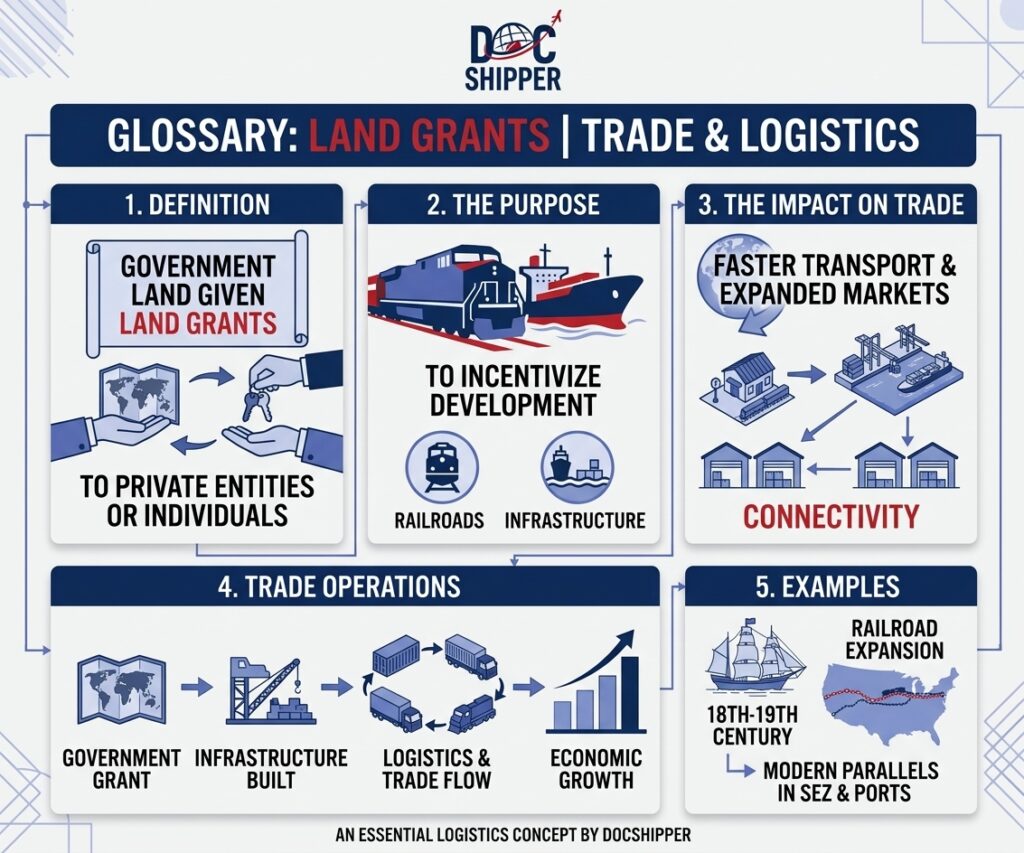
Land grants are governmental allocations of land or property rights to private entities, organizations, or individuals for specific economic, industrial, or infrastructure purposes. In international logistics, these grants facilitate the development of strategic trade zones, warehousing facilities, and transportation corridors that enhance supply chain efficiency and reduce operational costs.
Introduction
Many importers and logistics operators overlook a powerful tool that governments worldwide use to stimulate trade: land grants. These allocations can dramatically reduce infrastructure costs and accelerate market entry.
In global supply chains, land grants serve as catalysts for establishing distribution centers, manufacturing facilities, and intermodal hubs. They represent strategic government investments in commercial development that directly impact logistics efficiency.
Key characteristics of land grants in international trade include:
- Conditional allocation tied to specific investment or employment commitments
- Long-term lease agreements or outright property transfers at reduced rates
- Tax incentives accompanying the land allocation to maximize ROI
- Infrastructure development obligations that benefit broader logistics networks
- Strategic location selection near ports, airports, or border crossings
Legal Framework & Strategic Applications
Land grants operate within complex legal frameworks that vary significantly across jurisdictions. Understanding these mechanisms is essential for logistics planning and risk management.
Governmental authority to issue land grants typically stems from national economic development policies. Countries like China, Vietnam, and India actively use these instruments to attract foreign direct investment in logistics infrastructure. The UNCTAD World Investment Report documents these practices extensively across emerging markets.
Free Trade Zones (FTZs) frequently utilize land grant mechanisms. Governments allocate land at preferential rates within designated zones, coupled with customs exemptions and simplified regulatory procedures. These zones become critical nodes in international supply chains.
The duration and conditions of grants require careful examination. Most agreements span 25 to 99 years, with renewal options. Performance clauses typically mandate minimum investment thresholds, job creation targets, or export volume commitments within specified timeframes.
Transfer restrictions often apply to granted land. Recipients may face limitations on selling, subdividing, or repurposing the property without governmental approval. These constraints protect public interests while supporting intended economic outcomes.
Infrastructure obligations can transform grants into complex undertakings. Recipients may need to develop access roads, utilities, or environmental protections as grant conditions. At DocShipper, we conduct comprehensive due diligence on these requirements before recommending facility locations to our clients.
Case Studies & Comparative Data
Real-world applications demonstrate how land grants reshape logistics geography and competitive dynamics across regions.
Comparative Analysis: Regional Land Grant Programs
| Region/Country | Typical Grant Size | Investment Requirement | Typical Duration | Additional Incentives |
|---|---|---|---|---|
| Vietnam (Industrial Parks) | 10-50 hectares | $5-20M USD | 50 years | 4-year corporate tax exemption |
| UAE (Jebel Ali FTZ) | 1,000-100,000 sqm | Variable (facility-based) | Renewable leases | 100% foreign ownership, zero tax |
| India (SEZ Program) | 10+ hectares (multi-product) | Varies by state | Perpetual (conditions apply) | Duty-free imports, GST exemptions |
| Ethiopia (Industrial Parks) | 5-30 hectares | $1-5M USD | 30-60 years | 10-year income tax holiday |
| China (Pilot FTZ) | Custom-designed plots | $10M+ USD preferred | 50-70 years | Streamlined customs, preferential FX |
Use Case: Automotive Distribution Center
A European automotive parts distributor secured a 15-hectare land grant in Vietnam’s Chu Lai Open Economic Zone in 2019. The grant conditions required:
- Minimum investment: $8M USD in warehouse infrastructure within 24 months
- Employment commitment: 200 local jobs within three years
- Export requirement: 70% of processed goods for international markets
- Environmental compliance: ISO 14001 certification within first operational year
Financial outcomes after five years revealed 38% lower logistics costs compared to commercial lease alternatives in Ho Chi Minh City. The strategic location reduced container dwell time by 4 days and enabled direct consolidation for ASEAN markets.
At DocShipper, we helped this client navigate the application process, coordinate with local authorities, and structure their operations to maintain grant compliance while optimizing their regional distribution network.
Key Decision Factors for Land Grant Evaluation
- Proximity to transport infrastructure: Distance to seaports, airports, or rail terminals directly impacts TCO
- Labor market accessibility: Availability of skilled logistics workforce within commutable radius
- Regulatory stability: Track record of grant program administration and policy consistency
- Exit strategy flexibility: Terms for grant termination, transfer, or facility repurposing
- Total cost comparison: Grant benefits versus alternative market-rate facilities including all obligations
Conclusion
Land grants represent strategic opportunities to reduce capital expenditure while establishing permanent logistics infrastructure in high-growth markets. Their complexity demands thorough due diligence and expert guidance.
Need assistance evaluating land grant opportunities for your supply chain strategy? Contact DocShipper for comprehensive site selection and negotiation support.
📚 Quiz
Test Your Knowledge: Land Grants in International Logistics
What is the core definition of land grants in international logistics?
Which statement correctly describes transfer restrictions in land grant agreements?
A European automotive distributor received a land grant in Vietnam. After five years, they achieved 38% lower logistics costs compared to commercial alternatives. What was the PRIMARY strategic advantage?
🎯 Your Result
📞 Free Quote in 24hFAQ | Land Grants: Definition, Types & Strategic Examples in International Trade
A land grant typically involves governmental allocation at below-market rates with long-term conditions tied to economic development objectives, whereas commercial leases are market-priced agreements with private landlords. Grants often include additional incentives like tax breaks and may carry performance obligations such as job creation or investment thresholds that leases do not require.
This varies significantly by jurisdiction. Some countries like Vietnam and Ethiopia allow foreign entities to receive grants through registered local subsidiaries. Others, including China, may require joint ventures with domestic partners. The UAE permits 100% foreign ownership in designated zones. Legal structures must comply with foreign investment laws specific to each country.
Non-compliance typically triggers penalty clauses that may include financial forfeitures, grant revocation, or mandatory land return. Most agreements include grace periods and remediation opportunities. Severe violations can result in loss of all invested capital in improvements. Partial compliance may lead to renegotiated terms or proportional penalty assessments based on the shortfall.
Application timelines range from 6 to 24 months depending on country, grant size, and project complexity. Fast-track programs in competitive zones like Singapore or Dubai may complete in 3-6 months. Emerging markets with less streamlined processes can extend beyond two years. Pre-qualification, environmental assessments, and negotiation phases constitute the majority of this timeline.
Many modern grant programs explicitly target logistics infrastructure. Free trade zones, logistics parks, and multimodal hubs frequently offer grants for warehousing, distribution centers, and freight forwarding facilities. The key is demonstrating economic value through job creation, trade facilitation, or technology transfer rather than manufacturing alone.
Tax treatment varies but commonly includes reduced or eliminated property taxes during the grant period. Some jurisdictions treat grant value as taxable income offset by accompanying tax holidays. Transfer taxes may be waived on the initial grant. Corporate income tax incentives frequently accompany grants, ranging from partial reductions to complete exemptions for 5-15 years in developing economies.
Repurposing typically requires governmental approval and may trigger grant renegotiation. If the new use aligns with broader economic objectives, authorities often permit changes. Shifting from manufacturing to pure warehousing might face scrutiny if job creation commitments decrease. Documentation of continued compliance with core grant objectives strengthens repurposing applications.
Special Economic Zone (SEZ) grants usually bundle land allocation with comprehensive regulatory advantages including customs duty exemptions, simplified import/export procedures, and foreign exchange flexibility. Standard industrial grants focus primarily on land cost reduction and basic tax incentives without the extensive trade facilitation framework that characterizes SEZs.
Environmental compliance forms a critical grant component. Recipients must conduct impact assessments, implement waste management systems, and often achieve international environmental certifications. Non-compliance can void grants entirely. Progressive jurisdictions offer additional incentives for exceeding baseline environmental standards, particularly for green logistics facilities with renewable energy integration.
Transfer rights depend on specific grant terms. Most agreements prohibit transfers during initial compliance periods (typically 3-10 years). Post-compliance transfers usually require governmental consent and transferee assumption of all remaining obligations. Some jurisdictions permit transfers if the new operator maintains or exceeds original employment and investment commitments.
Infrastructure obligations can add 15-40% to initial investment projections. These may include road construction, utility connections, environmental protections, or worker housing. While increasing upfront costs, these improvements often yield long-term operational efficiencies and can enhance property value. Detailed cost-benefit analysis comparing grant obligations versus market alternatives is essential for accurate ROI calculation.
Optimal value extraction involves strategic facility design that exceeds minimum grant requirements to unlock maximum incentives, phased development aligning with compliance milestones to minimize carrying costs, integration with broader supply chain networks to leverage location advantages, proactive stakeholder engagement with local authorities, and detailed documentation of economic contributions to support potential grant extensions or expansions.
Need Help with
Logistics or Sourcing ?
First, we secure the right products from the right suppliers at the right price by managing the sourcing process from start to finish. Then, we simplify your shipping experience - from pickup to final delivery - ensuring any product, anywhere, is delivered at highly competitive prices.


Fill the Form
Prefer email? Send us your inquiry, and we’ll get back to you as soon as possible.
Contact us




