


In short ⚡
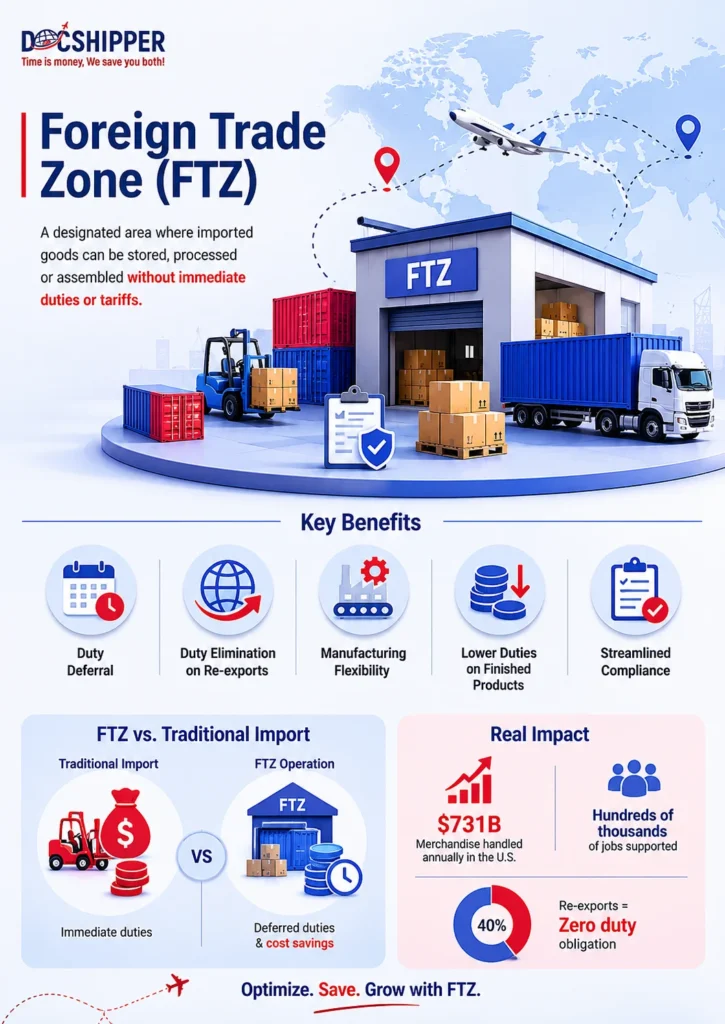
A Foreign Trade Zone (FTZ) is a designated geographic area within a country's borders where imported goods can be stored, processed, or assembled without being subject to immediate customs duties or tariffs. These zones offer significant cost advantages and operational flexibility for businesses engaged in international trade and logistics.
Introduction
Many importers face cash flow pressures when customs duties are immediately due upon goods arrival. Others struggle with complex regulations when repackaging or modifying imported products.
Foreign Trade Zones address these challenges by creating special economic enclaves. They serve as critical tools in global supply chain optimization, particularly for manufacturers, distributors, and logistics operators.
Key characteristics of FTZs include:
- Duty deferral – Customs payments postponed until goods enter domestic commerce
- Duty elimination – No tariffs on re-exported goods or rejected merchandise
- Manufacturing flexibility – Assembly and processing permitted under secure supervision
- Inverted tariff relief – Pay lower duty rates when finished products have reduced tariffs compared to components
- Streamlined compliance – Simplified documentation for qualified zone users
FTZ Mechanisms & Regulatory Framework
Foreign Trade Zones operate under specific legal frameworks that vary by jurisdiction. In the United States, FTZs function under the Foreign-Trade Zones Act of 1934, administered by U.S. Customs and Border Protection (CBP).
Activation procedures require zone operators to obtain authorization from the Foreign-Trade Zones Board. Each zone must demonstrate economic benefit and maintain secure boundaries with controlled entry/exit points.
Privileged foreign status is the cornerstone concept. Goods in FTZ territory are technically outside customs territory despite physical presence within national borders. This legal fiction creates unique opportunities for duty optimization.
Processing allowances permit substantial transformation activities. Companies can manufacture, assemble, test, label, repair, or destroy merchandise without triggering immediate customs obligations. At DocShipper, we help clients structure operations to maximize these processing advantages while ensuring full regulatory compliance.
Zone-to-zone transfers enable merchandise movement between different FTZ locations without customs intervention. This flexibility supports distributed manufacturing models and just-in-time inventory strategies.
Weekly entry procedures replace individual transaction reporting. Qualified operators submit consolidated weekly summaries rather than processing paperwork for each shipment, dramatically reducing administrative burden.
Concrete Examples & Economic Data
The economic impact of FTZs is substantial. According to recent reports, U.S. Foreign Trade Zones handled approximately $731 billion in merchandise annually, supporting hundreds of thousands of jobs.
Comparative Analysis: FTZ vs. Traditional Import
| Factor | Traditional Import | FTZ Operation |
|---|---|---|
| Duty Payment Timing | Immediate upon entry | Deferred until domestic sale |
| Re-export Duties | Full payment required | Zero duty obligation |
| Cash Flow Impact | High upfront capital requirement | Capital preservation |
| Processing Freedom | Limited post-entry modifications | Extensive manufacturing rights |
| Inventory Flexibility | Duties paid on all stock | Pay only on sold inventory |
Use Case: Electronics Manufacturer
A smartphone assembly company imports $50 million worth of components annually from Asia. Components face a 4.9% tariff, while finished smartphones incur only 1.5% duty.
Traditional scenario: Immediate duty payment of $2.45 million on components. After assembly, products sold domestically or exported.
FTZ scenario: Components enter FTZ duty-free. Assembly occurs in zone. For domestic sales, company pays 1.5% on finished value ($750,000 annual duty). For re-exports (40% of production), zero duty. Annual savings: approximately $1.7 million.
At DocShipper, we’ve helped similar clients establish FTZ-based operations, managing everything from zone application to inventory reconciliation systems.
Five Critical Success Factors for FTZ Operations:
- Volume threshold – Minimum $10-15 million annual import value typically needed for cost justification
- Product mix strategy – Greatest benefits when component tariffs exceed finished goods tariffs
- Inventory accuracy – Rigorous recordkeeping systems mandatory for compliance
- Export percentage – Higher re-export ratios generate proportionally greater savings
- Space optimization – Efficient zone layout maximizes operational flexibility within secured perimeters
Conclusion
Foreign Trade Zones represent a strategic advantage for businesses managing complex international supply chains. The combination of duty deferral, elimination on re-exports, and manufacturing flexibility creates compelling financial benefits for qualified operations.
Need expert guidance on whether an FTZ fits your logistics strategy? Contact DocShipper for a comprehensive assessment of your import/export patterns and potential FTZ savings.
📚 Quiz
Test Your Knowledge: Foreign Trade Zone (FTZ)
What is the primary defining characteristic of a Foreign Trade Zone?
An electronics manufacturer imports components at 4.9% tariff but finished smartphones face only 1.5% duty. What is this scenario called in FTZ operations?
Your company imports $8 million of goods annually with 30% being re-exported. You're considering FTZ operations. What should be your primary consideration?
🎯 Your Result
📞 Free Quote in 24hFAQ | Foreign Trade Zone (FTZ): Definition, Benefits & Concrete Examples
Manufacturers, assemblers, distributors, and logistics providers with high-volume imports benefit most. Companies that re-export significant percentages, perform substantial value-added processing, or deal with inverted tariff scenarios see the greatest returns. Industries like electronics, automotive, pharmaceuticals, and machinery frequently leverage FTZ advantages.
There is no statutory time limit for merchandise storage in U.S. Foreign Trade Zones. Goods can remain indefinitely as long as they comply with zone regulations and the operator maintains proper records. This unlimited duration supports long-term inventory strategies and postponement manufacturing models.
Quota-subject merchandise can enter FTZs without counting against quota limitations until admitted for domestic consumption. This allows companies to stockpile quota goods during periods of availability and release them strategically when quotas reopen or market conditions improve.
Inverted tariff situations occur when imported components carry higher duty rates than finished products. In FTZs, manufacturers can elect to pay duty on the finished product classification rather than component rates. For example, importing steel parts at 12% duty but paying only 5% on the assembled machinery creates substantial savings.
Zone operators and users must maintain adequate insurance, but FTZ status itself doesn't mandate special policies. Standard cargo, liability, and property insurance apply. However, insurers should be informed of FTZ operations as certain coverage terms may reference customs status or cross-border movements.
Yes, e-commerce distribution centers increasingly utilize FTZ designations. This arrangement allows retailers to import inventory duty-free, store it near consumers, and pay duties only when orders ship domestically. Returns destined for re-export incur no duty obligation, improving reverse logistics economics.
Primary documentation includes FTZ admission applications, inventory control records, zone activity summaries, and customs entry documents upon withdrawal. Weekly entry procedures consolidate reporting. Operators must maintain detailed records of merchandise status, location, and processing activities for CBP audit purposes.
Most commercial merchandise qualifies for FTZ admission. Prohibited items include those banned from importation entirely (certain weapons, narcotics) and goods subject to specific exclusions like retail sales of alcoholic beverages. Zone operators can request determinations on questionable merchandise categories.
FTZs complement free trade agreements by offering additional flexibility. Goods may enter zones duty-free regardless of origin, then claim preferential treatment under USMCA, US-Korea FTA, or other agreements when withdrawn. This dual-track approach optimizes duty minimization strategies across multiple trade regimes.
General-purpose zones are multi-user facilities typically at ports or industrial parks, operated by public or private entities. Subzones are single-company sites, often at existing manufacturing plants, granted FTZ status for specific operations. Subzones offer greater operational control but require individual authorization and compliance responsibilities.
Yes, one significant FTZ advantage is duty-free destruction of damaged, defective, or obsolete merchandise. Companies must obtain CBP approval and supervision for destruction activities, but no duties are owed on goods that never enter domestic commerce. This eliminates the financial penalty of paying tariffs on unsaleable inventory.
Application fees to the Foreign-Trade Zones Board range from $3,000-$10,000 depending on zone type. Approval timelines typically span 6-12 months for general-purpose zones and 8-14 months for subzones. Additional costs include legal counsel, recordkeeping systems, security infrastructure, and ongoing compliance management. Total setup investment varies from $50,000 to several hundred thousand dollars.
Need Help with
Logistics or Sourcing ?
First, we secure the right products from the right suppliers at the right price by managing the sourcing process from start to finish. Then, we simplify your shipping experience - from pickup to final delivery - ensuring any product, anywhere, is delivered at highly competitive prices.


Fill the Form
Prefer email? Send us your inquiry, and we’ll get back to you as soon as possible.
Contact us




