


In short ⚡
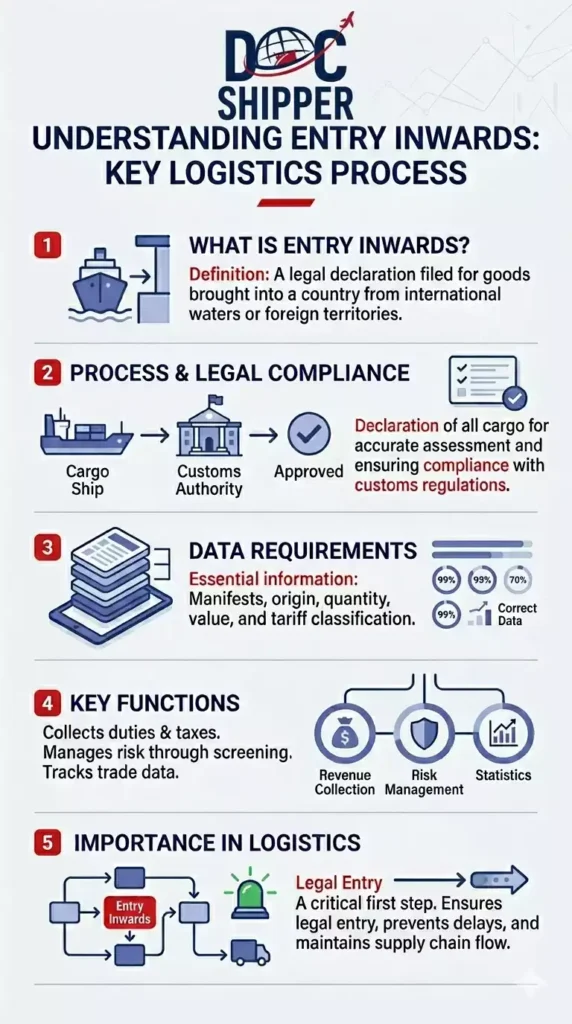
Entry is the formal declaration and documentation process required by customs authorities when goods arrive in a country. It involves submitting specific documents, paying applicable duties and taxes, and obtaining clearance before cargo can be legally released into domestic commerce or transported to its final destination.
Introduction
Many importers underestimate the complexity of customs entry procedures, leading to costly delays, penalties, or cargo holds at the border. The entry process represents the critical gateway between international shipment and domestic distribution.
Without proper entry documentation, goods remain in legal limbo—technically arrived but commercially inaccessible. This bureaucratic checkpoint serves multiple purposes: revenue collection, trade compliance, security screening, and statistical tracking.
Understanding entry requirements is essential because:
- Legal obligation: All commercial imports require formal entry before release
- Financial impact: Incorrect entries trigger audits, fines, or duty adjustments
- Time sensitivity: Entry delays accumulate demurrage and storage charges
- Compliance risk: Pattern of errors may result in increased scrutiny or bond requirements
- Supply chain coordination: Entry timing directly affects inventory availability and delivery schedules
Entry Mechanisms & Regulatory Framework
The entry process follows a structured workflow governed by customs legislation. In the United States, entries are regulated under U.S. Customs and Border Protection (CBP) guidelines, while the EU operates under the Union Customs Code.
Immediate delivery entry allows conditional release of goods before formal entry processing completes. This expedited option requires posting a bond and filing complete documentation within 10 working days. It’s particularly valuable for perishable goods or just-in-time manufacturing.
Formal entry applies to commercial shipments exceeding the de minimis threshold (typically $800 in the US, €150 in the EU). This comprehensive process requires detailed commodity classification, valuation documentation, and payment of all duties and fees before release.
Informal entry covers low-value shipments below formal thresholds. These simplified procedures require minimal documentation but still mandate customs declaration and potential inspection. Many courier services handle informal entries automatically through electronic systems.
Entry summary documentation must be filed within 10 days of cargo arrival, including the bill of lading, commercial invoice, packing list, and arrival notice. Missing or incorrect information triggers verification delays and potential examinations.
At DocShipper, we manage the complete entry process on behalf of our clients, ensuring accurate classification, timely filing, and proactive communication with customs authorities to prevent release delays.
Practical Examples & Data
Entry procedures vary significantly based on shipment characteristics and customs programs. Understanding these differences helps optimize clearance strategies and cost management.
Comparative Entry Types
| Entry Type | Processing Time | Bond Requirement | Best For |
|---|---|---|---|
| Immediate Delivery | Same day release possible | Required (continuous or single) | Time-sensitive cargo, perishables |
| Formal Entry | 1-3 business days | Required for >$2,500 value | Standard commercial imports |
| Informal Entry | Hours to 1 day | Not required | Low-value shipments, samples |
| Warehouse Entry | Immediate (duty deferred) | Required (warehouse bond) | Storage before duty payment |
| Foreign Trade Zone | No formal entry until withdrawn | Zone operator bond | Manufacturing, value-added operations |
Real-World Entry Scenario
A European electronics manufacturer imports $250,000 worth of semiconductors from Taiwan to their US facility. The shipment requires formal entry with specific considerations:
- Classification accuracy: HS code 8542.32 determines duty rate of 0% under normal trade relations
- Value declaration: Transaction value includes freight and insurance up to port of entry
- Entry bond: Continuous bond covering $50,000 minimum (annual imports justify this over single bonds)
- Special programs: Entry filed under First Sale rule reduces dutiable value by 15%, saving approximately $3,750 annually
- Timeline compliance: Entry summary filed on day 3 after arrival, goods released day 4, avoiding storage fees
Statistical data shows that approximately 32% of first-time importers experience entry delays due to documentation errors, with average resolution time of 5-7 business days. Professional customs brokers reduce this rate to under 3%.
Conclusion
Mastering the entry process is fundamental to efficient international trade operations. Proper entry management protects against financial penalties, accelerates cargo release, and ensures regulatory compliance across your supply chain.
Need expert assistance with customs entry procedures? Contact DocShipper for comprehensive import compliance support tailored to your business requirements.
📚 Quiz
Test Your Knowledge: Customs Entry Procedures
What is the primary purpose of the customs entry process?
An importer receives perishable goods that need immediate release. Which entry type would be most appropriate?
A company files their entry documentation 18 days after cargo arrival. What is the likely consequence?
🎯 Your Result
📞 Free Quote in 24hFAQ | Entry: Definition, Types & Practical Examples in International Trade
Formal entry requires a commercial invoice, bill of lading or airway bill, packing list, entry manifest (CBP Form 7533), and entry summary (CBP Form 7501). Additional documents may include certificates of origin, import licenses, and product-specific certifications. All documents must accurately describe the goods, their value, and country of origin.
You must file entry within 15 calendar days of cargo arrival at the port of entry. However, the entry summary and duty payment must be completed within 10 working days of entry filing. Missing these deadlines may result in cargo being sent to general order warehouse, incurring additional storage charges.
Yes, importers can file their own entries as "self-filers" without hiring a licensed customs broker. However, this requires obtaining an importer number, understanding classification rules, and navigating electronic filing systems. Most businesses use brokers for compliance expertise and time efficiency, especially for complex or high-value shipments.
Entry is the formal filing process that declares goods to customs authorities, while clearance is the official authorization to release those goods. Entry involves submitting documentation and paying duties; clearance is the customs decision allowing cargo to enter domestic commerce. Entry precedes clearance in the import timeline.
Minor errors may be corrected through post-entry amendments without penalties. Significant discrepancies in value, classification, or origin may trigger customs examinations, duty adjustments, and potential fines. Repeated errors can result in increased scrutiny, required continuous bonds, or audits of past entries under the reasonable care standard.
Single entry bonds cover individual shipments, while continuous bonds cover all entries over a 12-month period. Continuous bonds are cost-effective for regular importers, typically costing $400-$500 annually versus $50-$150 per single bond. CBP requires continuous bonds for entries exceeding $2,500 in value or subject to other agency regulations.
In Foreign Trade Zones (FTZ), goods enter "privileged foreign status" without formal customs entry. Duty payment is deferred until goods leave the zone for US consumption. This allows manufacturing, repackaging, or storage without immediate duty liability, potentially reducing costs if goods are later exported or transformed into lower-duty products.
You may request entry cancellation before goods are released, typically within the 10-day summary filing period. After release, entries cannot be withdrawn but can be amended through protest procedures if you discover errors. Cancellation does not affect your import record, but repeated cancellations may raise compliance questions.
Immediate delivery (ID) allows conditional release before completing formal entry procedures, providing same-day or next-day cargo availability. It's ideal for time-sensitive shipments, perishables, or just-in-time inventory. You must still file the complete entry summary within 10 days and post an appropriate bond covering potential duties and penalties.
Duties must be paid within 10 working days of entry filing for standard entries. Immediate delivery entries require duty estimates at release, with final calculation at summary filing. Warehouse entries defer duty payment until goods withdraw from the bonded facility. Statement processing allows qualifying importers to pay duties monthly rather than per shipment.
Remote Location Filing (RLF) allows brokers to file entries electronically from locations distant from the arrival port. This enables centralized processing teams to handle entries nationwide, improving efficiency and expertise concentration. Nearly all US entries now use RLF through the Automated Commercial Environment (ACE) system.
US importers must retain entry documentation for five years from the date of entry. These records support potential customs audits, duty refund claims, and compliance verification. Electronic records are acceptable if they meet CBP recordkeeping standards. Failure to maintain proper records can result in penalties and limit your ability to challenge duty assessments.
Need Help with
Logistics or Sourcing ?
First, we secure the right products from the right suppliers at the right price by managing the sourcing process from start to finish. Then, we simplify your shipping experience - from pickup to final delivery - ensuring any product, anywhere, is delivered at highly competitive prices.


Fill the Form
Prefer email? Send us your inquiry, and we’ll get back to you as soon as possible.
Contact us




