


In short ⚡
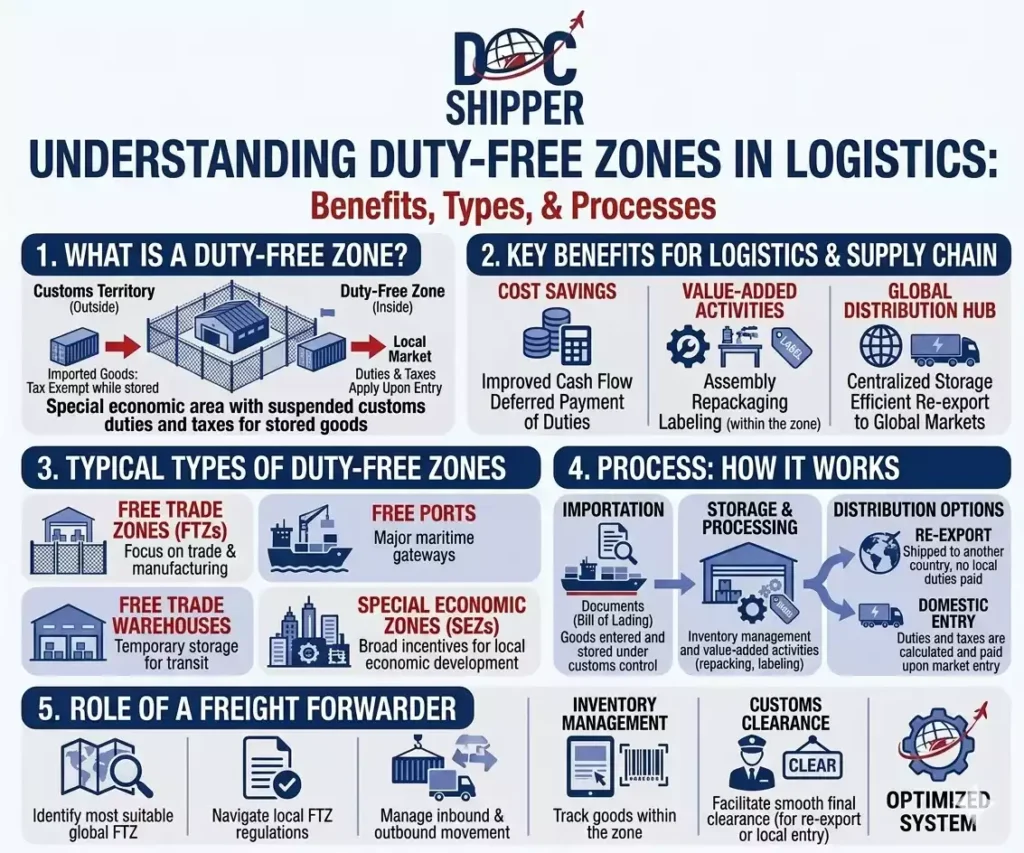
A Duty Free Zone (DFZ) is a designated geographic area within a country where imported goods can be stored, handled, manufactured, or reconfigured without being subject to customs duties, taxes, or stringent customs procedures. These zones enable businesses to defer or eliminate tariffs until goods enter the domestic market, optimizing cash flow and operational flexibility in international trade.
Introduction
International traders frequently struggle with upfront duty payments that strain working capital before goods are sold. This financial burden becomes particularly acute when managing inventory across multiple markets or engaging in manufacturing processes that add value to imported components.
Duty Free Zones address this challenge by creating customs-privileged territories where normal import regulations are suspended. These zones have become critical infrastructure in global supply chains, enabling cost optimization and operational agility.
Key characteristics of Duty Free Zones include:
- Tax suspension: No customs duties or VAT on goods entering the zone
- Manufacturing capabilities: Permission to process, assemble, or repackage goods
- Unlimited storage duration: Goods can remain indefinitely without duty accrual
- Re-export flexibility: Products can exit to international markets duty-free
- Simplified procedures: Reduced documentation and faster customs clearance
Regulatory Framework & Strategic Advantages
Duty Free Zones operate under specialized customs legislation governed by international conventions, particularly the Revised Kyoto Convention administered by the World Customs Organization. Each country implements DFZ regulations through national customs authorities, establishing physical boundaries monitored by customs officials.
The legal distinction is crucial: goods within a DFZ are considered outside the customs territory for duty purposes, yet remain under territorial jurisdiction for security and regulatory compliance. This dual status enables the suspension of tariffs while maintaining oversight.
Businesses leverage DFZs for several strategic operations. Manufacturing firms import components duty-free, add value through assembly or processing, then export finished products without ever incurring import duties. This creates significant cost advantages in competitive global markets.
The cash flow benefit is substantial. Instead of paying duties upfront and waiting for sales to recover costs, companies defer payment until goods actually enter the domestic market. For high-value inventory like electronics or automotive parts, this can represent millions in improved liquidity.
At DocShipper, we help clients establish operations within DFZs by navigating authorization procedures, ensuring compliance with zone regulations, and optimizing warehouse placement. Our expertise includes selecting the appropriate zone type—whether free trade zone, bonded warehouse, or export processing zone—based on specific business needs. Contact our specialists for DFZ feasibility assessments.
According to World Trade Organization data, over 4,300 special economic zones operate globally, with DFZs representing a major category driving $3.5 trillion in annual trade value.
Concrete Examples & Operational Data
Understanding DFZ benefits requires examining real-world applications across different industries and operational scenarios. The financial impact varies significantly based on product type, duty rates, and business model.
Comparative Analysis: Standard Import vs. DFZ Operations
| Scenario | Standard Import | DFZ Operation | Savings |
|---|---|---|---|
| Electronics ($500K shipment, 8% duty) | $40,000 upfront | $0 until sale | $40K cash flow benefit |
| Textile manufacturing (components + re-export) | 12% duty on inputs | 0% (re-exported) | 12% margin improvement |
| Automotive parts storage (6 months) | Full duty + storage costs | Storage only | 7-15% total cost reduction |
| Pharmaceutical distribution hub | VAT + duties per country | Consolidated clearance | 30-45 days faster to market |
Use Case: Electronics Distribution Company
A consumer electronics importer operates from Shanghai to Europe. By establishing a DFZ facility in Hamburg, Germany, the company imports €2 million in inventory monthly without immediate duty payment.
Financial impact breakdown:
- Standard EU electronics duty rate: 3.7% = €74,000/month
- DFZ deferral period: 90 days average before domestic sale
- Cash flow improvement: €222,000 working capital freed
- Re-exports to non-EU markets: 40% of volume = €800K monthly duty avoided
- Annual savings: €3.84 million in deferred or eliminated duties
The company also benefits from streamlined customs procedures, reducing clearance time from 3-5 days to same-day processing for zone-to-market transfers. This velocity advantage enables just-in-time inventory management and responsive market positioning.
DocShipper’s DFZ solutions include comprehensive zone selection, licensing support, and ongoing compliance management. We’ve helped clients establish operations in Dubai’s Jebel Ali Free Zone, Singapore’s Free Trade Zones, and US Foreign-Trade Zones, consistently achieving 8-12 month ROI on zone establishment costs.
Conclusion
Duty Free Zones represent a powerful strategic tool for international businesses seeking to optimize costs, improve cash flow, and enhance supply chain flexibility. The combination of duty deferral, manufacturing capabilities, and simplified procedures creates competitive advantages that directly impact profitability.
Need expert guidance on establishing DFZ operations or evaluating feasibility for your business model? Contact DocShipper’s logistics specialists for customized zone strategy development.
📚 Quiz
Test Your Knowledge: Duty Free Zone (DFZ)
What is the primary function of a Duty Free Zone?
When do goods stored in a Duty Free Zone become subject to customs duties?
An electronics company imports €2 million in components monthly to a DFZ, with 40% re-exported. What is the main financial advantage?
🎯 Your Result
📞 Free Quote in 24hFAQ | Duty Free Zone (DFZ): Definition, Benefits & Concrete Examples
The terms are often used interchangeably, but technically a Free Trade Zone (FTZ) is a broader category that includes Duty Free Zones. All DFZs are FTZs, but FTZs may include additional benefits like foreign ownership privileges, labor law exemptions, or special tax treatments beyond customs duty suspension. The specific nomenclature varies by country—what's called a "Free Zone" in UAE might be termed a "Foreign-Trade Zone" in the US.
Most DFZs are open to businesses engaged in international trade, manufacturing, or distribution. However, companies must typically apply for authorization from zone authorities, meet minimum investment or employment thresholds, and comply with specific operational requirements. Prohibited activities commonly include retail sales to the domestic market directly from the zone and certain regulated goods like weapons or restricted pharmaceuticals.
In most jurisdictions, there is no time limit for storage within a DFZ—goods can remain indefinitely without duty accrual. This contrasts with temporary import provisions or bonded warehouses, which often impose time restrictions. The unlimited duration makes DFZs ideal for long-term inventory management and market timing strategies.
When goods exit a DFZ for domestic consumption, they undergo formal customs clearance and become subject to applicable duties, taxes, and import regulations. The customs value is typically calculated based on the state of goods at entry into the zone, plus any value-added processing. Companies must file standard import declarations and pay duties at the prevailing rates for that product category.
Electronics, automotive, pharmaceuticals, textiles, and aerospace industries derive particular value from DFZs due to high component import volumes and significant duty rates. Additionally, businesses engaged in re-export trading, value-added manufacturing, or serving multiple international markets benefit substantially. E-commerce fulfillment centers increasingly utilize DFZs for cross-border inventory positioning.
Permitted activities vary by jurisdiction but typically include assembly, packaging, labeling, quality control, testing, light manufacturing, and substantial transformation processes. Some zones allow heavy manufacturing and production lines. The key requirement is that activities must be documented and comply with zone regulations. Finished goods can be exported duty-free or entered into domestic commerce with duties applied.
Yes, many DFZs provide additional advantages including simplified customs procedures, reduced documentation requirements, exemption from certain regulatory compliance burdens, access to modern logistics infrastructure, and sometimes corporate tax benefits or investment incentives. Some zones offer special labor regulations, 100% foreign ownership rights, and repatriation of profits without restrictions.
Companies must maintain detailed inventory records tracking goods entering, stored within, and exiting the zone. Modern DFZs use electronic inventory management systems integrated with customs authorities. Goods are tracked by unique identifiers, and any manufacturing or transformation processes must be documented. Regular audits ensure compliance, and reconciliation with customs declarations is required.
Yes, most DFZ regulations permit destruction of damaged, defective, or obsolete goods under customs supervision without incurring duty liability. This provides significant advantage for businesses managing quality control issues or product obsolescence. Proper documentation and customs approval are required, and destruction must follow environmental regulations.
Costs include zone lease or warehouse rental fees, utility charges, zone authority licensing fees, security deposits, and potentially minimum employment or investment commitments. Rental rates in DFZs are often competitive with standard industrial space, and the duty savings typically offset zone-specific fees within months. Some zones charge per-transaction processing fees or annual operating licenses.
Customs valuation principles apply when goods eventually enter domestic commerce from a DFZ. The valuation basis is typically the transaction value at zone entry, plus any value-added through permitted zone activities. Transfer pricing between related entities must follow arm's-length principles. Some jurisdictions allow valuation adjustments for zone storage costs or manufacturing inputs.
Modern DFZs increasingly incorporate sustainability standards, including waste management requirements, environmental impact assessments, and energy efficiency mandates. Some zones require ISO 14001 certification or compliance with local environmental regulations despite customs privileges. Companies should evaluate zone environmental policies as part of site selection, particularly for manufacturing operations with emissions or waste streams.
Need Help with
Logistics or Sourcing ?
First, we secure the right products from the right suppliers at the right price by managing the sourcing process from start to finish. Then, we simplify your shipping experience - from pickup to final delivery - ensuring any product, anywhere, is delivered at highly competitive prices.


Fill the Form
Prefer email? Send us your inquiry, and we’ll get back to you as soon as possible.
Contact us




:%20Definition,%20Benefits%20&%20Concrete%20Examples)