


In short ⚡
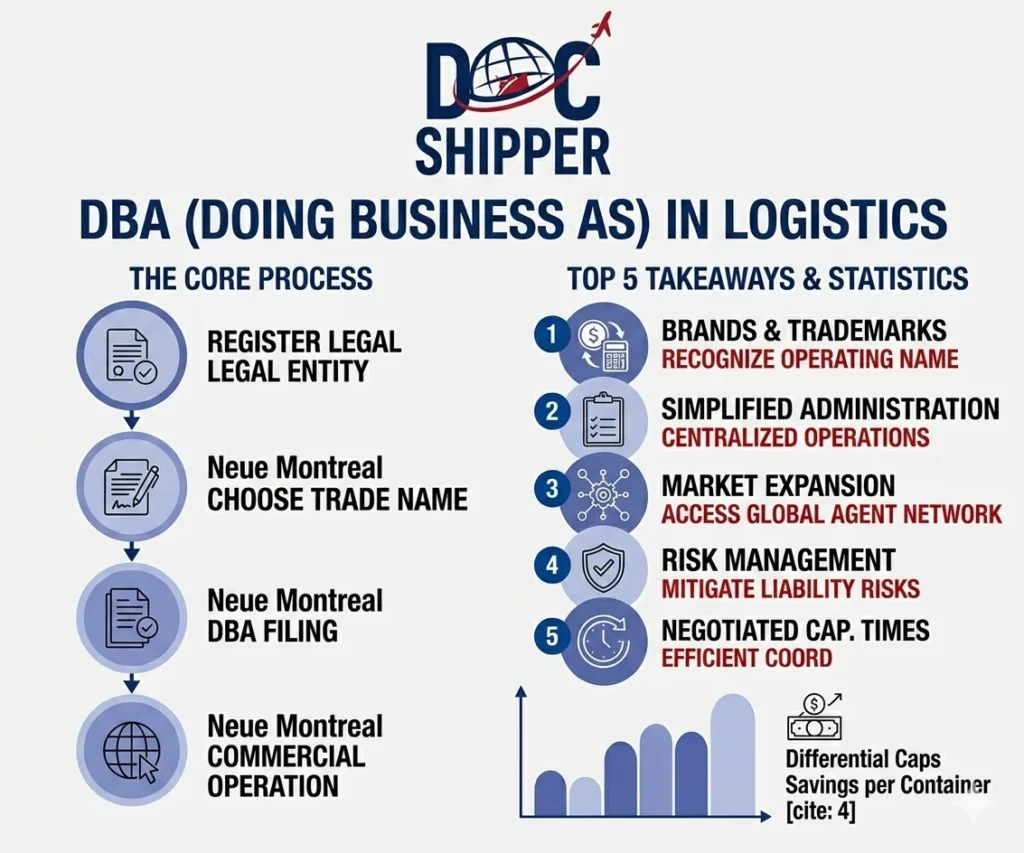
D.B.A. (Doing Business As) is a legal designation allowing a company or individual to operate under a trade name different from their registered business entity. Also known as a fictitious business name or assumed name, a D.B.A. enables entrepreneurs to conduct business, open bank accounts, and enter contracts without creating a separate legal entity, commonly used in international trade for brand differentiation.Introduction
Many international traders face confusion when encountering different business names on commercial invoices, customs declarations, and shipping documents. Understanding D.B.A. designations prevents costly delays at customs and ensures compliance with cross-border documentation requirements.
In global logistics, the D.B.A. structure plays a crucial role for businesses operating under multiple brand identities across different markets. A single legal entity might manage various product lines, each requiring distinct market positioning without the administrative burden of separate incorporations.
- Brand flexibility: Operate multiple brands under one legal entity
- Market segmentation: Target different customer bases without corporate restructuring
- Cost efficiency: Avoid multiple incorporation fees and administrative overhead
- Customs clarity: Proper documentation of business relationships for international trade
- Banking requirements: Enables opening accounts under trade names for payment processing
Legal Framework & Registration Requirements
The registration process for a D.B.A. varies significantly by jurisdiction but generally involves filing with local or state authorities. In the United States, businesses typically register at the county or state level, while international traders must understand how D.B.A. designations interact with customs authorities in import/export operations.
Unlike forming an LLC or corporation, a D.B.A. does not create a separate legal entity. This means the parent company remains fully liable for all obligations, debts, and legal responsibilities incurred under the assumed name. This distinction becomes critical in international contracts where liability clauses must reference the actual legal entity.
For customs documentation, the legal entity name must appear on primary documents like the commercial invoice and bill of lading, with the D.B.A. noted as “trading as” or “T/A.” According to U.S. Customs and Border Protection, failure to properly identify the legal importer of record can result in shipment holds and penalties.
The duration and renewal requirements for D.B.A. registrations differ by location. Most U.S. states require renewal every five years, while some jurisdictions mandate annual filings. International traders must maintain current registrations to avoid complications with banking institutions that process cross-border payments.
For trademark protection, a D.B.A. registration does not provide exclusive rights to the business name beyond the registered jurisdiction. Companies engaged in international trade should consider trademark registration in target markets to prevent brand confusion and protect intellectual property rights across borders.
At DocShipper, we verify that all business names on shipping documents align with customs requirements, preventing delays caused by entity name discrepancies during the clearance process.
Practical Examples & Comparative Analysis
Consider a manufacturer legally registered as “Global Manufacturing Solutions LLC” that operates three distinct product lines: premium electronics under “TechElite,” home appliances as “HomeComfort,” and industrial equipment through “IndustrialPro.” By registering three D.B.A. names, the company segments its market presence without tripling incorporation costs or administrative complexity.
| Structure Type | Registration Cost | Annual Maintenance | Liability Protection | Customs Documentation |
|---|---|---|---|---|
| D.B.A. | $50-$150 | $50-$100 | None (parent entity liable) | Parent entity + D.B.A. notation |
| Separate LLC | $500-$1,500 | $300-$800 | Full separation | Independent entity documentation |
| Subsidiary Corporation | $800-$2,500 | $500-$1,200 | Full separation + tax benefits | Complete independent status |
Use Case: An e-commerce retailer “Blue Sky Imports Inc.” imports fashion accessories from Vietnam and electronics from China. They register D.B.A. names “FashionFirst” and “TechDirect” to create distinct brand identities. On customs declarations, the importer of record appears as “Blue Sky Imports Inc. T/A FashionFirst” for fashion shipments, maintaining legal clarity while preserving brand separation in the marketplace.
In international logistics, approximately 35% of U.S. small businesses operate under at least one D.B.A., with this percentage rising to over 60% for companies engaged in multi-channel e-commerce requiring distinct brand positioning across platforms.
Banking implications are significant for international traders. Most financial institutions require D.B.A. registration certificates to open business accounts under assumed names. For cross-border wire transfers, banks must verify that the receiving account matches documentation, making proper D.B.A. registration essential for payment processing.
Customs compliance requires consistent entity identification across all documentation. When the commercial invoice shows a D.B.A., the packing list, certificate of origin, and bill of lading must reflect the same naming convention with clear indication of the parent legal entity to avoid classification as misrepresentation.
Tax reporting under a D.B.A. remains the responsibility of the parent entity. All income and expenses flow through the primary business tax return, simplifying accounting but requiring meticulous record-keeping to separate performance metrics across different D.B.A. operations for strategic analysis.
Conclusion
The D.B.A. structure provides international traders with strategic brand flexibility while maintaining simplified legal and administrative frameworks. Proper registration and documentation ensure smooth customs clearance and financial operations across borders.
Need assistance with entity documentation for international shipments? Contact DocShipper for expert guidance on customs compliance and business registration requirements.
📚 Quiz
Test Your Knowledge: D.B.A. (Doing Business As)
What is the primary legal distinction of a D.B.A. registration?
A common misconception is that D.B.A. registration provides trademark protection internationally. Is this correct?
How should a company properly identify itself on customs documentation when using a D.B.A.?
🎯 Your Result
📞 Free Personalized QuoteFAQ | D.B.A. (Doing Business As): Definition, Registration & Practical Examples
No, a D.B.A. does not create a separate legal entity or provide liability protection. The parent company or individual remains fully liable for all debts, obligations, and legal actions related to the D.B.A. For liability protection, you must form an LLC or corporation.
The legal entity must be the importer of record, not the D.B.A. Customs documentation should list the registered business name followed by "trading as" or "T/A" and the D.B.A. name. Using only the D.B.A. without the legal entity can cause clearance delays.
D.B.A. registration requirements vary by country. While your home jurisdiction registration may suffice for import/export documentation, some countries require local business registration or agent appointment. Consult with customs brokers or legal advisors in target markets for specific requirements.
D.B.A. registration does not provide trademark protection. You must file separate trademark applications in each jurisdiction where you want exclusive rights to your business name. Without trademark registration, another company could legally use your D.B.A. name in foreign markets.
In most jurisdictions, D.B.A. registrations are unique within the registration area, preventing duplicate names in the same county or state. However, businesses in different jurisdictions can register identical D.B.A. names unless trademark protection exists.
Banks typically require a certified copy of the D.B.A. filing certificate, business license, and EIN letter. Some international banks may request additional documentation such as articles of incorporation, operating agreements, or board resolutions authorizing the D.B.A. usage.
Processing times vary from immediate (online filings) to 4-6 weeks for paper applications. Most U.S. states process D.B.A. registrations within 1-2 weeks. International traders should register well before launching operations to avoid delays in banking and customs documentation setup.
No, income and expenses under a D.B.A. are reported on the parent entity's tax return. You do not file separate tax returns for each D.B.A. However, maintaining separate accounting records for each D.B.A. helps track performance and simplifies bookkeeping.
Yes, D.B.A. registrations can be amended or cancelled through the same authority where originally filed. International traders should update all banking, customs, and supplier documentation when changing D.B.A. names to prevent payment processing and clearance issues.
Operating under an unregistered fictitious name can result in fines, inability to enforce contracts, banking restrictions, and potential legal complications. Customs authorities may flag shipments with unverified business names, causing delays and additional scrutiny.
The standard format is "Legal Entity Name T/A D.B.A. Name" or "Legal Entity Name doing business as D.B.A. Name." The legal entity must be clearly identifiable as the party responsible for customs duties, taxes, and regulatory compliance.
Yes, foreign entities can register D.B.A. names in U.S. jurisdictions, but typically must first register as a foreign business entity in the state. This involves appointing a registered agent and paying foreign qualification fees before filing the D.B.A. registration.
Need Help with
Logistics or Sourcing ?
First, we secure the right products from the right suppliers at the right price by managing the sourcing process from start to finish. Then, we simplify your shipping experience - from pickup to final delivery - ensuring any product, anywhere, is delivered at highly competitive prices.


Fill the Form
Prefer email? Send us your inquiry, and we’ll get back to you as soon as possible.
Contact us




:%20Definition,%20Registration%20&%20Practical%20Examples)