


In short ⚡
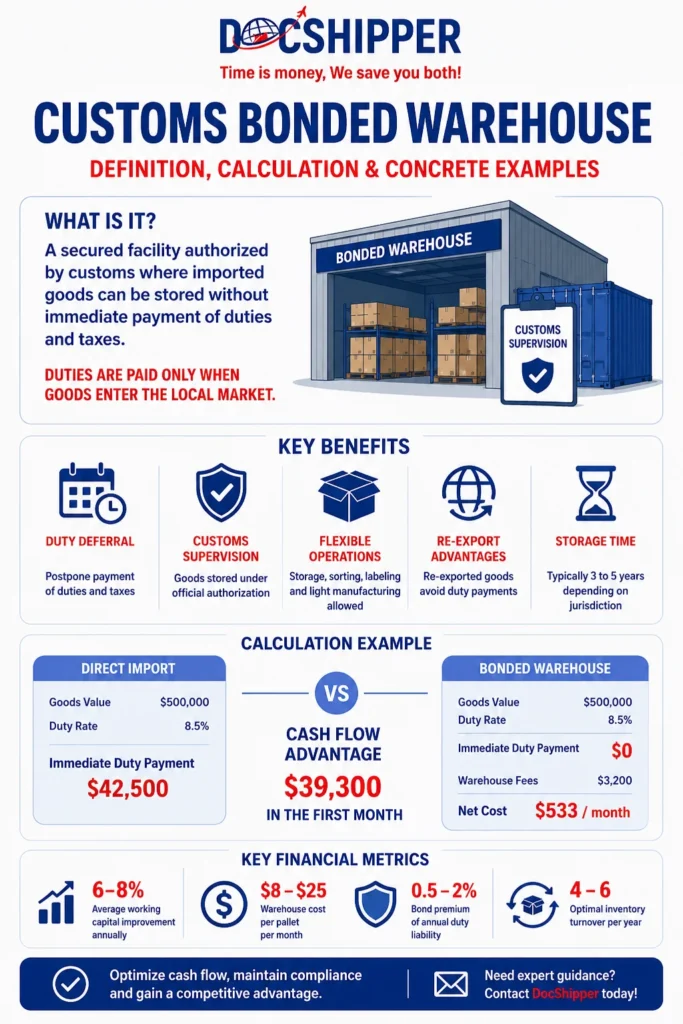
A Customs Bonded Warehouse is a secured storage facility authorized by customs authorities where imported goods can be stored without immediate payment of duties and taxes. Goods remain under customs supervision until released for domestic consumption, re-export, or further processing, offering businesses critical cash flow advantages.
Introduction
Many importers face a common dilemma: pay substantial customs duties upfront on inventory they haven’t yet sold, or delay shipments until cash flow improves. This predicament creates operational bottlenecks and competitive disadvantages.
The Customs Bonded Warehouse solves this challenge by acting as a duty-suspension zone. It enables strategic inventory management while maintaining full regulatory compliance across international supply chains.
- Duty deferral: Payment postponed until goods enter domestic commerce
- Customs supervision: Facilities operate under official authorization and monitoring
- Flexible operations: Permits storage, sorting, labeling, and light manufacturing
- Re-export advantages: Goods leaving the country avoid duty payments entirely
- Time limits: Storage periods typically range from 3 to 5 years depending on jurisdiction
In-Depth Analysis & Regulatory Framework
Customs bonded warehouses operate under strict legal frameworks established by national customs authorities. In the United States, these facilities fall under 19 CFR Part 19, while the European Union regulates them through the Union Customs Code (UCC) Article 237-242.
The authorization process requires operators to demonstrate financial solvency, maintain adequate security systems, and implement comprehensive inventory tracking. Customs authorities conduct regular audits to verify compliance with storage conditions and documentation requirements.
Five distinct warehouse classifications exist under U.S. regulations: Type I (premises owned/leased by the government), Type II (private bonded warehouses), Type III (public bonded warehouses), Type IV (bonded yards for heavy merchandise), and Type V (bonded bins for grain storage). Each category serves specific operational needs.
The bonding mechanism itself involves posting a surety bond guaranteeing payment of duties if goods enter domestic commerce illegally. Bond amounts typically equal the estimated annual duty liability, providing customs authorities financial protection against revenue loss.
Permitted warehouse activities extend beyond simple storage. Operators can perform repacking, relabeling, quality inspections, sample extraction, and even light manufacturing under customs supervision. These value-added services transform bonded warehouses into strategic distribution hubs.
At DocShipper, we systematically guide clients through bonded warehouse selection and compliance procedures, ensuring seamless integration with broader import strategies. Our expertise prevents costly regulatory violations while maximizing duty deferral benefits.
For official regulatory guidance, consult the U.S. Customs and Border Protection bonded warehouse regulations.
Concrete Examples & Cost Calculations
Understanding the financial impact of bonded warehousing requires examining real-world scenarios. The following comparative analysis demonstrates tangible cash flow advantages.
| Scenario | Direct Import | Bonded Warehouse | Savings |
|---|---|---|---|
| Goods Value | $500,000 | $500,000 | — |
| Duty Rate | 8.5% | 8.5% | — |
| Immediate Duty Payment | $42,500 | $0 | $42,500 deferred |
| Storage Period | N/A | 6 months | — |
| Warehouse Fees | $0 | $3,200 | — |
| Net Cash Flow Advantage (Month 1) | -$42,500 | -$533/month | $39,300 |
Use Case: Electronics Importer
A consumer electronics distributor imports $2 million worth of smartphones quarterly. Using a bonded warehouse strategy, they release inventory to the domestic market gradually as sales occur. Over 12 months, this approach defers $680,000 in duty payments (average 4-month deferral per shipment), improving working capital by 18% compared to immediate duty payment.
Re-export Scenario: A manufacturer imports raw materials worth $300,000 with a 12% duty rate. After processing in the bonded warehouse, 40% of finished goods are exported to third countries. The company permanently avoids $14,400 in duties on re-exported merchandise while paying only $21,600 on domestically consumed goods.
Key Financial Metrics:
- Break-even storage period: Typically 45-60 days for most commodities
- Average duty deferral value: 6-8% annual working capital improvement
- Warehouse cost range: $8-$25 per pallet per month depending on location
- Bond premium: 0.5-2% of annual duty liability
- Optimal inventory turnover: 4-6 times annually for maximum benefit
Conclusion
Customs bonded warehouses represent a strategic financial tool for importers seeking to optimize cash flow while maintaining supply chain flexibility. The duty deferral mechanism transforms inventory management from a capital constraint into a competitive advantage.
Need expert guidance on implementing bonded warehouse solutions for your import operations? Contact DocShipper for customized logistics strategies.
📚 Quiz
Customs Bonded Warehouse
Q1 — What is the primary purpose of a Customs Bonded Warehouse?
Q2 — A company imports raw materials, processes them in a bonded warehouse, and then exports 40% of the finished goods abroad. What happens to the customs duties on those re-exported goods?
Q3 — An e-commerce business imports $500,000 worth of electronics and stores them in a bonded warehouse. Which scenario correctly describes how duties are applied?
🎯 Your Result
📞 Free Quote in 24hFAQ | Customs Bonded Warehouse: Definition, Calculation & Concrete Examples
Prohibited items typically include perishable goods requiring refrigeration beyond warehouse capabilities, explosives, hazardous materials without special authorization, and goods subject to immediate regulatory inspection like pharmaceuticals. Each jurisdiction maintains specific exclusion lists.
Storage periods vary by country: the United States allows up to 5 years, the European Union permits 3 years, while some Asian countries limit storage to 2 years. Extensions may be granted under specific circumstances with customs approval.
Yes, authorized activities include repacking, relabeling, quality testing, sample extraction, sorting, and light manufacturing. All manipulations require customs notification and must not alter the goods' tariff classification without proper documentation.
Operators must immediately notify customs authorities. If damage results from unavoidable circumstances (fire, natural disaster), duties may be waived with proper documentation. Negligence-related losses typically still incur duty obligations plus penalties.
Public bonded warehouses generally accept any shipment size, while private facilities may impose minimum storage commitments. Typical thresholds range from 5-10 pallets for public warehouses, with private operations requiring annual volume commitments of $500,000+.
Bonded warehouses focus solely on duty deferral for imported goods under customs supervision. Free trade zones offer broader benefits including manufacturing exemptions, foreign trade company establishment, and duty elimination on re-exported goods with fewer restrictions.
Standard requirements include a withdrawal request, commercial invoice, packing list, bill of lading, and customs entry documentation. For domestic consumption, importers must file entry and pay applicable duties before release.
Yes, in-bond transfers are permitted under customs supervision. Operators must file an in-bond movement document (IT/FIRMS in the U.S., T1 in the EU) and obtain approval before physical transfer. The receiving warehouse assumes custody responsibility.
Operators must maintain comprehensive liability coverage including fire, theft, and damage protection. Minimum coverage typically equals 110% of maximum anticipated inventory value. Importers should verify their goods are included in the warehouse operator's policy.
Duties apply proportionally to the quantity removed. Customs authorities use the entry documentation's declared value and tariff classification at the time of withdrawal. First-in-first-out (FIFO) accounting typically applies unless specific lot tracking is maintained.
Violations range from administrative fines ($1,000-$10,000) for documentation errors to criminal prosecution for smuggling attempts. Severe infractions may result in warehouse authorization revocation, bond forfeiture, and assessment of unpaid duties plus interest.
Absolutely. E-commerce importers use bonded warehouses to defer duties on inventory until individual orders ship domestically, significantly improving cash flow. This strategy works particularly well for high-value electronics, fashion items, and seasonal merchandise with unpredictable demand.
Need Help with
Logistics or Sourcing ?
First, we secure the right products from the right suppliers at the right price by managing the sourcing process from start to finish. Then, we simplify your shipping experience - from pickup to final delivery - ensuring any product, anywhere, is delivered at highly competitive prices.


Fill the Form
Prefer email? Send us your inquiry, and we’ll get back to you as soon as possible.
Contact us




